
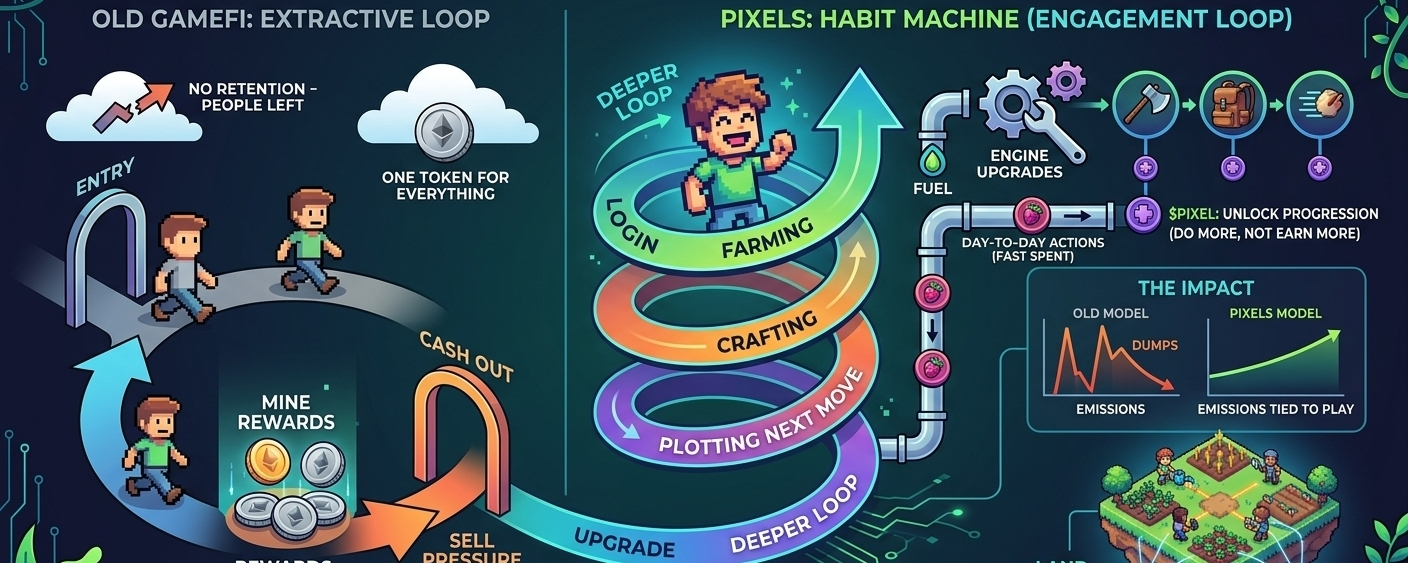
GameFi didn’t break because of tokenomics. That’s the lazy take. The real issue was simpler — people didn’t stay. They came in, farmed rewards, and left the moment it stopped making sense. The system trained them to behave like that.
Pixels flips that behavior.
It’s not something you notice instantly. It’s a shift you only really feel once you’re ten hours deep into the loop. You log in for a quick session, and suddenly you’re optimizing your farm layout, planning your next upgrade, thinking about what to unlock next. There’s no obvious “exit point.” No moment where the game quietly tells you to cash out and move on. Just momentum. Constant, low-friction progression.
That’s where the structure starts to matter.
Most GameFi projects rely on one token to do everything. Reward, utility, value capture. It sounds efficient, but it creates pressure from every direction. Players earn, then sell. Of course they do. The system practically tells them to.
Pixels splits that dynamic cleanly.
$BERRY is the fuel. It powers the day-to-day — farming, crafting, grinding. It moves fast, gets spent fast, and keeps the loop alive. $PIXEL, on the other hand, is where things get interesting. It’s not fuel. It’s engine upgrades. You use it to move faster, unlock better tools, access deeper layers of the game. It doesn’t carry the weight of daily activity, and because of that, it doesn’t get crushed by it.
That separation changes behavior.
You’re not constantly thinking about when to sell. You’re thinking about when to upgrade. Subtle difference. Massive impact.
And then there’s demand. This is where most people still misunderstand the model. $PIXEL isn’t designed around “earning more.” It’s designed around doing more. Saving time. Improving efficiency. Standing out. In real games, that’s what people actually spend on. Not yield. Experience.
Because let’s be honest — if a game is only worth playing when it pays you, is it even a game?
Pixels answers that question without saying it directly. It builds a system where spending feels natural, not forced. Where progression matters more than extraction. Where staying in the loop is the default behavior, not the exception.
Even the reward system leans into this. Emissions aren’t just handed out for existing. They’re tied to how you play. What you do. How you engage. Over time, that shapes the entire player base. Less farming-and-dumping. More actual participation.
And then you have land.
Most people see it as just another NFT layer. It’s not. It’s production. It’s coordination. It’s where individual players start to connect into something bigger — sharing resources, optimizing output, building small economic systems inside the game. That’s when it stops feeling like a token model and starts feeling like an ecosystem.
Underneath all of this is a quiet design choice that holds everything together. Different layers, different roles. Gameplay drives engagement. A fast-moving currency keeps things fluid. A premium layer captures value without breaking the loop. Nothing overlaps too much. Nothing fights itself.
Simple. But intentional.
Pixels doesn’t try to overwhelm you with complexity. It just removes the parts that usually break. No forced exits. No constant sell pressure. No illusion of sustainability built on new users.
Just a loop that keeps pulling you back in.
And that’s the part most GameFi never figured out.
