
When I think about systems that depend on many moving parts working together, I’m reminded of something as ordinary as a neighborhood grocery store. On the surface, it looks simple: shelves are stocked, customers walk in, and transactions happen. But beneath that simplicity is a web of coordination—suppliers delivering goods on time, employees managing inventory, pricing that balances affordability with profit, and customers behaving in predictable ways. If even one piece drifts out of alignment—say, suppliers delay shipments or prices stop reflecting demand—the whole system begins to strain. The store doesn’t collapse immediately, but inefficiencies accumulate until something breaks or has to be corrected.
That same lens is useful when I look at Pixels (PIXEL), a social casual Web3 game built on the Ronin Network. At first glance, it presents itself as a relaxed, open-world experience centered on farming, exploration, and creation. Players plant crops, gather resources, interact with others, and participate in a digital economy. It feels intentionally low-pressure, almost like a familiar casual game—but layered with blockchain-based ownership and tokenized incentives.
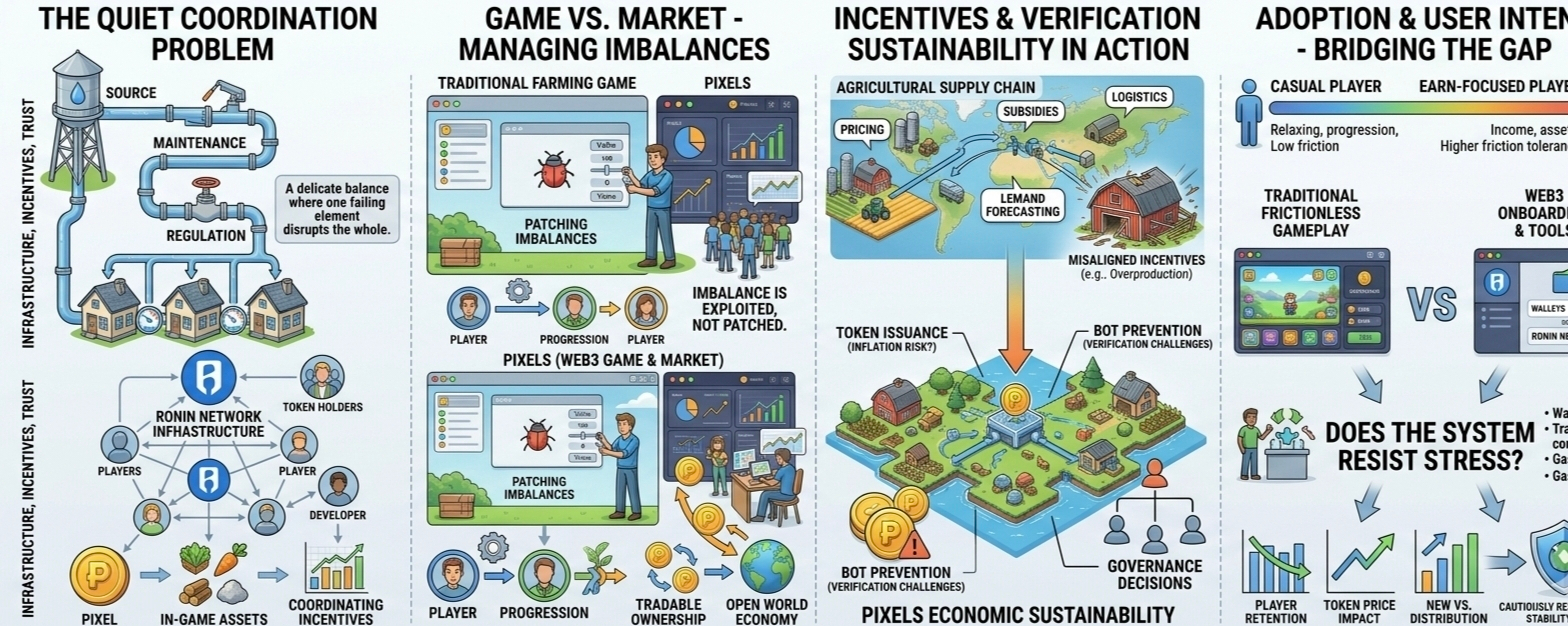
What interests me is not the surface experience, but the underlying system that makes it function. Any game that introduces real economic value—through tokens, tradable assets, or ownership—stops being just a game. It becomes something closer to a small, self-contained economy. And like any economy, it must answer a set of practical questions: where does value come from, how is it distributed, and what prevents it from collapsing under its own incentives?
In Pixels, value is tied to participation. Players farm, produce goods, and interact with a broader ecosystem where assets and outputs can carry financial weight. This is conceptually similar to early online economies in games like RuneScape or Stardew Valley, where time investment translates into in-game progress. The difference here is that the outputs are no longer confined to a closed system. They are connected to blockchain infrastructure, meaning they can, in theory, be exchanged, priced, and speculated on externally.
That shift introduces both opportunity and tension. In a traditional game, developers can rebalance systems quietly when something goes wrong—adjust drop rates, tweak resource scarcity, or redesign mechanics. In a Web3 environment, especially one tied to tokens, those adjustments become more complicated. Players are not just users; they are stakeholders with financial expectations. Any change can feel less like game design and more like economic intervention.
This leads me to think about incentives, which are often where these systems either stabilize or unravel. In Pixels, the incentive structure encourages activity—farming, crafting, interacting—but also implicitly encourages extraction. If players are rewarded in a way that can be converted into real-world value, a portion of the user base will approach the system not as a game, but as a yield-generating mechanism. That changes behavior. Efficiency starts to dominate over enjoyment. Automation, optimization, and even exploitation become rational strategies.
We’ve seen similar dynamics in earlier Web3 gaming experiments, particularly those that gained rapid popularity and then struggled to maintain balance. The challenge is not attracting users initially—it’s sustaining a system where new value is continuously created rather than simply redistributed. If rewards are primarily funded by new entrants or speculative demand, the system begins to resemble a loop that depends on constant growth. That’s a fragile position, especially in volatile markets.
Another aspect I consider is verification. In a physical system, like a supply chain, there are checks and constraints—physical limits, transportation costs, storage requirements. In a digital environment, those constraints are more abstract. The system must enforce scarcity, fairness, and integrity through code and governance. On the Ronin Network, transactions are verifiable, but that doesn’t automatically guarantee that the in-game economy itself is balanced or resistant to manipulation. Bots, multi-accounting, and coordinated strategies can still distort outcomes if not carefully managed.
There’s also the question of operational sustainability. Running a game like Pixels isn’t just about maintaining servers or deploying smart contracts. It involves continuous content updates, community management, and economic tuning. Traditional game studios rely on revenue models like purchases or subscriptions to fund this work. In a tokenized system, funding often comes from a mix of token issuance, marketplace activity, and ecosystem growth. That can work, but it requires a delicate balance. If the economic layer becomes too dominant, the game risks losing its identity as a game and turning into a financial platform with gameplay attached.
Adoption is another practical lens. For a system like this to endure, it needs users who are there for reasons beyond short-term financial gain. Players who enjoy farming, exploration, and social interaction for their own sake provide a stabilizing force. They are less likely to exit abruptly when incentives shift. The challenge is whether Pixels can cultivate that kind of user base while still offering economic rewards. It’s not an impossible balance, but it’s a narrow one.
What I find myself returning to is the idea of testability. A robust system should be able to withstand stress—declining user growth, reduced token demand, or adversarial behavior—and still function. In practical terms, that means the in-game economy should remain meaningful even if speculative interest fades. Crops should still matter, interactions should still feel rewarding, and the world should still feel alive without relying on external valuation.
My own view, after thinking this through, is cautiously measured. Pixels has some of the right instincts in focusing on accessible gameplay and social interaction rather than purely financial mechanics. That gives it a stronger foundation than many earlier attempts in this space. But the presence of a tokenized economy introduces pressures that are hard to ignore. The real test isn’t whether it can attract attention or early engagement—it’s whether it can sustain a balanced, resilient system when conditions are less favorable.
If I had to summarize my position, I’d say Pixels is an interesting experiment in blending casual gameplay with Web3 infrastructure, but its long-term success will depend less on its concept and more on its discipline in managing incentives and maintaining economic integrity. Like the grocery store, it doesn’t need to be perfect—but it does need all its moving parts to stay aligned over time.
