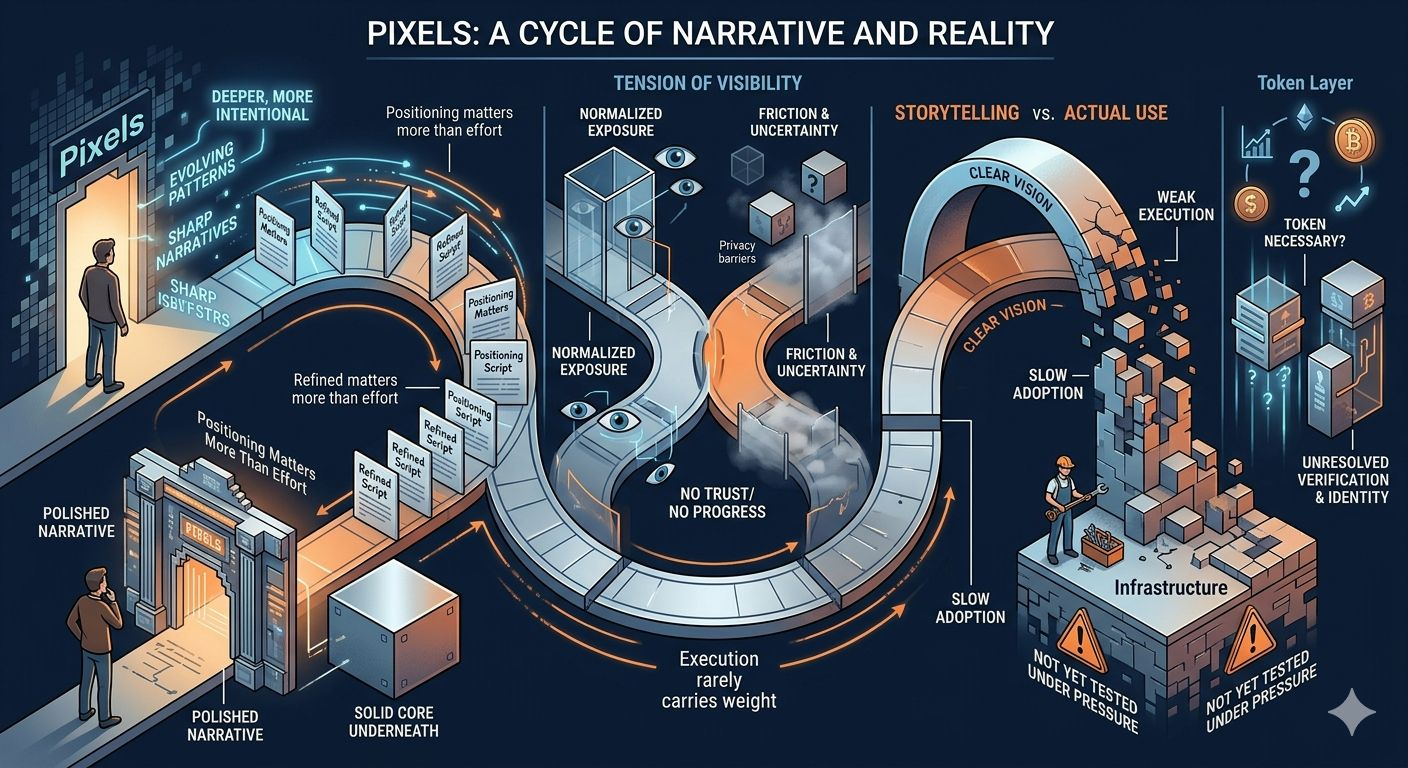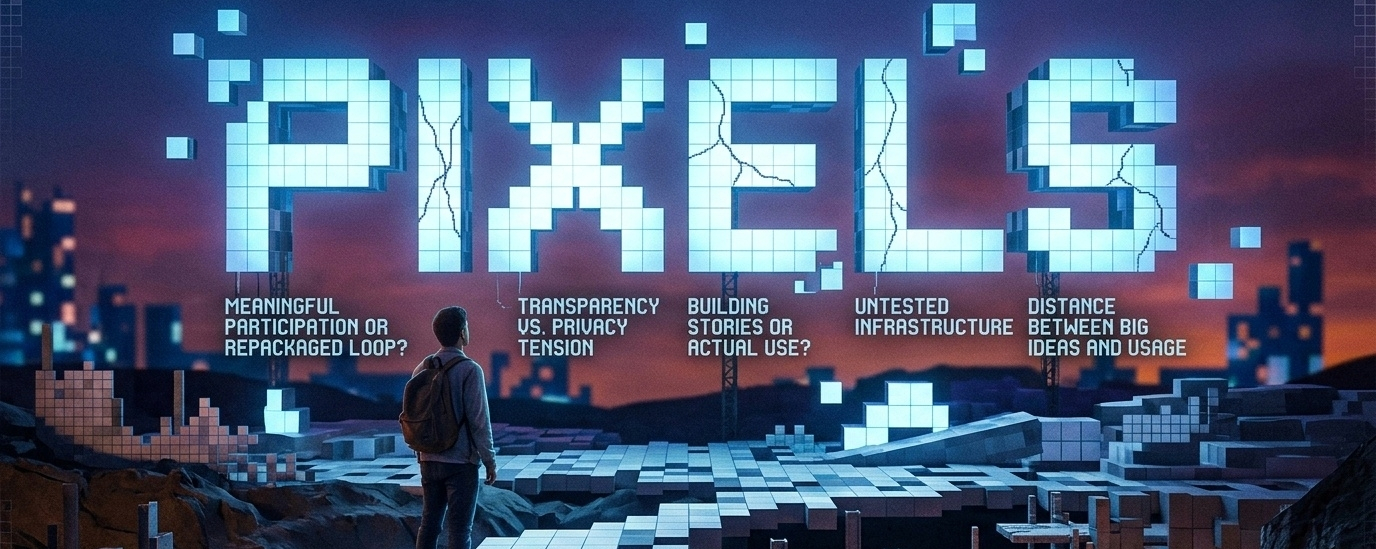
I keep coming back to the same thought when I look at Pixels. Am I actually participating in something meaningful, or am I just moving inside a loop that’s been dressed up differently each time? I’ve seen this pattern before, not just here but across different cycles, and it always starts the same way. There’s a sense that things are evolving, that this time it’s deeper, more intentional. But after sitting with it long enough, I start noticing how familiar it all feels. The language changes, the structure shifts a bit, but the core doesn’t move as much as it pretends to.
With Pixels, I can’t ignore how often I hear the same narratives recycled. At first they sound sharp, almost insightful, but over time they lose weight. I’ve heard variations of “positioning matters more than effort” so many times that it starts to feel less like a realization and more like a script. And I catch myself wondering if I’m thinking independently anymore, or just absorbing a refined version of what everyone else is already saying. That’s the part that bothers me the most. Not that the ideas are wrong, but that they become automatic.
Then there’s this constant tension I feel inside Pixels between transparency and privacy. It’s like I’m always being pushed to choose one at the expense of the other. Either I accept full visibility into everything I do, or I move toward systems that promise privacy but end up feeling disconnected and hard to trust. I don’t think it’s supposed to be this binary, but somehow it keeps becoming that. And over time, I’ve noticed how much exposure has been normalized, almost quietly. Things that should feel personal or controlled are just… expected to be open. I don’t even question it immediately anymore, which is probably the most concerning part.
At the same time, the so-called privacy solutions around Pixels don’t really settle things either. They swing too far in the opposite direction. Instead of balance, I get friction. Instead of trust, I get uncertainty. It becomes harder to verify what’s real, harder to rely on anything without second-guessing it. So I’m left in this middle space where neither side feels complete. And I start asking myself if this is actually progress, or just another trade-off being repackaged as innovation.
What keeps standing out to me in Pixels is how much of it feels built for storytelling rather than actual use. Everything sounds good when it’s explained. The vision is always clear, almost too clear. But when I try to map that vision to real behavior, to actual usage patterns, the connection feels weak. It’s like the idea exists more convincingly than the reality. And I’ve seen this gap so many times now that I can’t ignore it anymore. Ambition is always there, but execution rarely carries the same weight.
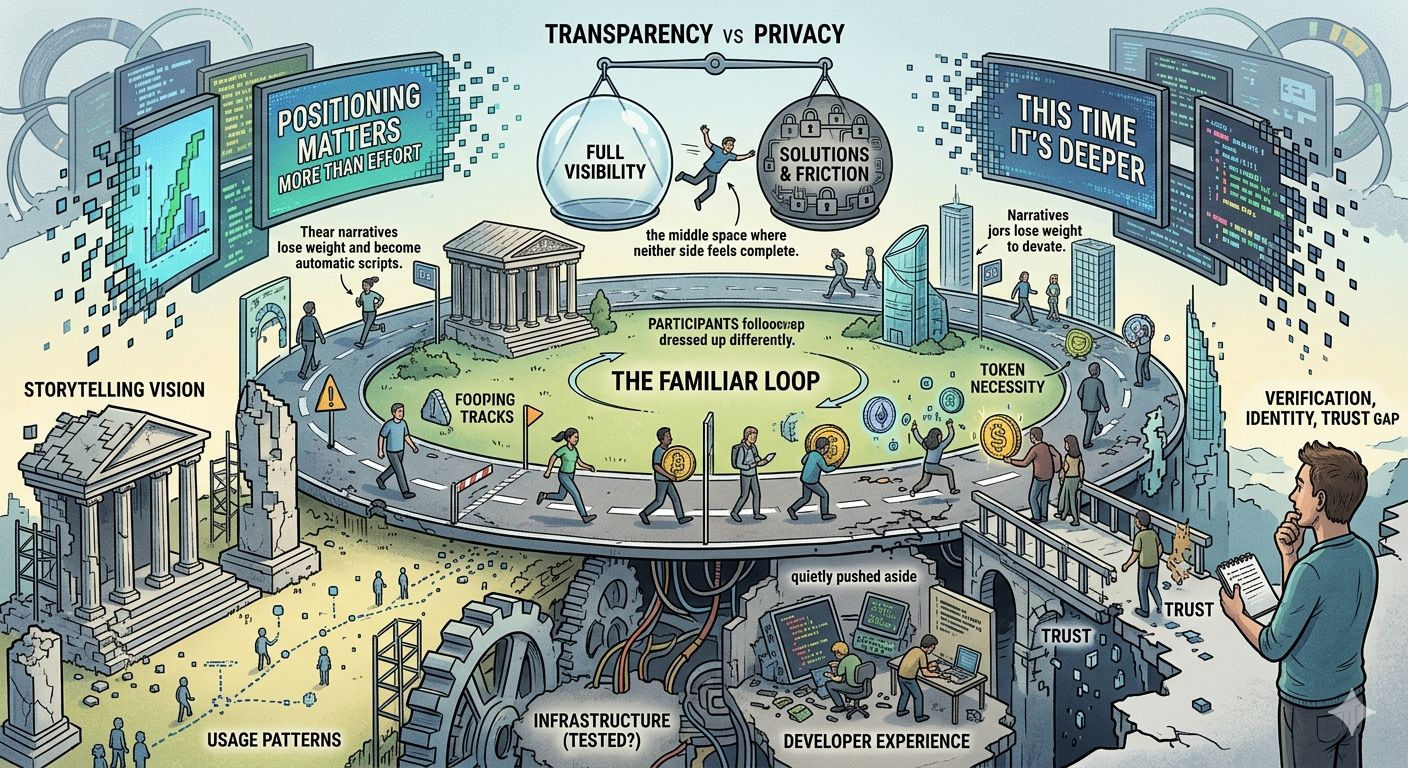
Infrastructure is another thing I keep thinking about with Pixels. It’s always described as the foundation, the thing that will hold everything together long-term. But I don’t think I’ve seen it truly tested under pressure in a way that proves it can hold. It sounds solid in theory, but theory doesn’t break systems. Real usage does. And until that pressure comes, I’m not sure what I’m actually looking at. Something stable, or something that just hasn’t been challenged enough yet.
I also notice how quietly developer experience gets pushed aside in Pixels. It’s not something people talk about often, but I can feel its absence. When the people building on top of a system struggle, it doesn’t show immediately. It shows later, in slow adoption, in abandoned ideas, in things that never quite take off. And by the time it becomes visible, the narrative has already moved on. That gap between what’s promised and what’s actually usable starts widening without anyone really acknowledging it.
The token side of Pixels adds another layer to this. I keep asking myself if it’s really necessary, or if it’s just expected at this point. Sometimes it feels like it’s there because it has to be, not because it truly fits. And that creates this underlying pressure where everything has to justify its existence economically, even when it doesn’t make sense. It complicates things that might have worked better if they were simpler.
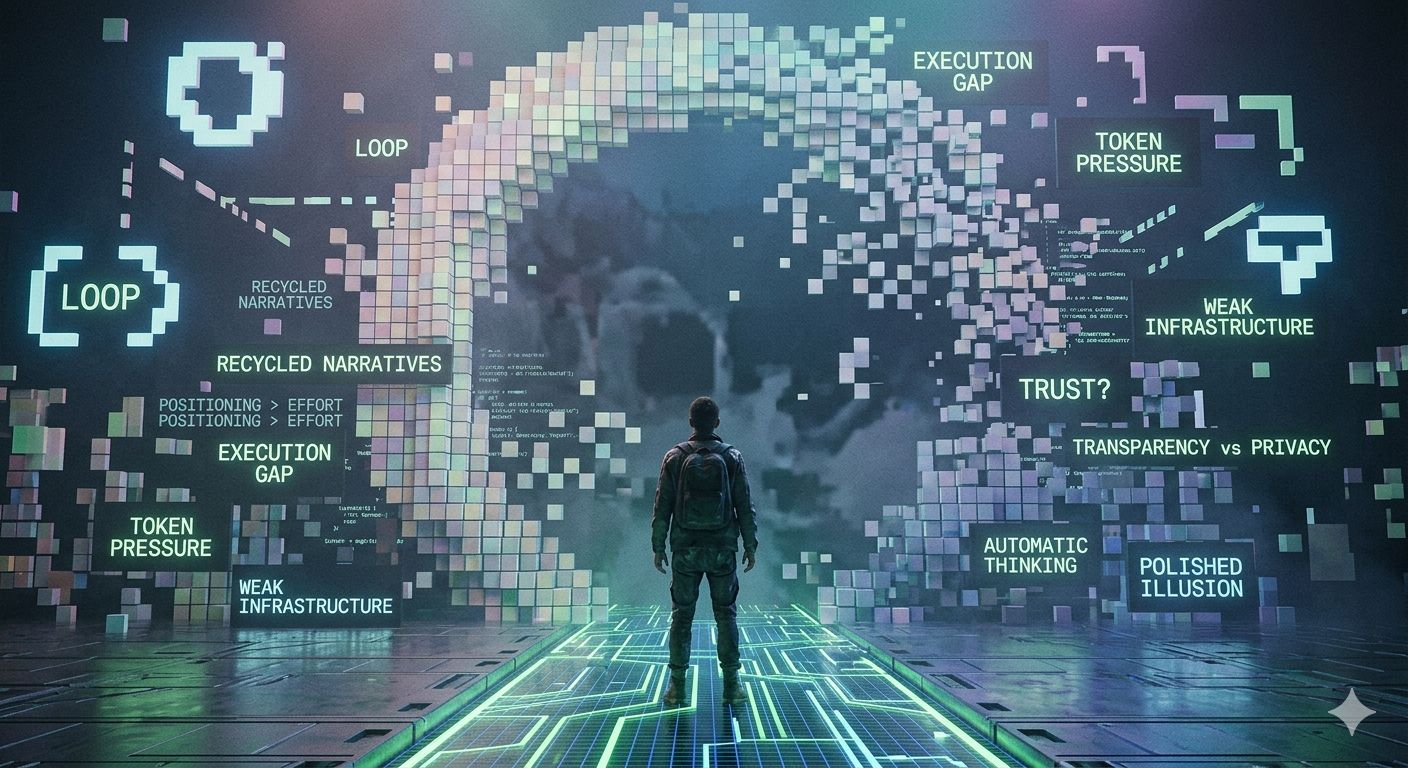
Verification, identity, trust… these are still unresolved in Pixels, at least from where I’m standing. I don’t feel confident relying on them, and I don’t think I’m alone in that. There’s always some uncertainty, some gap that hasn’t been closed. And for something that’s supposed to support real interaction, that gap matters more than anything else. Without trust, everything else feels fragile.
What I keep noticing, over and over, is that the distance between big ideas and actual usage in Pixels never really disappears. It shrinks sometimes, enough to create excitement, but it doesn’t close. And I’ve started to see how big ideas can act as camouflage. They draw attention away from weak execution, at least for a while. But eventually, that weakness shows up. It always does.
The hardest part for me now is trust. Not in the system itself, but in the narratives around it. Pixels looks polished from the outside, and maybe that’s part of the problem. I’ve seen how the market reacts to that polish. It rewards it. It amplifies it. But that doesn’t mean it’s real. And after watching this happen enough times, I find myself pulling back. Not rejecting it, just… observing more carefully.
So I’m still here, watching Pixels, thinking through it, trying to understand where it actually stands. I’m not as convinced as I used to be, but I’m not completely detached either. There’s still something that keeps my attention. Maybe it’s curiosity. Maybe it’s habit. Or maybe it’s the possibility that something eventually breaks in a way that reveals what’s actually solid underneath all of this.