
i m not someone who easily believes in “next big things,” especially in crypto, because I’ve seen how fast hype can rise and collapse. But I when I first came across Pixels, it didn’t feel like hype screaming for attention—it felt quiet, almost too simple to matter. That’s exactly why I start paying attention.
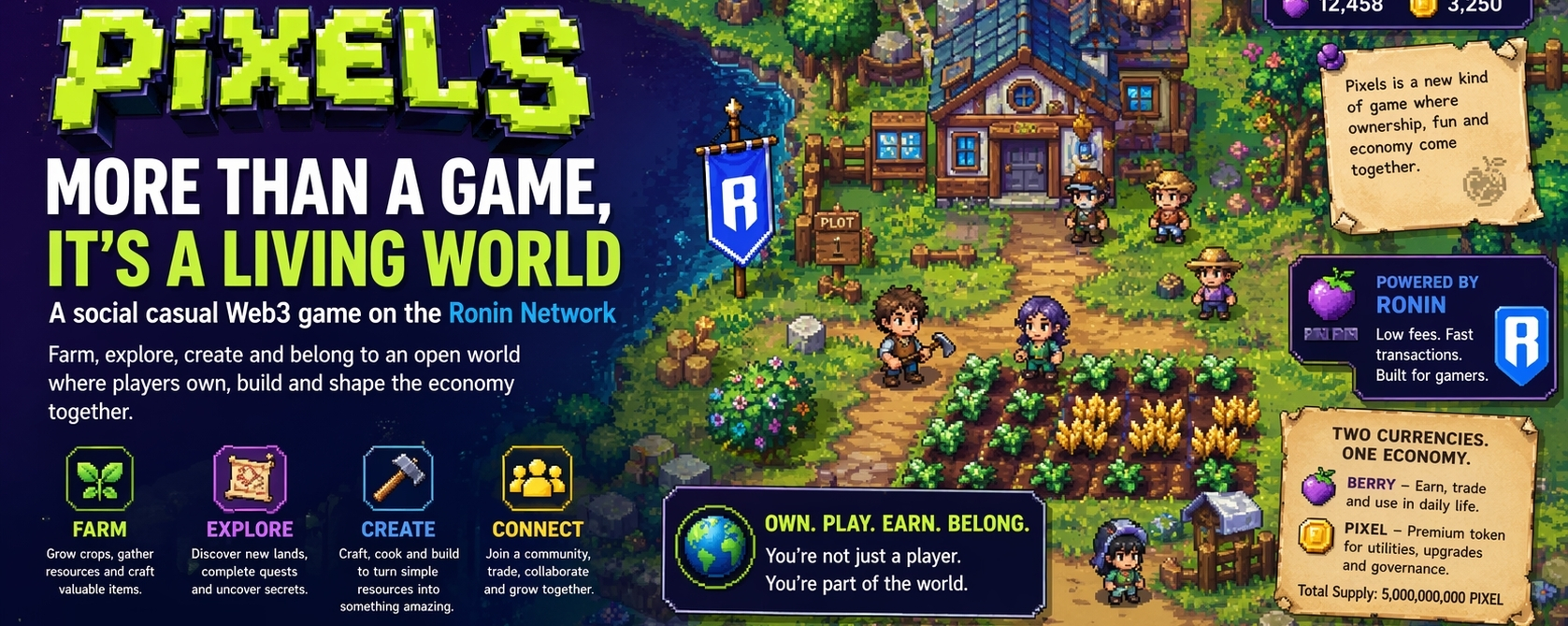
I start the game expecting another typical play-to-earn loop, something mechanical where I click, earn, and leave. But instead, I find myself planting crops, walking through soft pixel landscapes, interacting with systems that don’t rush me. It feels strangely familiar, almost like older games where progress wasn’t tied to urgency but to rhythm. And that’s when I noticed something subtle—this game isn’t trying to impress me immediately, it’s trying to keep me.
i noticed that behind the calm farming mechanics, there’s a structure quietly shaping everything I do. Every crop I plant, every resource I collect, every action I take it feeds into something bigger than just gameplay. There’s an economy underneath, not aggressively visible, but always present. I’m not just playing, I’m participating. And that realization shifts how I see every small action.
I when I look deeper, I start understanding that Pixels is built on lessons learned from failures that came before it. The earlier wave of Web3 games pushed too hard on earning, and people came not to play, but to extract value. That model collapsed under its own weight. Pixels feels like a reaction to that a quieter attempt to blend fun and finance without letting either one dominate too quickly.
i start noticing how ownership plays a role, but not in a loud or intimidating way. Land exists, assets exist, but they don’t block me from entering. Instead, they sit there like layers I can grow into. This creates a strange balance where I feel both free and aware free to play, but aware that others might be playing at a different level entirely. It mirrors real-world systems more than I expected, and that realization stays with me.
i noticed something else too the game doesn’t force me to think about money, but it never lets me forget it completely either. There’s always a quiet tension between enjoying the moment and calculating its value. I find myself asking questions I don’t usually ask in games: is this action worth it, not just in progress, but in potential return? That shift in thinking feels small at first, but over time it changes how I engage completely.
i noticing that the simplicity I first doubted is actually the core strength. The visuals are minimal, the mechanics are easy to understand, but that simplicity creates space for more players, for more interaction, for more growth. It doesn’t overwhelm, which means it spreads. And in a world where most projects try to stand out by doing more, Pixels stands out by doing less, but doing it carefully.
I when I step back and look at the bigger picture, I realize this isn’t just about a game succeeding or failing. It’s about whether a new kind of digital environment can exist one where people don’t just play, but also build, earn, and stay. Pixels feels like it’s testing that idea in real time, with real players, real risks, and real consequences.
i start questioning whether this balance can actually last. Because if people come for earning, they might leave when it slows. And if they stay for fun, the economy still has to make sense. That tension doesn’t disappear it sits quietly beneath everything, shaping the future of the game in ways players might not even notice yet.
But maybe that’s what makes it interesting.
i m not fully convinced that Pixels has solved anything yet. But I noticed that it’s asking better questions than most projects before it. It’s not trying to be the loudest or the fastest. It’s trying to be something that lasts, even if that means growing slowly and imperfectly.
And I when I think about it now, Pixels doesn’t feel like a finished idea.
It feels like something still becoming.