
Most Web3 games don’t fail because the idea is wrong they fail because the balance is. Sooner or later, either the gameplay gets boring or the economy falls apart. Rewards inflate, value drops, and players shift from playing to extracting.
Pixels is trying to move differently and that’s exactly why people are paying attention.
Built Like a Game, Not a Reward Machine
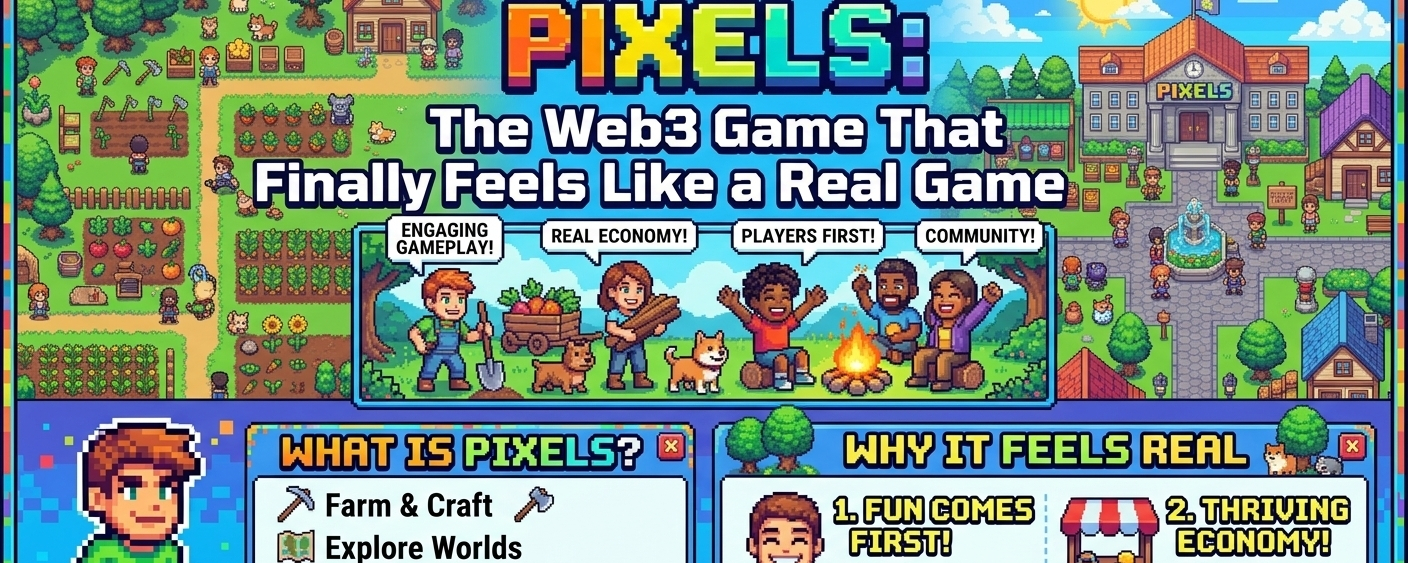
On the surface, Pixels is simple: farming, crafting, exploring. But once you’re inside, the difference is clear.
You’re not constantly interrupted by transactions. You’re not pushed to optimize every move for profit. You just play. And strangely, that’s what makes it stand out in Web3.
The loops connect naturally. Farming feeds crafting. Crafting supports progression. Progression unlocks more of the world. It feels less like grinding for tokens and more like building something over time.
A Different Approach to Rewards
Most projects follow the same cycle: high rewards bring users in, supply increases, value drops, and eventually people leave.
Pixels is trying to avoid that trap.
Instead of endlessly increasing rewards, it adjusts how those rewards convert over time. That shift matters. It reduces the “farm and dump” mindset and pushes the system toward something more stable.
It’s not about promising more it’s about sustaining what’s already there.
An Economy That Needs Players, Not Just Investors
Ownership exists, but it’s not the main story.
Landowners, farmers, crafters, and traders all depend on each other. No single role dominates the system. That interdependence makes the world feel more alive and less like a collection of isolated profit strategies.
It’s not perfect, but it’s closer to a real economy than most Web3 games have managed.
The Ronin Shift
A big part of Pixels’ growth came after moving to the Ronin Network.
With better speed, lower costs, and an existing gaming audience (thanks to Axie Infinity), the experience became smoother and more accessible.
This wasn’t just a backend improvement it changed how the game reached and retained players.
Why It’s Still Growing
Pixels isn’t driven by hype cycles. It’s driven by retention.
People keep coming back not just to earn, but because the gameplay loops feel consistent and the world keeps evolving. That’s something most Web3 games struggle to achieve.
Final Take
Pixels doesn’t claim to have everything figured out. But it’s asking better questions:
What if rewards didn’t inflate forever?
What if ownership supported gameplay instead of replacing it?
What if players stayed even when the incentives weren’t perfect?
That’s what makes it interesting.
Not because it’s loud but because it’s working quietly in a space where most things don’t last.