
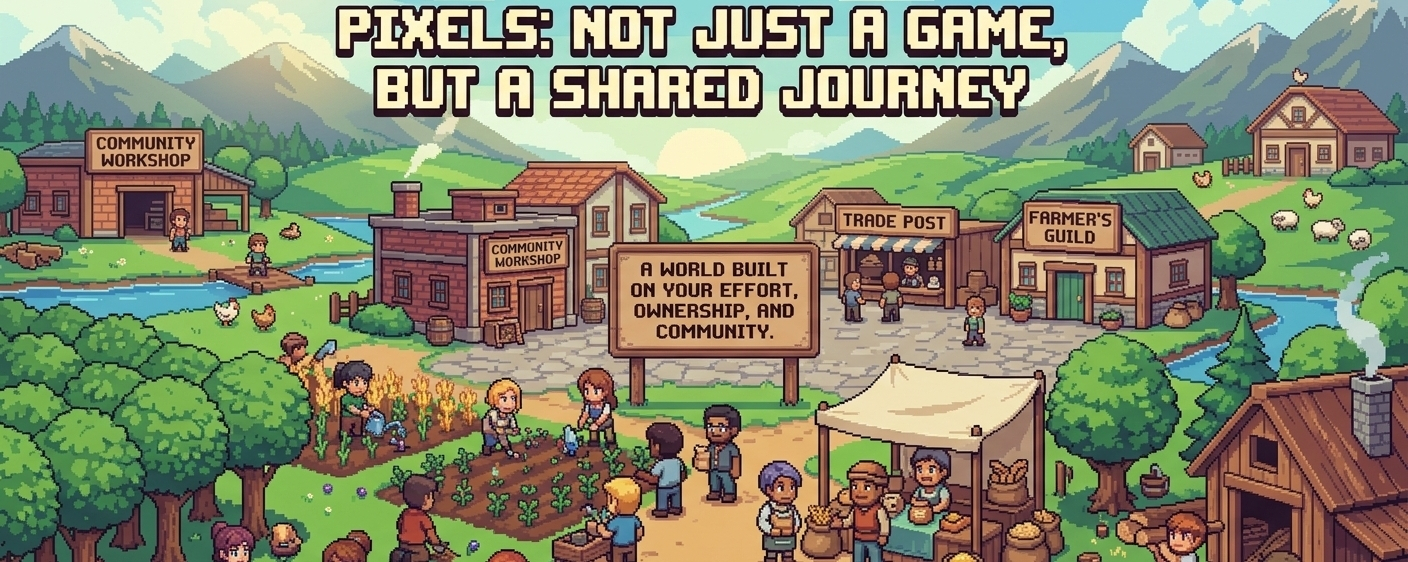
Pixels doesn’t try to impress you at first. It doesn’t open with cinematic explosions or overwhelm you with complexity. Instead, it feels small, almost quiet. You step into a pixelated world where people are farming, gathering, crafting, moving about their routines. It looks like something you’ve seen before—a soft echo of older browser games or indie farming simulators. And yet, if you stay a little longer, you begin to notice that something underneath is different.
What seems like a simple game is actually a carefully layered system where time, effort, ownership, and community all intersect. Pixels is not just asking you to play. It is asking you to participate.
The origins of the game reflect this slow unfolding. It didn’t emerge as a dominant Web3 title or a headline-grabbing experiment. It began modestly, closer to a social farming experience than an economic simulation. Over time, though, it adapted. It found its footing, especially after moving onto the Ronin Network, where the infrastructure better matched its needs. That transition wasn’t just technical—it reshaped how the game functioned. Suddenly, the world could support faster interactions, smoother trading, and a larger number of players behaving like participants in a shared system rather than isolated users clicking through tasks.
That shift matters because Pixels thrives on continuity. It is built around repetition, but not the empty kind. The repetition here is meaningful because it feeds into a larger loop. You plant crops, gather materials, cook food, craft items—not as isolated actions, but as parts of a chain. Each step supports another. Over time, your actions start to feel less like chores and more like contributions to something ongoing. The world doesn’t reset when you log out. It waits. It remembers.
This sense of persistence is where the emotional tone of the game begins to change. In most traditional games, your progress is contained within the system, but it rarely feels like it belongs to you in a deeper sense. Pixels introduces a different feeling. When you own land, when you build something, when you produce goods that others use, the connection becomes more personal. Your effort leaves a trace. That trace has value, not just inside the game, but sometimes beyond it.
Ownership, in this context, is not just a feature. It quietly reshapes behavior. It influences how players think about time, strategy, and interaction. Some people focus on building productive land. Others lean into gathering and crafting. Some become traders, learning the flows of supply and demand within the game. Over time, patterns emerge. Roles form naturally, not because the game forces them, but because the system allows them.
This is where Pixels begins to resemble something more than a game. It starts to look like a small economy.
The economy itself is not decorative. It is not a layer sitting on top of gameplay. It is woven into everything. Resources are not infinite. Energy limits how much you can do at once. Access to land shapes what you can produce. These constraints create movement—goods flow from one player to another, value shifts depending on scarcity, and decisions begin to carry weight. If one part of the system changes, other parts adjust around it.
There is something quietly revealing about this. It shows how even a simple-looking world can produce complexity when systems are allowed to interact. Players are not just completing tasks; they are navigating relationships between time, resources, and opportunity. Some optimize. Some cooperate. Some simply enjoy the rhythm without thinking too deeply about it. All of these approaches coexist, and together they create a kind of lived-in environment.
The visual style plays a role in making all of this approachable. The pixel art is not trying to compete with high-end graphics. It does something more subtle. It lowers the barrier to entry. It makes the world feel readable, understandable, and open. There is no intimidation factor. You can enter quickly, grasp the basics, and start moving. That accessibility allows the deeper systems to reveal themselves gradually, rather than all at once.
There is also a kind of emotional softness to the visuals. They make the world feel safe, even when the underlying systems are quite serious. That contrast is part of the design. You are engaging with scarcity, trade, and ownership, but it is wrapped in a world that feels calm and familiar. It allows players to explore economic behavior without the harshness that usually accompanies it in real life.
At the center of everything, though, is the social layer. Pixels only works because people are there together. Farming alone would not sustain the experience for long. It is the presence of others—the trading, the collaboration, the shared spaces—that gives the game its momentum. When players interact, the systems come alive. Value is not just generated; it is exchanged, negotiated, and sometimes contested.
This is where the game becomes less about mechanics and more about relationships. People begin to recognize patterns, remember names, form small communities. The world starts to feel inhabited rather than simulated. That shift is subtle, but it is critical. A system can be perfectly designed, but without human presence, it remains empty. Pixels manages to create just enough structure for meaningful interaction to happen.
Still, there is a tension running through all of this. It is not always obvious, but it is always there. When a game introduces ownership and real value, it changes how people engage with it. For some, this adds meaning. Time spent in the game feels less disposable. Effort feels rewarded in a more tangible way. For others, it introduces pressure. Activities that might have been relaxing can start to feel like obligations. Efficiency begins to matter more. The line between play and work becomes harder to define.
Pixels sits directly in that space between enjoyment and productivity. It has not fully resolved that tension, and perhaps it never will. But that tension is also what makes it interesting. It reflects a broader question about digital environments: what happens when virtual spaces begin to carry real economic weight?
The answer is not simple. On one hand, it opens up new possibilities. Players can build, earn, and participate in ways that feel meaningful. On the other hand, it introduces familiar challenges—inequality, optimization, competition for resources. Even in a pixelated world, those dynamics begin to surface. Some players gain advantages. Others adapt. The system evolves not just through design, but through behavior.
What Pixels demonstrates, more than anything, is that games can become something more layered than pure entertainment. They can act as small-scale environments where ideas about ownership, labor, and community are tested in real time. Not in a theoretical sense, but in a lived, everyday way.
And yet, despite all of that, it still feels like a game. You can still log in, plant crops, walk around, interact with others, and enjoy the simplicity of it. That balance is delicate. If the economic side becomes too dominant, the experience risks losing its warmth. If the gameplay becomes too shallow, the system loses its depth. Pixels exists in the space between those extremes, trying to hold both at once.
Maybe that is why it resonates with so many people. It doesn’t force a single way of engaging. You can treat it casually or seriously. You can focus on farming, trading, socializing, or simply exploring. The world adapts to how you approach it, and in doing so, it reflects your priorities back to you.
In the end, Pixels is not just about what you do inside the game. It is about what the game allows you to become within it. A farmer, a trader, a builder, a participant in something shared. It offers a space where small actions accumulate, where presence matters, and where value is not only measured in tokens, but in time, relationships, and continuity.
It may look simple, but it carries a quiet ambition. Not to overwhelm, not to dominate, but to build something that feels alive.
