
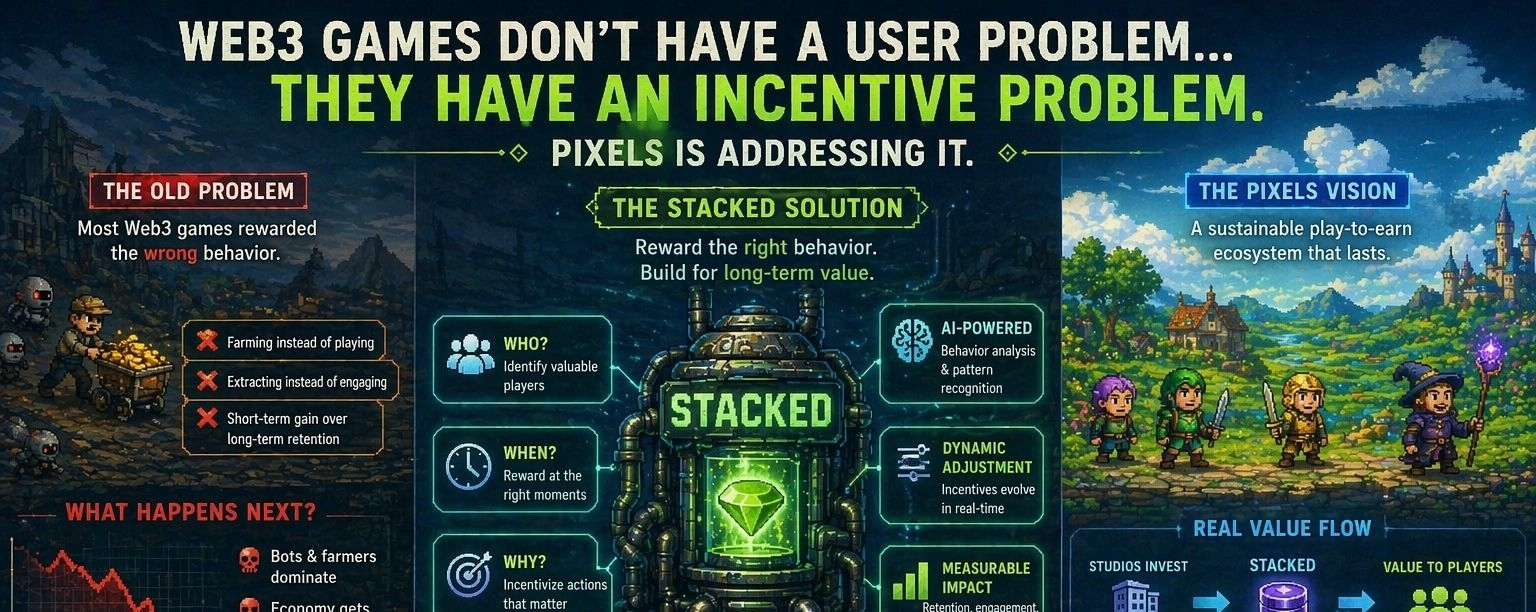
I don’t think most Web3 games have a user problem.
They have an incentive problem.
Because if you look back at the last few cycles, users did show up.
A lot of them.
New games launched → activity spiked → wallets increased → volumes moved.
So it’s not like people weren’t interested.
The real issue showed up later.
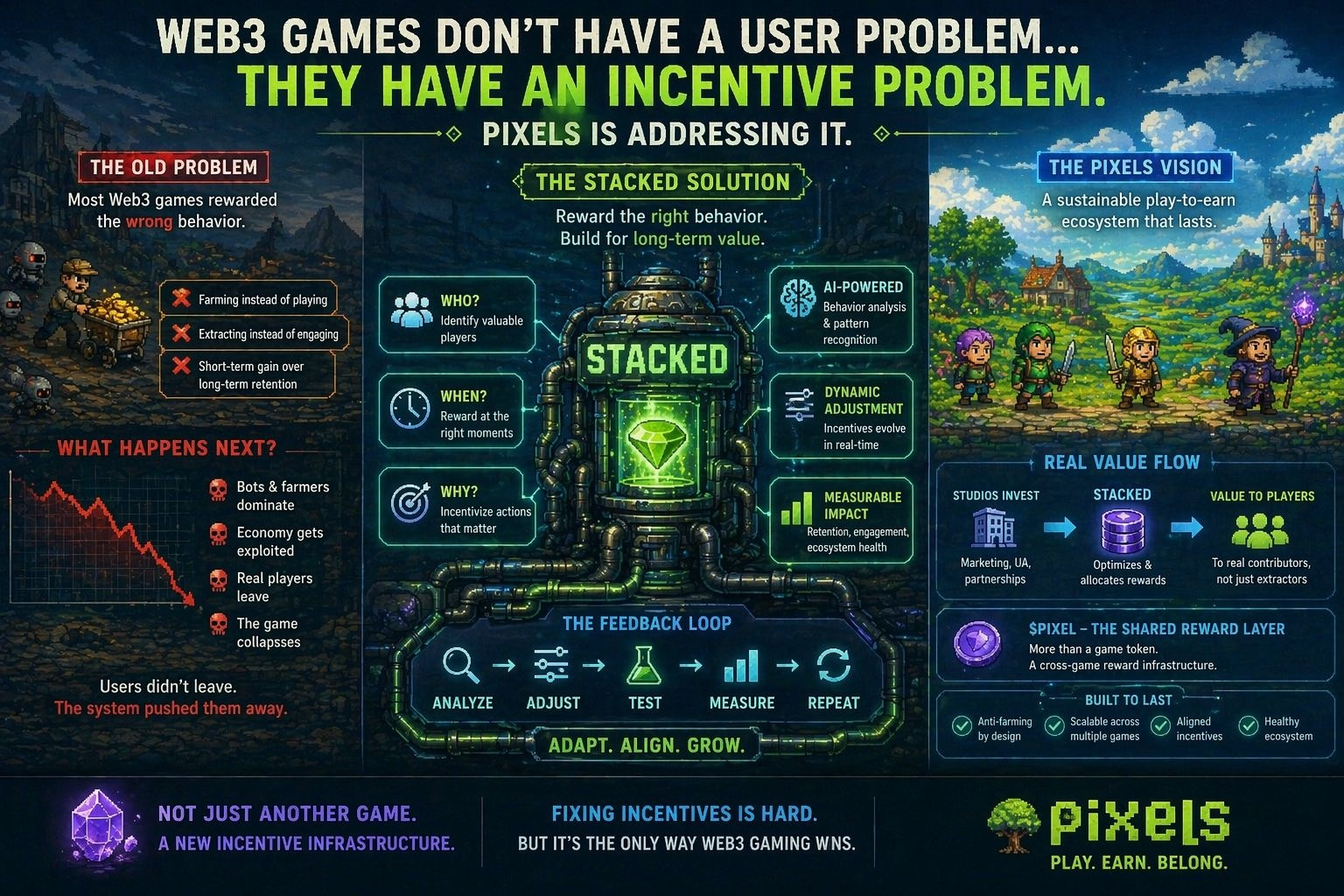
When the system started rewarding the wrong behavior.
Farming instead of playing.
Extracting instead of engaging.
Short-term gain over long-term retention.
And once that loop starts, it’s hard to reverse.
The system basically trains users to break it.
That’s why most play-to-earn models didn’t just slow down…
they collapsed.
So when I look at something like Pixels, I’m not really focused on the game itself.
I’m looking at the system behind it.
Stacked.
At first glance, it doesn’t look like much.
Just a reward engine.
But that’s exactly where the problem has always been.
And from what I’ve observed, the approach here is different.
Not static rewards.
Not “everyone gets the same thing.”
Instead, it’s trying to answer a harder question:
Who should be rewarded… and why?
That’s a much more complex problem.
Because now you need to understand behavior.
Retention patterns.
Churn signals.
Engagement quality.
And then tie rewards to that.
That’s where the AI layer becomes relevant.
Not as hype.
But as a feedback system.
Analyze what’s happening → adjust incentives → test results → repeat.
That loop is what most Web3 games never had.
They launched incentives once…
and then watched them get exploited.
Another angle that stands out to me is how value flows.
Game studios already spend heavily to acquire users.
Ads, campaigns, platform fees.
A lot of that value never reaches the player.
Stacked changes that direction.
Instead of paying platforms…
that value can be directed toward users who actually contribute to the ecosystem.
If that works, it aligns incentives in a way that most systems don’t.
Players aren’t just extracting value.
They’re part of how value gets distributed.
Then there’s $PIXEL.
Right now, it’s still viewed mostly in the context of one game.
But if this system expands across multiple titles, it starts to function differently.
Less like a game token…
more like a shared reward layer.
That shift doesn’t happen overnight.
But if it does, the way people think about it changes completely.
Of course, there are still real challenges.
Can this system actually resist farming long-term?
Can it scale across different games and player behaviors?
Will external studios adopt it?
Because we’ve seen promising systems break at scale.
So I’m not treating this as a solved problem.
But I do think it’s focused on the right one.
And that alone makes it more interesting than most Web3 gaming projects right now.
Because fixing incentives…
is a lot harder than attracting users.
Curious what others think:
Do Web3 games actually struggle with users…
or have they just been rewarding the wrong behavior this whole time?