
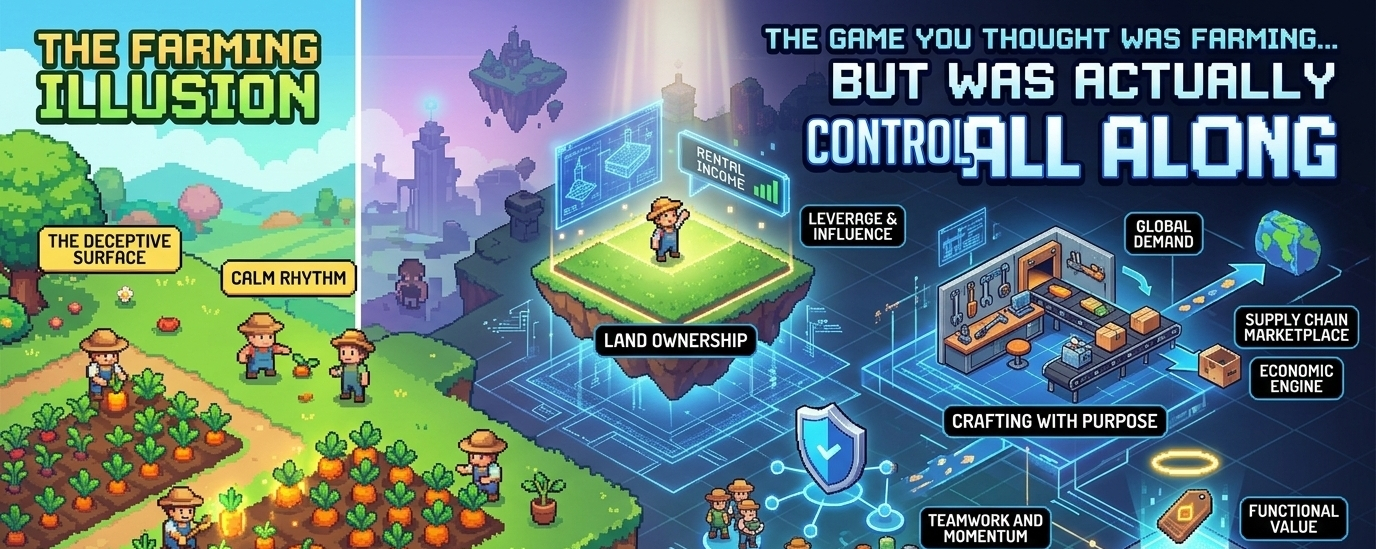
@Pixels used to look at Pixels the same way most people still do from the outside. Just another calm, slow farming loop where you log in, plant a few crops, maybe check your inventory, and log out without thinking too much about it. And for a while, it really does feel exactly like that. Nothing demanding, nothing intense, just a quiet rhythm that doesn’t push you. But the strange part is, the longer you stay, the more that simplicity starts to feel misleading. Not in a bad way, but in a way that makes you question what is actually going on underneath.
At some point, it stops feeling like you are just “playing” and starts feeling like you are positioned somewhere inside a system that keeps moving whether you notice it or not. That shift is subtle. There is no big moment where the game announces it. You just start realizing that certain players are not progressing the same way others are. Some are comfortably ahead, not because they grind harder, but because they understood something earlier. And once that realization hits, the farming part begins to look more like an entry layer than the actual core.
Land is where that realization becomes impossible to ignore. It is not just a feature, it is leverage. The idea that space itself can be controlled, shaped, and turned into something productive changes everything. When someone owns land, they are not just participating anymore, they are influencing how others interact with the world. And the earlier that position is secured, the stronger it becomes over time. That advantage does not stay static, it grows quietly. Meanwhile, players who come later often don’t even realize they are already behind. They adapt, they rent, they try to fit into a structure that was already built by someone else. And that gap, once it opens, doesn’t close easily.
Then crafting starts to reveal its real weight. At first, it feels optional, almost like something you can casually engage with whenever you feel like it. But that illusion fades quickly. The moment you understand that other players depend on what is being created, everything changes. It is no longer about crafting for completion, it is about crafting with purpose. Demand begins to matter. Timing begins to matter. You start noticing patterns, what moves fast, what sits idle, what suddenly becomes valuable. And that is when it stops feeling like a game mechanic and starts feeling like a living exchange between players. Some treat it lightly and stay in that comfortable middle. Others pay attention, adjust, and quietly move ahead without making noise.
Guilds take that entire dynamic and push it even further. Playing alone still works, and it can still be enjoyable, but it starts to feel limited once you see what coordinated groups are actually doing. There is a kind of silent efficiency in the way roles divide naturally. One focuses on gathering, another refines, another trades, and together they move in a way that feels almost unfair at first glance. But it is not unfair, it is structured. It is the difference between effort and organized effort. And in a system like this, organization always wins over time. Solo players often don’t lose because they are doing something wrong, they just don’t have the same momentum building behind them.
Even the asset side, which many people approach with skepticism, starts to make more sense the deeper you go. It does not feel disconnected or artificially important. Ownership has function. Items have purpose. Things move because they are needed, not just because they exist. That creates a different kind of attachment. Instead of hoping something becomes valuable, you begin to understand why it is valuable. And that difference is what keeps the system grounded. It feels less like speculation and more like positioning within something that is actively being used.
By the time all of this becomes clear, it is hard to go back to seeing Pixels as just a farming game. That label feels incomplete, almost misleading. What looks slow and simple on the surface is actually layered with decisions, timing, coordination, and control. You can still choose to play it casually, and it will let you. But if you start paying attention, really paying attention, you begin to see how much is happening in the background. And once that perspective shifts, the entire experience changes with it in a way that is difficult to reverse.