
Let me tell you something that almost nobody talks about when they discuss PIXEL.
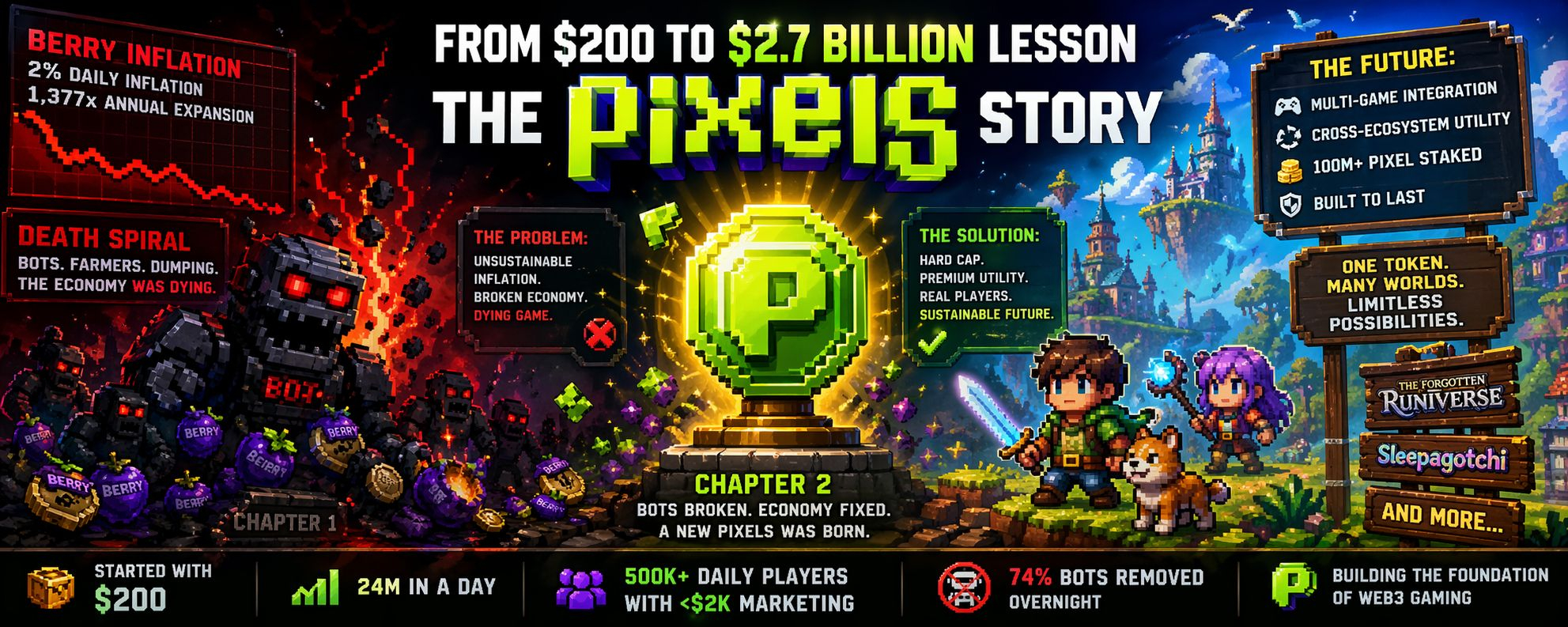
The game started with two hundred dollars in the company wallet.
Not two hundred thousand. Not two million. Two hundred dollars. And within a single day, that became $2.4 million. By 2024, with less than $2,000 spent on marketing, Pixels had half a million daily active players.
No hype campaigns. No influencer army. No paid promotions.
Just a game people actually wanted to play.
But here is the part of this story that matters even more than the rise it is what happened after the rise, what nearly destroyed everything, and how PIXEL's response to that crisis became a blueprint that the entire Web3 gaming world needs to study.
THE PROBLEM NOBODY WANTED TO ADMIT
When Pixels was growing fast, it had two tokens running simultaneously. PIXEL was the premium token. BERRY was the in-game soft currency that everyone was farming and earning daily.
And BERRY had a problem.
The BERRY token was averaging a 2% daily inflation rate a staggering 1,377 times the annual expansion of supply. Let that number sink in for a second. Every single day, the supply was growing by 2%. Every bot, every grinder, every farmer was pumping more BERRY into existence and immediately dumping it.
Web3 technology made this worse than it would be in traditional games it lowered the barrier to selling a soft currency, meaning farmers could grind harder and sell their earnings more easily. The team saw it clearly. Even the founder Luke Barwikowski publicly said that soft currency inflation in Web3 can become a death spiral. And they were living inside that spiral in real time.
This is the problem that kills every P2E game eventually. It is not that blockchain gaming is a bad idea. It is that bots and mercenary farmers will always find the weakest point in your economy and exploit it until there is nothing left.
Pixels chose to do something most Web3 projects are too afraid to do.
They admitted it. Publicly. And then they rebuilt.
THE DECISION THAT CHANGED EVERYTHING
Chapter 2 moved BERRY to an off chain coin to ensure fairness, taking steps to reduce market sell pressure and focusing on a single currency to simplify the economic model and improve the game experience.
Think about what that actually means. They took a live token with real holders, real value, and real market trading and they shut it down. They transitioned everyone to a new system. That is an enormously difficult decision to make, and an even harder one to execute without destroying community trust.
But they did it.
When Chapter 2 went live on June 18, 2024, the Pixels team implemented systematic changes to discourage bot activities, claiming that "Chapter 2 broke all bots."
Three words that carry the weight of an entire industry's failures: broke all bots.
Every Web3 game suffers from bots. Most teams acknowledge it, promise to fix it, and then quietly accept it as the cost of doing business. Pixels actually fixed it. Not perfectly, not permanently but they broke the existing bot infrastructure so thoroughly that their player numbers dropped by 74% overnight as fake accounts got purged.
Most companies would panic at a 74% user drop. Pixels saw it as proof the medicine was working.
WHAT PIXEL ACTUALLY SOLVED
Here is the thing that separates Pixels from every other farming game in the Web3 space they identified that the real enemy was not competitors. It was not bear markets. It was not even bots specifically.
The real enemy was having a token that anyone could extract value from without putting value in first.
Unlike BERRY, PIXEL has a hard token cap. PIXEL is used to pay for new premium features Realms, Guilds, Pets, Memberships. It can be used to boost energy, speed up build times, unlock new skins, and more. Due to its hard cap, the distribution of PIXEL is controlled more tightly than that of BERRY.
This is the structural fix that matters. A hard cap means the supply cannot inflate infinitely. Premium utility means you have to actually spend PIXEL to access the best features it is not just an exit token you dump after farming. And tighter distribution means rewards flow to people who are genuinely contributing to the ecosystem.
Pixels has also announced a shift in its engagement strategy, moving away from a broad focus on daily active adventurers and placing greater emphasis on daily active users with higher lifetime value.
That is a massive strategic shift. Most Web3 games chase raw user numbers because big DAU numbers look good in press releases. Pixels is now deliberately choosing quality over quantity even if it means smaller headline numbers.
That kind of thinking is rare. And it is exactly what sustainable economies are built on.
THE RONIN MOVE A MASTERCLASS IN USER ACQUISITION
Before any of this, there was another decision Pixels made that completely changed the game.
In late 2023, they migrated from Polygon to the Ronin blockchain.
According to project founder Luke Barwikowski, Ronin offered a ready made audience thanks to its ties with Axie Infinity, dramatically reducing user acquisition friction.
Instead of spending millions trying to market to cold audiences, they moved to where a warm, crypto native, gaming ready audience already existed. The Axie community. People who already understood blockchain gaming, already had wallets, and were already looking for the next thing.
Ronin's active addresses skyrocketed from 20,000 at the start of November 2023 to a peak of 897,000 on February 19th, 2024. During the same period, the Ronin network token RON significantly increased in value from $0.50 to $3.46.
Pixels did not just grow. They pulled an entire blockchain up with them. That is the kind of ecosystem impact that turns a game into infrastructure.
NOW IT IS GOING MULTI GAME
The latest chapter of this story might be the most important one yet.
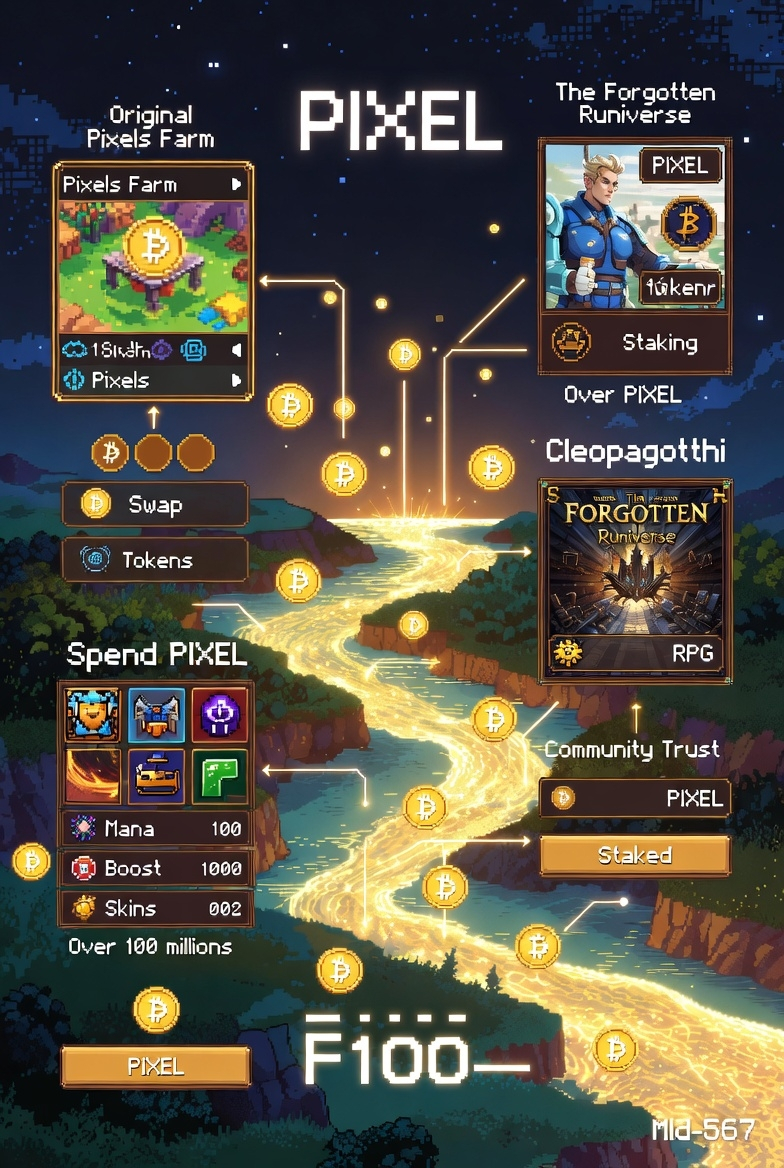
PIXEL is moving outside its own ecosystem for the first time and integrating with The Forgotten Runiverse, a grand fantasy RPG. Players can swap their game tokens for PIXEL tokens and spend PIXEL in-game on Mana, Boosts, and other extras.
Mid-2025 also sees integration with partner games like Sleepagotchi, allowing PIXEL use for in-game purchases and staking. Over 100 million PIXEL tokens are now staked, signalling strong community trust.
This is where the PIXEL thesis gets really interesting.
If PIXEL becomes the currency that flows across multiple games not just one farming game then its utility compounds with every new integration. Players earn it in one game and spend it in another. The token develops real cross-ecosystem demand. And the ecosystem that grows around it becomes genuinely difficult to replace.
That is not a gaming token anymore. That is infrastructure.
THE HONEST PART
I want to be straight with you because real talk matters more than hype.
PIXEL is not a perfect project. The token reached a fully diluted valuation of over $2 billion before experiencing a sharp decline of approximately 95% from its all time high. The token has taken a brutal beating in price. Bot problems did not disappear completely after Chapter 2. Revenue sustainability is still a work in progress.
But here is what separates PIXEL from the graveyard of failed Web3 games: they have consistently shown they are willing to make hard decisions to protect the long term health of the ecosystem even when those decisions hurt in the short term.
Killing BERRY hurt holders. It was the right call. Purging bots crashed user numbers. It was the right call. Shifting focus from DAU to lifetime value makes press releases less impressive. It is still the right call.
A team that makes the right call consistently, even when it is painful, is the kind of team that eventually figures it out.
Pixels has demonstrated what many believed to be impossible: you do not need AAA budgets. You do not need hype driven tokenomics. You do not need millions spent on marketing.
What you need is a game people actually want to play, an economy that rewards the right people, and the courage to fix your mistakes in public.
That started with $200. It turned into a $2.7 billion lesson for an entire industry.
