
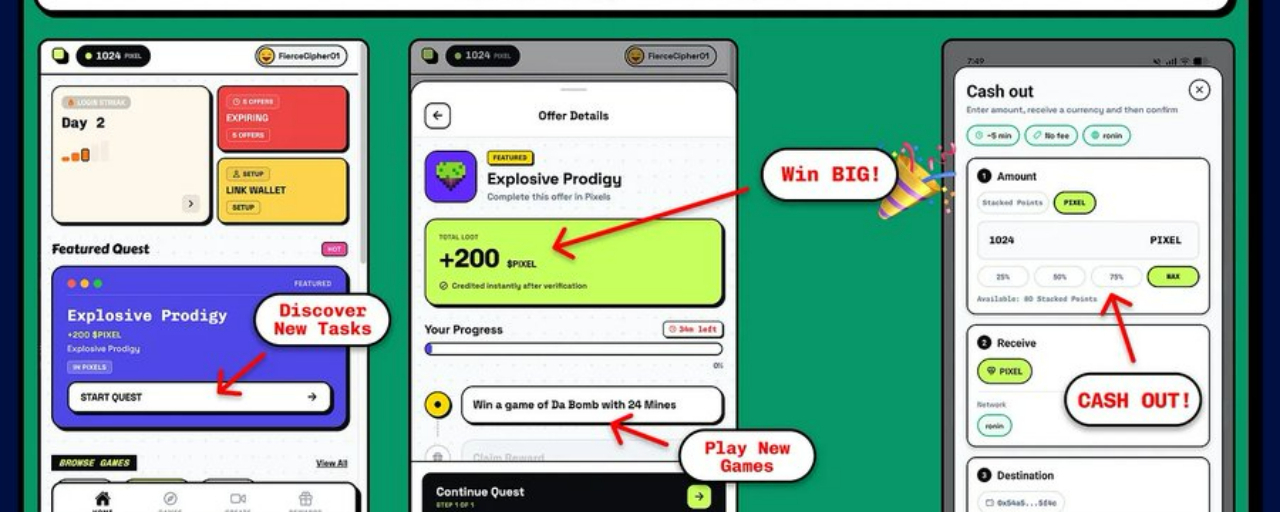
Brothers, Ning Fan is here to chat about @Pixels again. First, a greeting, the CreatorPad event at Binance Square is still distributing tokens, 15 million $PIXEL waiting for everyone to share, those who haven't boarded should hurry up and see how to participate.
But today Ning Fan is not here to teach everyone how to shear sheep. Ning Fan is here to report a 'personal test result'—recently, in this wave of Bountyfall updates from Pixels, Ning Fan has truly spent several nights in it, and the feeling now is: this game finally has the vibe of 'brothers charging together.'
What exactly is Bountyfall Chapter 3 playing?
In simple terms, Bountyfall is a union system. You have to choose a Union to join, and there are currently three options: Wildgroves, Seedwrights, Reapers. Once you choose, it's like joining a small gang, where everyone in the Union works together to chase bounties, grab territories, and stack Yieldstones, helping each other while also having a bit of competition.
Ning Fan chose Seedwrights for a very simple reason—this name sounds like farming, and someone like Ning Fan, who is a casual player, enjoys farming and raising pets, so there's no need to engage in those high-risk, high-return routes. But which one to choose is not important; what matters is that after you make your choice, you have a little bit of anticipation every time you log in every night. It's not that anxious feeling of 'hurrying to grind tasks for money,' but more like returning to a familiar small town to see how my farm is doing and chatting with friends in the Union about whose Yieldstones are stacking the most today.
This feeling, to be honest, is quite rare in Web3 games. Too many chain games under the banner of 'social' are actually just places for solo task grinding. Bountyfall is different; it really makes you feel like 'someone is playing with you.'
Multi-game staking: your tokens are your 'voting rights'
What Ning Fan is most excited about this time is actually the $PIXEL staking system.
The traditional concept of staking is basically 'locking up coins to earn returns,' like a fixed deposit, without much sense of participation. This time, Pixels is doing something different—what you stake
$PIXEL is in different game pools: main world, Pixel Dungeons, Forgotten
Runiverse, etc. The more you invest, the bigger the reward pool the game receives. In plain language, you are using your tokens to 'vote' for the game content you like.
Ning Fan really buys into this logic. As a player, what Ning Fan dislikes the most is when the project team decides 'what the next update is' without considering what players want to play. Now, through multi-game staking, the power of the community is directly reflected in resource allocation. If you think a game is fun or worthy of support, you can stake your tokens there, and the reward pool will tilt towards that direction. In short, this is a decentralized game release mechanism—not decided solely by the project team, but determined by community votes on the flow of ecological resources.
Moreover, if you have a Land NFT, each piece of land can give you an additional 10% staking bonus (with a cap of 100,000 $PIXEL per piece of land), making virtual real estate not just a decoration but a real 'influence amplifier.'
Ning Fan tried a diversified investment strategy: most of it is put into the main game pool to enjoy the daily farming bonuses; a small portion is invested in new modules, expecting more surprises in the future. The operation is really simple, and even beginners can get it done in a few minutes without needing any advanced DeFi knowledge.
$PIXEL's role upgrade: from a single game token to an ecological hard currency
Speaking of this, Ning Fan felt it was necessary to talk about the positioning of PIXEL separately.
Many people ask Ning Fan: Isn't PIXEL just the token for farming in the game? Is it worth holding long-term?
This understanding might have been valid a year ago. But now Pixels has evolved to Chapter
3, and the role of PIXEL is no longer as simple as a 'single game token.' Its current identity is closer to that of a 'cross-game reward and loyalty currency'—it can be used not only in the Pixels farm but also as hard currency in multiple games across the entire Ronin ecosystem in the future. This cross-game asset value is its true long-term potential.
Additionally, Pixels has a more refined design: through the Events API, players' reputations and progress in the core farming game can directly unlock privileges in cooperative games. In simple terms, the deeper you play in Pixels and the greater your contributions, the higher your 'status' in the entire ecosystem, and the more benefits you can enjoy. This is not just 'spending money to buy skins,' but 'exchanging time and participation for identity.'
Ning Fan's heartfelt words
Of course, Ning Fan is not urging everyone to go all in. The price of PIXEL has been fluctuating around $0.0075-$0.0082 recently, with a huge gap from its historical peak; short-term fluctuations are unpredictable. Any crypto project has its ups and downs; the economy will also fluctuate with the market.
But what Ning Fan wants to say is: if your purpose in playing games is that sense of 'effort being recognized,' the Pixels ecosystem is indeed serious about this matter. The alliance competition in Bountyfall creates real bonds among players, multi-game staking allows the community's voice to truly be heard, and PIXEL's cross-game positioning gives each investment a more long-term value.
It’s not like a high-risk gamble; it’s more like being a resident with a little influence in a constantly growing small town. Every day, logging in to check the crops, reviewing the staking status, and chatting with brothers in the Union—those little moments of happiness are truly healing.
Brothers, have you played Bountyfall? Which Union did you choose? Let's chat with Ning Fan in the comments!