
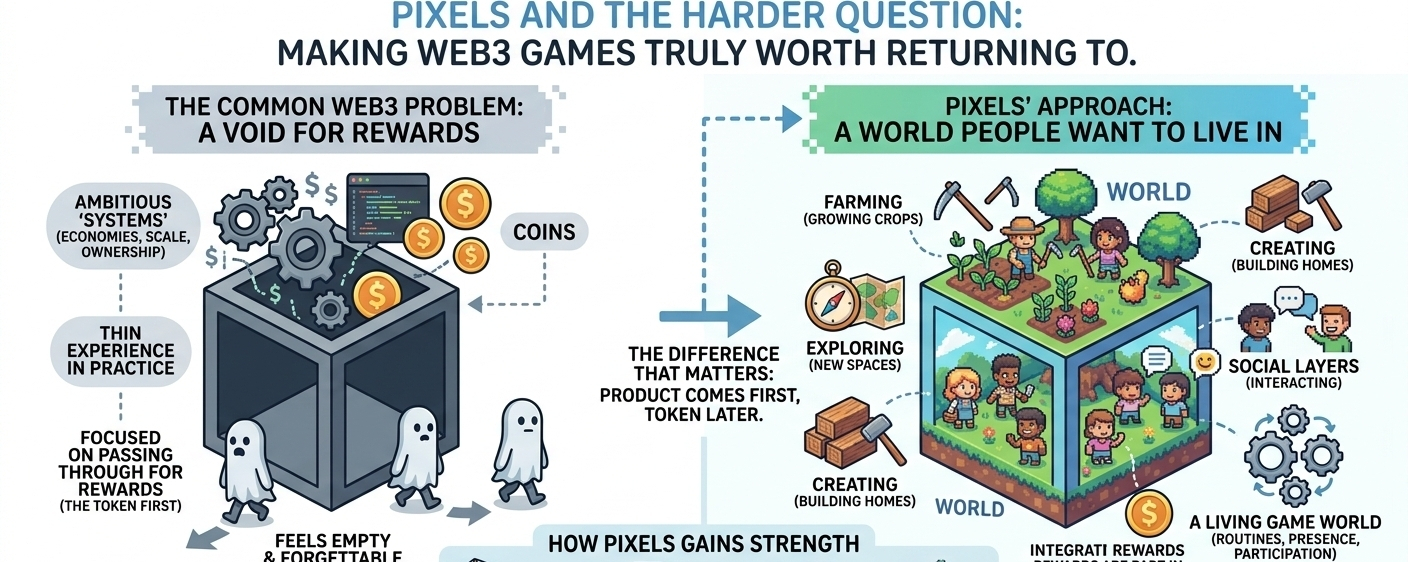

Pixels is one of those projects that feels easier to understand when you stop looking at the token first and look at the product itself. At the surface, it is a social casual Web3 game built around farming, exploration, and creation. But what makes it interesting is not just that description. It is the fact that the team seems to be trying to make a world people actually spend time in, not just a system people pass through for rewards.
That difference matters more than people admit. A lot of Web3 games have looked ambitious on paper and thin in practice. They knew how to talk about ownership, economies, and scale, but not always how to make the day-to-day experience feel alive. Pixels, at least from the outside, seems more aware of that gap. Its open-world design, its social layer, and its focus on simple repeatable activities give it a more grounded feel. Farming, exploring, collecting, building, interacting — none of that is revolutionary on its own, but sometimes the real work is not inventing a new genre. Sometimes it is shipping familiar mechanics in a way that people want to return to.
What I find notable is that Pixels does not need to overcomplicate its identity. It is a game about activity, presence, and participation. The product introduction is fairly clear: this is a living game world where players can create routines, discover spaces, and become part of a broader social loop. That clarity helps. In crypto, projects often try to be ten things at once. Pixels feels more useful when viewed as a product that is trying to make Web3 gaming feel normal, accessible, and continuous.
There is also something worth respecting in projects that keep building in public and learning through use rather than hiding behind vision alone. Shipping a social casual game is not glamorous work. It means working on retention, rhythm, user behavior, and the small design choices that decide whether a world feels sticky or forgettable. That kind of building is slower, less dramatic, and probably more honest.
Pixels may not be important because it promises a grand future. It may be important because it keeps testing what a Web3 game can actually feel like when the product comes first. And that is usually where the better lessons are. Not in the loudest claims, but in the projects that keep making, adjusting, and learning while everyone else is still talking.