
At first glance, Pixels feels like something we’ve all seen before. A colorful, casual-looking Web3 game built around farming, wrapped in social mechanics, powered by a token, and launched into an ecosystem that has already seen both explosive growth and equally sharp declines. The pattern is familiar enough to predict the lifecycle before even opening the game: attention spikes, users rush in to farm rewards, tokens get sold off, and eventually the whole thing fades into the background as the next shiny project takes its place.
That instinctive skepticism isn’t misplaced. Web3 gaming has trained people to expect exactly that. So when something like Pixels shows up, the default reaction is not excitement—it’s caution.
But then you spend a bit more time with it, and the reaction shifts slightly. Not into full belief, but into curiosity. Because Pixels doesn’t seem entirely content with just repeating the usual formula. There are small but noticeable design choices that suggest the team is at least aware of the problems that have plagued similar projects before.
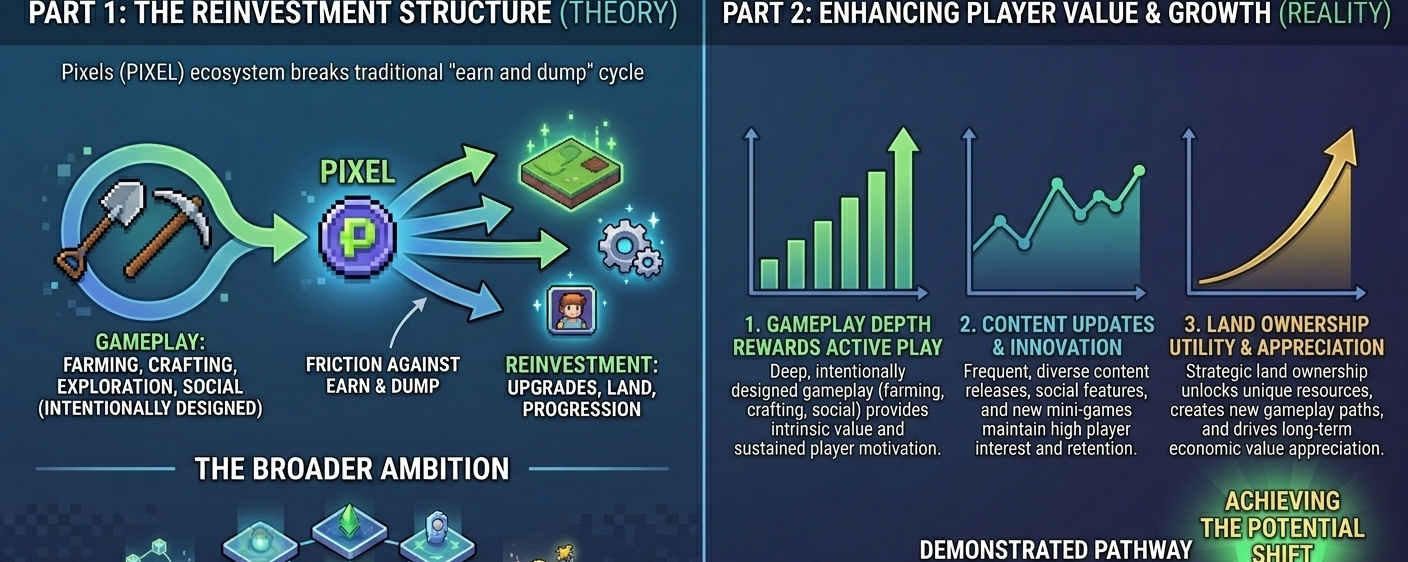
Underneath its simple presentation, the game revolves around a loop that is easy to understand but carefully structured. Players farm, gather resources, craft items, explore the world, and interact with other players. It leans heavily into social activity and persistence rather than short, extractive sessions. In return, players earn rewards, primarily in the form of the PIXEL token, which functions as the backbone of the in-game economy. What matters more than the earning, though, is what the game pushes players to do next. Instead of encouraging immediate exits, it nudges users to reinvest. Tokens are spent on upgrades, land, pets, cosmetics, and progression systems that deepen involvement over time. The design is clearly trying to slow down the typical “earn and dump” reflex.
That alone isn’t revolutionary. Plenty of projects have tried to create sinks and retention loops. Where Pixels starts to feel slightly different is in how it positions itself beyond being just a standalone game. It hints at becoming part of a broader, interconnected ecosystem where player activity, assets, and incentives can move across experiences. That ambition—to function less like a single product and more like a layer within a network of games—is where things become interesting. It’s not entirely proven, and it’s certainly not guaranteed to work, but it’s a more ambitious direction than most farming simulators wrapped in tokens.
The token itself, PIXEL, initially feels like another familiar piece of the puzzle. A capped supply, tied to gameplay, used for upgrades, access, and various in-game utilities. On the surface, it doesn’t break new ground. But looking deeper, the system tries to tie emissions more closely to active participation rather than passive accumulation. Spending is not optional if you want to progress meaningfully, and the game continuously creates reasons to put tokens back into the system. There’s an effort to recycle value internally instead of letting it leak out immediately. Whether that balance holds under pressure is still an open question.
What stands out more is how the game attempts to shape player behavior. It doesn’t simply reward activity; it structures it. Progression systems, energy mechanics, and social features all push toward consistency rather than short bursts of farming. There’s an attempt to make players care about their place in the world, their land, their reputation, and their ongoing presence. In theory, that reduces the likelihood of purely extractive users dominating the economy. In reality, it depends heavily on whether the gameplay itself is engaging enough to justify that commitment. If the underlying experience feels like a grind, no amount of clever design will stop people from optimizing it into a farming loop.
Economically, Pixels appears to be aiming for something closer to a closed system. Players earn, spend, and circulate value within the game, while the broader ecosystem introduces additional layers of utility and sinks. This is the kind of structure that many Web3 games claim to have but rarely achieve. The real test is whether value stays inside because players want to keep playing, or because they’re temporarily incentivized to do so. If it’s the latter, the system eventually cracks. If it’s the former, there’s a chance for something more sustainable.
There are parts of the project that sound strong in theory. The early traction suggests genuine interest, not just speculative attention. The integration with a larger ecosystem adds depth that most projects lack. And the focus on retention over pure acquisition is a step in the right direction. At the same time, the risks are still very real. If rewards remain too attractive relative to gameplay, the economy will tilt toward extraction. If new user growth slows, the system loses momentum. And if the experience starts to feel repetitive, even engaged players will drift away.
What makes Pixels worth watching is not that it has solved these problems, but that it seems to be actively trying to address them. It doesn’t feel like a finished product with a proven model. It feels like an ongoing experiment attempting to find a balance that most Web3 games have failed to achieve. That alone sets it apart, even if only slightly.
In the end, Pixels sits in an uncomfortable but honest position. It might be an early example of a more sustainable direction for Web3 gaming, or it might end up following the same path as those that came before it, just with better design and a longer runway. The difference will come down to execution and whether real players—not just farmers—find enough value to stay.
For now, it makes sense to approach it with measured curiosity. Not dismissive, but not convinced either. The idea has potential, the structure shows intent, but the outcome is far from certain.
