

In an industry filled with grand narratives like 'changing the world' and 'digital immortality,' Pixels' recent turmoil feels like an old gambler in Las Vegas who has lost everything suddenly deciding to wash their hands of gambling and start an advertising agency. It's a strange yet very real feeling.
Do you remember those crazy days from the last cycle? The little sprites of Axie Infinity were dancing in the guilds of Southeast Asia, and the farms of Pixles were packed with 'farmers' working day and night. At that time, everyone was talking about 'Play to Earn,' that illusion where wealth could gush out like a spring just by clicking the mouse. No one cared about whether the game was fun; everyone only cared about the return on investment period.
But fundamentally, this is a liquidity mining disguised as a game. Everyone is a vampire, all sucking on the liquidity pool of the project, desperately drawing the last bit of FOMO (fear of missing out) dividends.
After seeing enough of this kind of thing, you will find that all chain game white papers look similar. The first thirty pages discuss the grand blueprint of the metaverse, while the last five pages use complex calculus formulas to cover up a fact: as long as there aren't enough new entrants, a collapse is just a matter of time.
But when I opened the latest white paper of Pixels, that sense of disillusionment as a 'professional veteran' was surprisingly cured by an inexplicable sense of humor.
Is this a game white paper? This is clearly an internal KPI assessment manual from a major internet company.
It no longer talks to you about dreams. It is even too lazy to pretend to be 'I am creating art'. The core logic of the entire document can actually be summed up in one sentence: I found that constantly giving money to freeloaders is suicidal, so I need to transform into a blockchain advertising intermediary alliance.
The founder of Pixels may have finally realized a truth: Ponzi schemes will always collapse, but advertising intermediaries will always make money.
What is this called? In the context of Web3, this is called a dimensionality reduction attack of 'meta-narrative'. While other projects are still struggling with how to modify output coefficients to extend their lifespan, Pixels directly cut off the freeloaders' internet connection and introduced a set of calculations called RORS (gold farming return on investment).
Previously, we talked about 'user growth', 'daily active users (DAU)'. Now Pixels tells you, if you are only here to freeload, your daily active users are not only worthless to it but are actually a liability. The most valued metric now is: if I give you a dollar in rewards, how much value can you return to my system? If this ratio (RORS) is less than 1, sorry, you are the 'vampire' that needs to be cleansed.
This 'stinginess' and 'accounting sense' have shattered the previous illusion of 'easy money'.
To achieve this accounting goal, Pixels has established a rather clever but also quite harsh mechanism. For example, the joy beans (vPIXEL) that can only be spent in the game. This is quite interesting; it is pegged 1:1 to the main token, but it is locked within the ecosystem. Want to cash out? You can, but you will have to pay a heavy tax called the 'farmer's tax'. Want to spend in the game? There are no transaction fees.
This means it is very clear: stop thinking about cashing out my tokens on exchanges. If you really want to play in this circle, just circulate within my advertising alliance.
Even more incredible is its 'precise reward' system. This thing is simply the AppsFlyer on the blockchain. It will monitor every player's data: Are you a bot? How much money did you spend in this game? How many people did you bring? If you are just a freeloader, the rewards you receive might not even cover your electricity bill; but if you are a 'high-quality user' willing to spend real money, the system will accurately present the rewards to you like a fawning waiter.
This has produced a very counterintuitive insight: in the hypocritical chain game circle that constantly shouts 'Play and Earn' and 'metaverse', the naked honesty of Pixels has become a rare clarity.
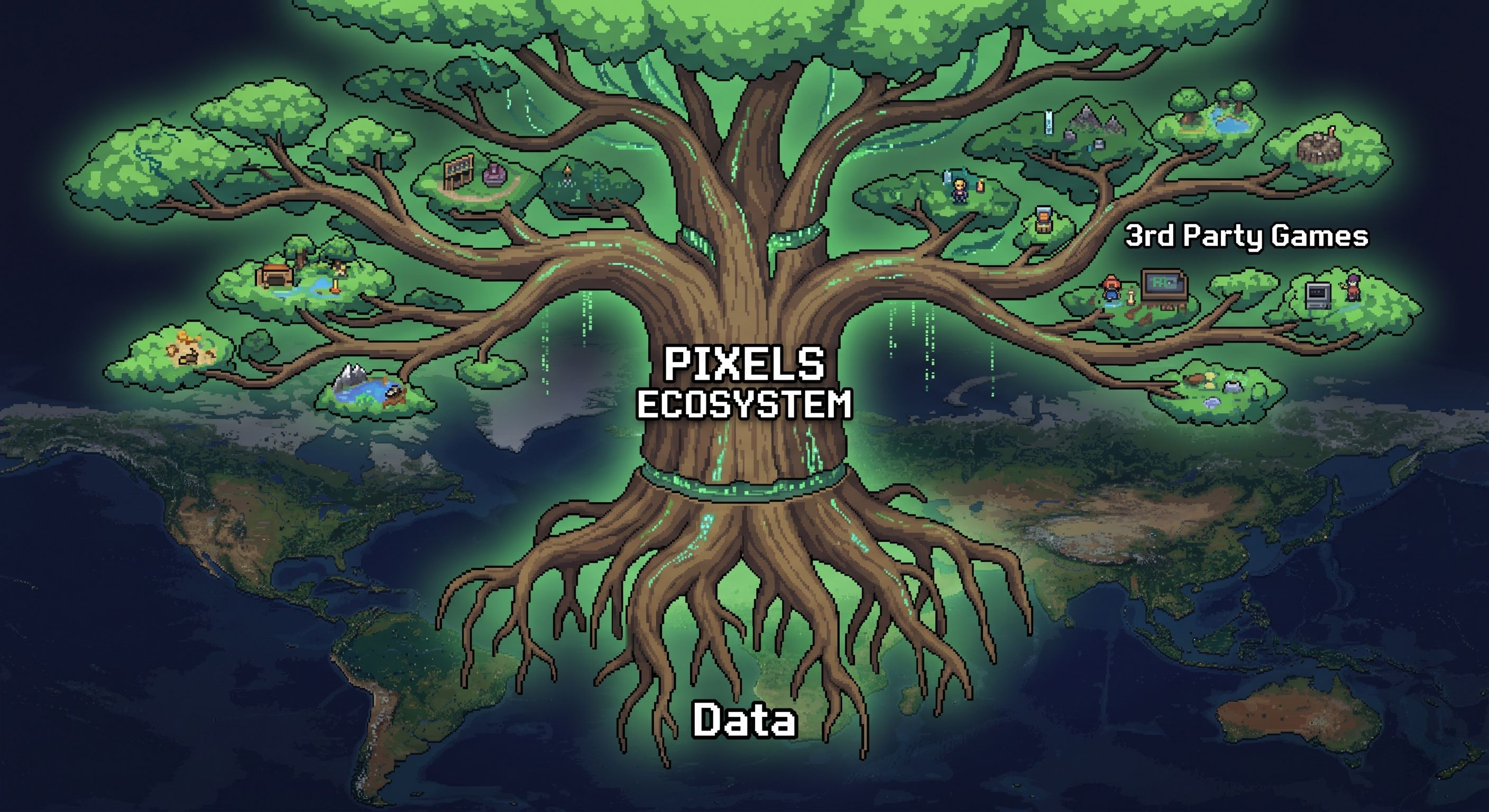
It no longer sees itself as a game; it sees itself as a distribution node that 'picks dishes based on the person'. It provides users for other games at the cost of having those games share their data with it. It treats players as data packets labeled with LTV (lifetime value), and tries to establish an extremely precise, ROI-driven data calculator in this land full of speculators.
Is this called a game? This is called business.
Looking at it from another logic, Pixels is actually using the most boring and realistic Web2 user acquisition logic to counter greed in Web3.
It acknowledges: the vast majority of players come to Web3 just for money. Since it is for money, let’s not talk about feelings, let’s talk about the cost of 'buying users'. If my cost to acquire a user is 5 dollars, but he can create 6 dollars in value for me, then this business can continue indefinitely. As for whether the game itself is fun, that is just a means to improve retention, not the goal.
This transformation is actually quite cruel. It means that the era of the 'makeshift troupe' where everyone could get rich is completely over.

Pixels in the future may become very stable or may become very mediocre. It will analyze retention curves every day and optimize reward algorithms like those traditional internet advertising platforms. It will never return to that era of everyone crazily gold farming.
If you still play with the idea that 'as long as I click the mouse, the project team has to pay me a salary', you will likely be disappointed. Because the project teams have now learned to monitor, to calculate, and to avoid those who only want to freeload when issuing tokens.
In this circle, after a long time, you will find that all enthusiasm eventually turns into reports.
The white paper from Pixels is actually a 'layoff notice' for all the chain game players who have not yet woken up. It tells everyone: the benefits of freeloading are gone, and now we need to focus on the 'gold farming return on investment'.
Lastly, let me say something heartfelt.
I do not dislike this change in Pixels. Compared to those scammers who misappropriate the national treasury while shouting 'We are early' on Twitter, Pixels' confession of 'I just want to be an advertiser' exudes a kind of veteran-like honesty.
Code does not lie, and calculators do not either. When a project starts to seriously discuss whether the output of each token can be exchanged for equivalent income, it may no longer be sexy, but at least it is trying to survive.
As for whether this is still the 'freedom, equality, and wealth' Web3 metaverse in your heart?
Don't be silly. In the eyes of veterans, where is the metaverse? There are only the ledgers that have not yet collapsed and the accountants preparing to run away. Pixels simply wants to become that 'ledger distribution center' that never has to run away.
This may be the endgame of Web3 gaming: either die completely in a romantic illusion or live as the Web2 version you hate the most in the reality of calculations.