
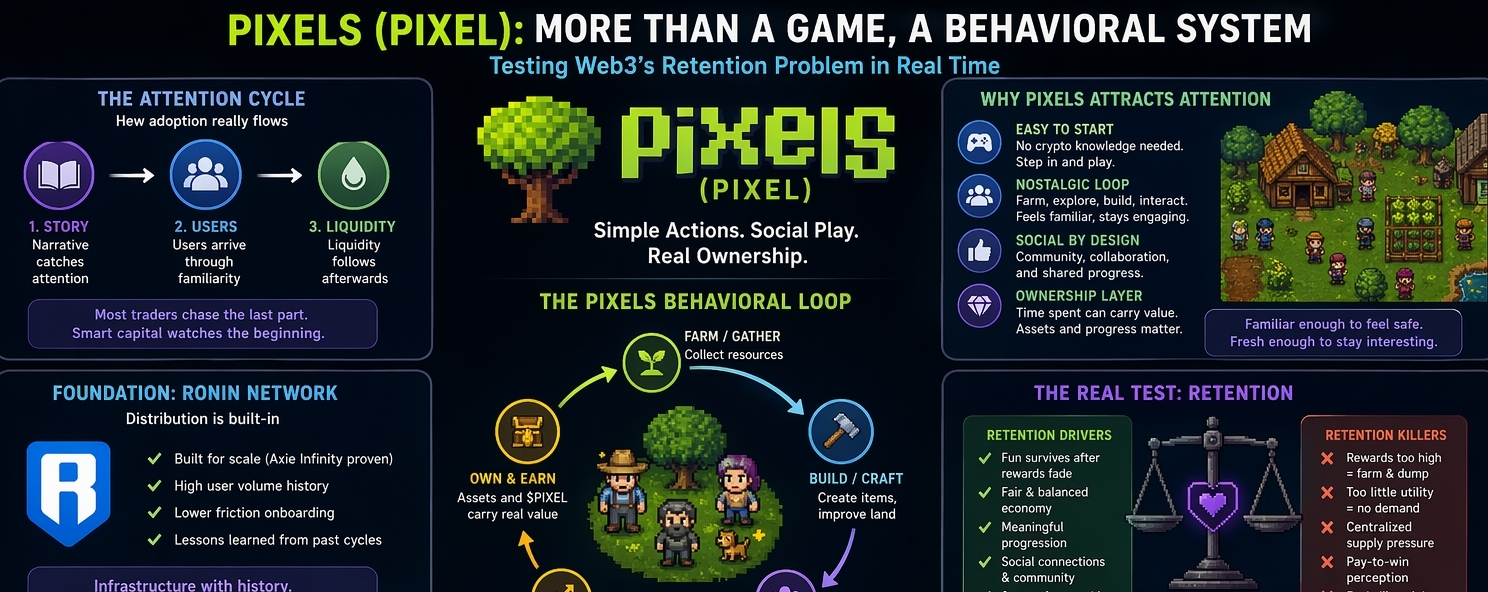
Attention doesn’t show up by accident. It rotates. First the story catches people, then users arrive, and only after that does liquidity follow. Most traders chase the last part. I keep my eyes on the beginning of the cycle.
Lately, I’ve been noticing a quiet shift. The market is leaning back into products people actually use, not just hold. Not another abstract protocol, not another “infrastructure play,” but something that pulls people in without forcing them to understand crypto first. That’s where the real onboarding happens.
That’s where Pixels (PIXEL) starts to stand out.
I don’t look at it as just a game. I see a behavioral loop. Simple actions, slow progression, social interaction — the same formula that made FarmVille addictive back in the day. But now there’s ownership layered underneath. Time spent isn’t just time lost. It can carry value.
That changes how people behave.
Pixels runs on Ronin Network, which already tells me distribution is not an afterthought. This chain has seen real user volume before through Axie Infinity. And that history matters, because it comes with lessons. Growth is easy when rewards are flowing. Sustainability is where most things break.
This is where I slow down and pay closer attention.
On the surface, Pixels looks calm. Farming, exploring, building, interacting. It feels light. But under that simplicity sits an economy. Resources, land, time — all feeding into a system where players can extract value. And the moment value enters the equation, behavior shifts. People stop playing casually. They optimize. They grind. They calculate.
Sometimes that’s good. Sometimes it kills the experience.
So the real question isn’t “is this fun?” It’s whether fun survives once money becomes part of the loop.
From an attention perspective, I understand why it’s working. It doesn’t overwhelm. It doesn’t demand technical knowledge. You can step in without feeling lost. That alone puts it ahead of most Web3 games that feel like you need a manual before you even begin.
But attention is fragile. People come quickly, and they leave even faster.
Retention is the real test.
And retention depends on whether the system feels fair and balanced, or if it starts to feel like a machine designed to extract more than it gives back.
Narratively, Pixels fits almost perfectly into what the market is warming up to again. Not “play-to-earn” in the old, aggressive sense, but something softer. Something that blends entertainment with light economic participation. People don’t want to feel like they’re working inside a game. They want optional upside, not pressure.
That subtle difference matters more than most realize.
Now when I look at the token, I’m not just looking at supply numbers or charts. I’m thinking about behavior. How does this token move? Who is holding it, and why? Are players earning it just to sell, or are there reasons to keep it inside the system?
Because if the primary loop becomes earn → sell → repeat, the outcome is already written.
This is where I stay careful.
Too much emission, and it turns into a farm-and-dump cycle. Too little utility, and demand fades. And if early holders control too much, retail ends up buying into strength without understanding the pressure above them.
I’ve seen this play out more than once.
From a smarter capital perspective, I don’t think the focus is on hype. It’s on behavior. Are users sticking around without being constantly incentivized? Are they engaging because they want to, or because they’re being paid to?
That distinction decides everything.
Retail, though, tends to move differently. They see activity, they see familiarity, and they assume growth will continue in a straight line. That’s usually where expectations get ahead of reality.
There’s opportunity in that gap, but it’s not clean.
On one side, I see strong onboarding, simple design, and a narrative that feels aligned with where things are going. On the other, I see the same structural risks that have broken similar systems before.
I’m not fully convinced yet.
But I’m paying attention.
Because if Pixels manages to keep users engaged without constantly feeding them rewards, it does something most Web3 games haven’t figured out. It becomes a place people return to, not just a place they extract from.
And if that happens, it’s no longer just a game sitting in a niche corner of crypto.
It turns into a gateway.
And gateways are where the next wave usually begins.
