
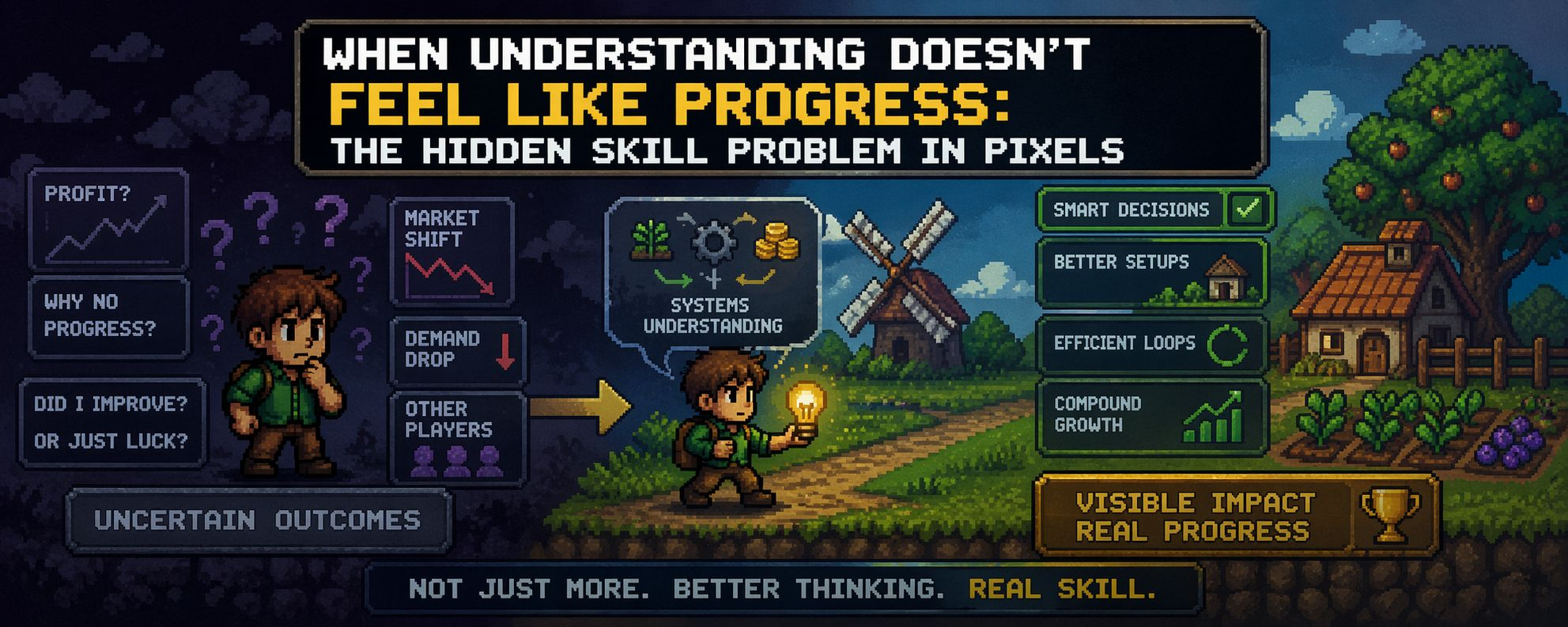
There’s something slightly uncomfortable about how Pixels handles improvement. Not because it lacks depth, but because it refuses to make that depth obvious in the way most players expect.
If you spend enough time in the system, you start to notice patterns. Certain production paths quietly outperform others. Timing matters more than it looks. Some players seem to extract more value from the same tools, even without dramatically better assets. So yes, there is clearly a layer where understanding the system leads to better outcomes.
But the part that doesn’t sit cleanly is this: the game rarely stops to show you that you’re getting better.
In more traditional games, improvement has a kind of immediate feedback. You dodge faster, aim cleaner, react quicker. The result feels earned in the moment. Pixels replaces that with something slower and less direct. You adjust your process, maybe reorganize your workflow, maybe rethink how you use your land or someone else’s. Then you wait. And when results come, they’re mixed with everything else happening in the economy.
That delay changes how improvement feels.
Because now, even when you make a smart decision, you’re never fully sure if the outcome belongs to you. Maybe it does. Or maybe prices shifted. Maybe demand dropped. Maybe another group of players discovered the same strategy at the same time. The system doesn’t separate your contribution from the noise very clearly.
And over time, that starts to matter more than it should.
It’s not that players need constant rewards. But they do need a sense that their thinking is making a difference. Without that, optimization starts to feel like guesswork dressed up as strategy. You can still engage with it, even enjoy it, but it doesn’t quite build that internal momentum where you feel yourself improving in a meaningful way.
What Pixels does well, though, is create space for a different kind of skill. It’s not about execution. It’s about reading the system. Understanding how different loops connect. Recognizing when something that looks profitable isn’t sustainable. Seeing where effort actually compounds and where it just keeps you busy.
That’s not a shallow layer. In fact, it’s probably one of the more interesting parts of the game.
But it stays hidden too often.
Take the sharecropping dynamic, for example. On paper, it’s a clever structure. Land owners build infrastructure. Other players bring time and effort. The output gets split. Simple idea, but with real implications. Not all land is equal. Not all setups are efficient. Some environments quietly produce more value than others.
A player who learns to identify better setups, or understands how to work within them more effectively, is absolutely improving. But again, that improvement isn’t always visible in a clean way. It blends into broader economic outcomes. So instead of feeling like “I made a better decision,” it often feels like “this happened to work out.”
That subtle difference affects how people engage with the system.
Because if improvement feels uncertain, players start leaning on what is certain. Assets. Scale. Access. Things that produce consistent advantages regardless of how well you understand the mechanics. And once that shift happens, skill doesn’t disappear, but it becomes secondary in how players think about progression.
That’s where the tension sits.
Pixels isn’t missing depth. If anything, it has more layered decision-making than most games in this space. The issue is that those layers don’t always translate into a clear personal experience of getting better. And without that, progression starts to feel external rather than internal.
Still, there’s something worth paying attention to here.
If Pixels finds a way to make system understanding more visible—if it can show players that their decisions are shaping outcomes in ways that are hard to confuse with luck or capital—it could land somewhere interesting. Not a traditional skill loop, but something quieter. A form of progression where players feel smarter over time, not just richer.
Right now, it’s close. You can sense it under the surface.
But sensing something isn’t the same as feeling it. And until that gap closes, the question isn’t whether skill exists in Pixels.
It’s whether players actually experience it as their own.