

For a long time, crypto gaming has had one big problem that a lot of people did not want to say out loud.
A lot of these games were never really games.
They were reward systems dressed up as games. You clicked, farmed, repeated tasks, collected tokens, and hoped you could cash out before the economy started breaking. That was the loop. Not fun, not immersion, not real attachment, just extraction with better branding.
That is why Pixels gets more attention than most projects in this space.
It feels different. Not perfect, not proven, but different. It looks more like an actual game people might want to spend time in, instead of a token machine with pixel art on top. And that is exactly why the staking question matters.
Because staking is not just some side feature. It changes behavior. Quietly, but in a very real way.
And the real question is not just whether staking helps the token. The real question is whether it helps the game world feel stronger, or whether it slowly pushes players back into the same old crypto habit of optimizing for extraction.
To be completely honest, that is the tension sitting at the center of Pixels.
Most crypto games do not fail because the idea of earning is bad. They fail because the gameplay is weak, and the economy ends up carrying everything.
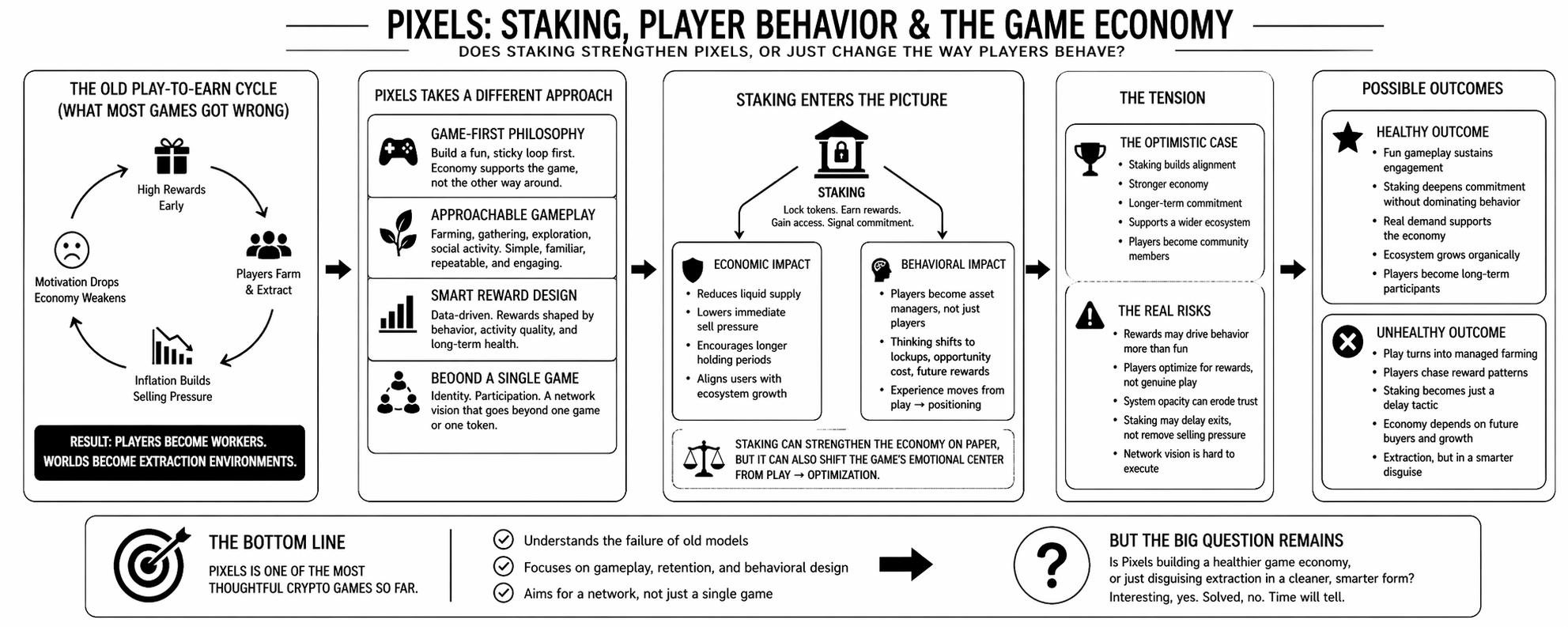
That usually leads to the same cycle. The game itself is not fun enough to hold attention, so players focus on farming. Rewards are too generous early on, inflation builds, people start dumping what they earn, and new users are expected to absorb the pressure. Eventually the economy weakens, motivation drops, and the whole thing starts feeling empty.
At that point, nobody is really playing. They are calculating.
That has been the real disease inside play-to-earn for years. It turns players into workers, and it turns game worlds into extraction environments. Instead of asking, “is this fun?” people start asking, “is this still worth it?”
Once that becomes the dominant mindset, things usually go downhill fast.
Pixels stands out because it seems to understand that if the game is not enjoyable on its own, the economy eventually collapses under its own weight.
That is already a smarter starting point than what most Web3 games had.
The game is simple, but that simplicity works in its favor. Farming, gathering, exploration, social activity, none of this is revolutionary on its own, but it is approachable. It has rhythm. It has familiarity. More importantly, it gives people a reason to show up that is not purely financial.
That is a real strength.
Because if people are there for the loop itself, then the token becomes an enhancement, not the entire reason the system exists. That is already healthier than the usual model where the token is carrying a weak game on its back.
But there is still a catch.
Even when a game starts with a game-first philosophy, stronger financial layers can slowly reshape the culture around it. A fun game can still become a farming environment if the incentives get heavy enough. People go where the rewards point them. They always do.
So yes, Pixels is different, but different does not automatically mean safe.
One of the better things about Pixels is that it seems to understand sequencing. Most crypto games launch with token logic first and gameplay second. Pixels seems to be trying the opposite. Build a sticky loop first. Build habits first. Build community first. Then let the economy sit on top of that.
That is the right instinct.
Because a real game economy cannot survive if the economy comes before the reason anyone would want to be there in the first place.
But here is the uncomfortable part. Once staking enters the picture, the vibe starts to change.
Now players are not just planting crops, exploring, or participating casually. They are also thinking about lockups, utility, opportunity cost, future rewards, maybe status, maybe access, maybe upside. The behavior becomes more strategic.
And that is where the line starts to blur.
Staking can absolutely make the economy look stronger. It reduces liquid supply, encourages commitment, and gives holders a reason not to dump immediately. On paper, that sounds healthy.
But behaviorally, it can shift the experience away from play and toward positioning.
That is the part people often miss.
A player who stakes is no longer just enjoying the game. They are now managing an asset. Watching value. Thinking ahead. Trying to optimize outcomes. That does not kill the game instantly, but it does quietly change the emotional center of participation.
Instead of “I’m here because I like being here,” it can become “I’m here because I have exposure here.”
That is a very crypto sentence.
Another thing Pixels seems to do better than most projects is reward design.
Older play-to-earn models were blunt instruments. They handed out rewards too freely, got farmed to death, and then acted shocked when the token came under pressure. Pixels looks much more aware of that problem. It seems more focused on player data, activity patterns, and behavioral signals to decide how rewards should work.
That is honestly one of the more mature parts of the project.
Because if you can identify bad farming behavior, sybil activity, low-value loops, or shallow engagement, then at least you have a chance to protect the economy from being drained too easily. That is not a small improvement.
But there is another side to it.
When rewards are shaped by behavioral data, players eventually start trying to decode the system. They stop simply playing and start performing what they think the system wants. They chase the pattern behind the rewards.
That creates a new type of farming.
Not the old obvious kind where everybody just repeats the same tasks for tokens. A more polished version. A more adaptive version. Players begin optimizing for reward qualification rather than genuine play.
And that can get weird fast.
Because then the game is no longer just a world. It becomes a behavior filter. A test. A scoreboard players cannot fully see. People start asking what counts as good activity, what gets rewarded, what gets ignored, what the system is trying to encourage.
That kind of opacity may help control abuse, but it can also make the economy feel managed instead of alive.
And in crypto, once people feel that the rules are being adjusted too much behind the curtain, trust gets fragile very quickly.
Then there is the bigger idea behind Pixels, which might be the most important part of the whole story.
It seems to be aiming for something larger than a single game.
Not just “play this and earn,” but “enter this ecosystem, build identity here, participate here, and maybe move across a wider network over time.” That is a much stronger ambition. And honestly, it is probably the only way something like this has a real shot at lasting.
Because one game, one token, one reward loop is usually not enough.
If Pixels can become a network, not just a game, then staking starts to mean something different too. It is no longer only about supporting one in-game economy. It becomes part of a wider system of access, alignment, participation, and ecosystem loyalty.
That is the optimistic case.
The more serious version of Pixels is not just a cute Web3 farming game. It is a live user network with tokenized coordination and distribution power.
That is a much more compelling idea.
But it sounds good on paper, and execution is the whole game here.
Turning a game into a network is hard. Keeping users engaged across products is hard. Building real demand that is not just speculative is hard. A lot of projects talk about ecosystems when what they really have is one product and a lot of ambition.
So yes, the flywheel is promising. But it still has to become real in a durable way, not just in theory.
And this is where the old crypto problem comes back.
No matter how thoughtful the design is, no matter how much better Pixels looks compared to the average crypto game, the token still carries the same pressure every game token carries.
That part has not disappeared.
If too many users are earning with the intention of eventually selling, then the system needs a constant stream of demand to absorb that pressure. Otherwise, cracks start showing.
That is why staking gets presented as such an important mechanic. It can reduce immediate sell pressure. It can encourage longer holding periods. It can give users more reasons to stay aligned with the ecosystem.
And yes, that helps.
But staking does not magically solve weak foundations. It mostly changes timing.
It can delay selling. It can reshape incentives. It can create stronger attachment among some users. But if the token still depends too heavily on future buyers, future growth, or continued belief, then staking may be stabilizing the surface more than fixing the structure underneath.
That is why I keep coming back to behavior.
Because token design is never just token design. It is human design.
What are people being trained to do here?
Are they being encouraged to participate more deeply in the world, build longer-term identity, and contribute to a stronger network? Or are they being gently pushed into becoming more efficient economic actors inside a prettier system?
Those are two very different futures.
And that is why Pixels is genuinely interesting.
I do think it understands the failure of earlier crypto games better than most of the market. It seems more aware of how destructive inflationary rewards can be. It seems more serious about retention, behavioral design, and ecosystem thinking. It feels less naive than the first wave of play-to-earn projects.
That should be acknowledged.
At the same time, understanding the problem is not the same thing as escaping it.
Pixels may be replacing the crude version of extraction with a more refined one. A smarter one. A more sustainable-looking one. Instead of obvious overfarming, you get managed incentives. Instead of instant dumping, you get staking. Instead of one game loop, you get a network narrative.
That does not mean it is fake. It just means the same structural questions still matter.
Is the economy generating real demand, or mainly organizing internal incentives more efficiently?
Are players becoming community members, or just more sophisticated yield participants?
Is staking building alignment, or just slowing the exit queue?
Those are not anti-Pixels questions. They are the only serious questions worth asking.
My view is pretty simple.
Pixels is one of the more intelligent attempts to rethink crypto gaming. Not because it has solved everything. It clearly has not. But because it seems to understand that the old model was broken at a behavioral level, not just a tokenomic one. It knows that boring gameplay, inflationary rewards, and constant dumping create hollow ecosystems. It is trying to build something more layered than that.
And to be fair, there is real promise in that.
But the execution risk is still high. The token still needs to prove it can handle pressure. The staking model still needs to prove it strengthens commitment without quietly financializing the whole player experience. And the network vision still needs to prove it is more than a smart idea.
So the conclusion is not that Pixels has cracked the code.
It is that Pixels is interesting because it looks like it might be evolving past the worst version of play-to-earn.
But whether it is truly building a healthier game economy, or just disguising extraction in a cleaner, smarter form, is still an open question.
Interesting, yes. Solved, no. Time will tell.
