
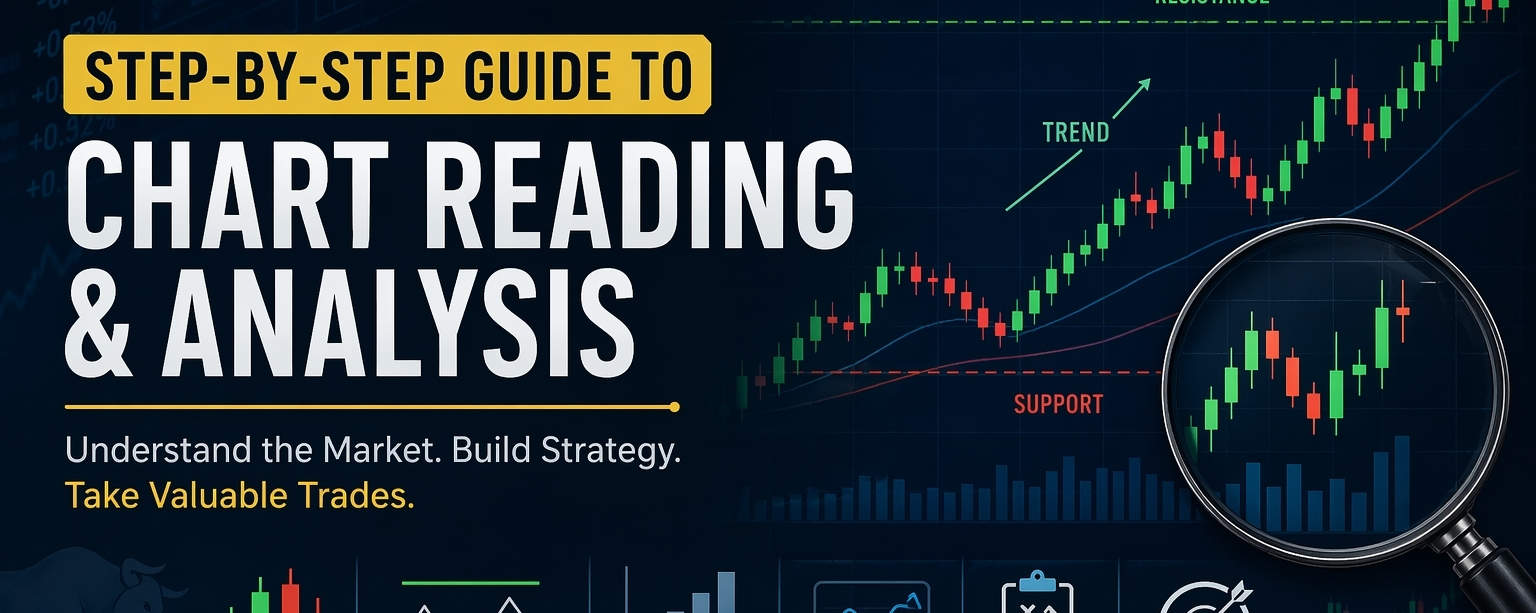
Introduction: Why Chart Reading Matters
Chart reading is one of the most essential skills in trading, whether you are involved in stocks, forex, or cryptocurrency markets. It allows traders to understand price movements, identify trends, and make informed decisions instead of relying on guesswork.
Without proper chart analysis, trading becomes more like gambling. Charts provide a visual representation of market psychology—showing how buyers and sellers interact over time. Learning to read charts effectively can significantly improve consistency and reduce unnecessary losses.
Step 1: Understanding the Basics of a Chart
Before diving into strategies, it’s important to understand what a chart represents.
Price: The current value of an asset
Timeframe: The period each candle or bar represents (e.g., 1 min, 5 min, 1 hour, daily)
Candlesticks: Show open, high, low, and close prices
Each candlestick tells a story:
Green (or bullish) candle → price increased
Red (or bearish) candle → price decreased
Understanding these basics helps you interpret market behavior more clearly.
Step 2: Identifying Trends
The market generally moves in three types of trends:
Uptrend → Higher highs and higher lows
Downtrend → Lower highs and lower lows
Sideways (Range) → Price moves within a fixed range
Trend identification is crucial because:
“The trend is your friend.”
Trading with the trend increases the probability of success.
Step 3: Support and Resistance
These are key levels where price reacts repeatedly:
Support → A level where price tends to stop falling
Resistance → A level where price tends to stop rising
Why they matter:
They help identify entry and exit points
They indicate potential reversals or breakouts
Strong support/resistance levels often act as decision zones for traders.
Step 4: Volume Analysis
Volume shows the strength behind a price move.
High volume + price movement → Strong move
Low volume + price movement → Weak move
For example:
Breakout with high volume → More reliable
Breakout with low volume → May be fake
Step 5: Using Indicators (Optional but Helpful)
Indicators can support your analysis, but should not be overused.
Common indicators:
Moving Averages (for trend direction)
RSI (Relative Strength Index for overbought/oversold conditions)
MACD (for momentum and trend changes)
Remember:
Indicators are tools, not guarantees.
Step 6: Building a Trading Strategy
A strategy gives structure to your trading. It defines:
When to enter a trade
When to exit
Risk management rules
Example of a simple strategy:
Identify trend (uptrend)
Wait for price to come near support
Confirm with indicator (e.g., RSI oversold)
Enter trade
Set stop loss below support
Set target near resistance
Consistency in following a strategy is more important than constantly changing it.
Step 7: What Makes a Valuable Trade?
A valuable trade is not just about profit—it’s about quality.
Key characteristics:
Clear setup (trend + support/resistance)
Proper risk-reward ratio (at least 1:2)
Confirmation from volume or indicators
Controlled risk (never risking too much capital)
Avoid:
Emotional trades
Overtrading
Trading without a plan
A good trader focuses on high-probability setups, not frequent trades.
Conclusion
Chart reading is the foundation of successful trading. By understanding price action, trends, and key levels, traders can make informed decisions rather than emotional ones.
To summarize:
Charts help you understand the market
Strategy gives you discipline
Valuable trades come from patience and proper analysis
Trading is a skill that improves with practice. The more time you spend analyzing charts, the better your decision-making will become.