
I was talking to a friend about Pixels a few days ago, and I realized I couldn’t explain it in a simple way.
Not because it’s complicated, but because it doesn’t behave the way you expect. On the surface, it feels like a very normal game. You log in, do a few things, earn Coins, and leave. Nothing feels blocked. Nothing feels forced.
And honestly, for a while, that’s all I thought it was.
Just a clean, simple loop that works.
But after spending more time inside it, I started noticing small things that didn’t fully add up. Not in a bad way, just… things that made me pause a little.
The first thing was how time behaves.
Some actions move quickly, others take longer than expected. Not slow enough to frustrate you, but just enough to make you aware that you’re waiting. At first, I ignored it. It felt like normal game pacing.
But then I noticed how often I had a choice in those moments.
Wait it out… or do something about it.
That’s usually where PIXEL shows up. Not everywhere, not constantly, just in those specific points where time starts to matter more than usual. And what’s interesting is that the game never pushes you toward it. It just sits there as an option.
That made it harder to notice at first.
Because most of the game doesn’t depend on it.
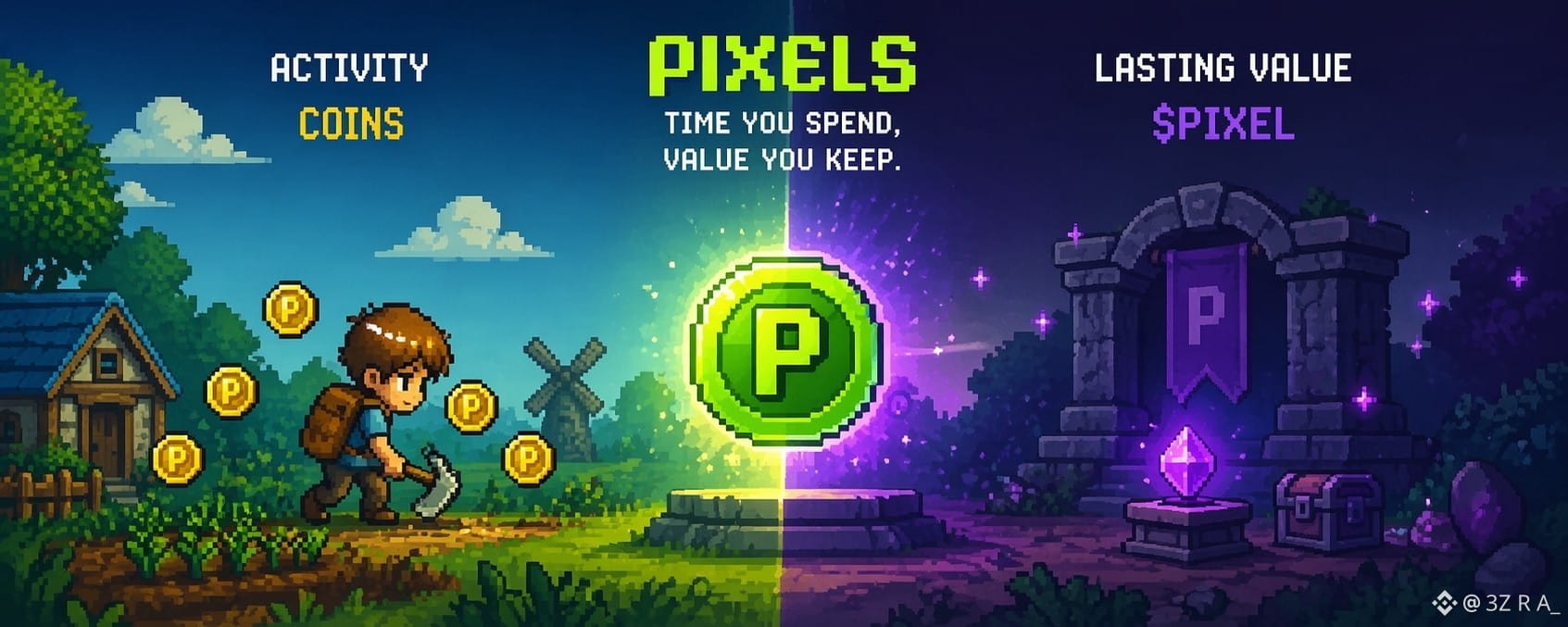
Coins handle almost everything you do daily. You earn them, spend them, repeat. It’s a very active loop. You’re always doing something, always progressing in some way. And for many players, that’s enough. They stay inside that loop and never really feel the need to step outside of it.
But the more I paid attention, the more it felt like Coins are tied to movement, not memory.
They keep the system active, but they don’t really hold value beyond the moment they’re used.
PIXEL feels different.
It doesn’t appear often, but when it does, it’s usually connected to something that lasts a bit longer. Something that doesn’t reset as easily. And that’s where the system starts to feel layered, even if it doesn’t openly say it.
Two players can spend the same amount of time in Pixels.
Same effort, same routines, same consistency.
But over time, their outcomes might start to look slightly different.
One player stays fully inside the Coin loop. Always active, always moving, but mostly within a cycle that keeps refreshing itself.
The other player steps into PIXEL occasionally. Not all the time, not aggressively, just at certain moments where they decide to lock in progress or move differently.
At first, there’s no visible difference.
That’s what makes it interesting.
It builds slowly. Small decisions that don’t feel important in the moment start to stack over time. And after a while, the gap becomes noticeable, even if you can’t point to a single moment where it happened.
That’s the part I find myself thinking about the most.
It’s not about how much time you spend in the game.
It’s about where that time is being applied.
And I’m not completely sure how many players actually see it that way.
Most people don’t think in layers when they’re playing. They just follow what feels natural. If the basic loop works, they stay there. If the deeper layer isn’t obvious, they might never really interact with it in a meaningful way.
And if that happens, then PIXEL exists… but not as part of the majority experience.
At the same time, the system itself doesn’t slow down. Tokens exist, supply moves, and the structure keeps evolving whether players fully engage with it or not.
That creates a bit of tension.
Because now the question isn’t just about design, it’s about alignment.
Are players naturally moving toward the parts of the system that give PIXEL value, or are they staying in the simpler loop where it doesn’t matter as much?
I don’t think there’s a clear answer yet.
What I do find interesting is that Pixels doesn’t force this realization. You can play for a long time without ever thinking about any of this. The experience stays smooth, uninterrupted, and easy to return to.
From the outside, it still looks like a free and open system.
And in many ways, it is.
But after spending more time with it, it doesn’t feel completely flat. It feels layered, with different types of value being created in different parts of the experience.
And depending on how a player moves through those parts, the same time spent inside the game might not mean the same thing at all.
I’m still trying to figure out if that’s intentional…
or just something that slowly emerges as you keep playing.