
It shows up in small ways. A message you haven’t replied to yet. A task you left halfway. A subscription you forgot to cancel but keep “meaning to use.” Nothing urgent, nothing forceful. Just a quiet reminder sitting somewhere in the back of your mind, asking you to come back and finish what you started.

You don’t feel controlled. You feel slightly incomplete.
That same pattern shows up in systems like Pixels.
From a distance, the Pixels game presents itself as something simple. A farming loop, a light Web3 gaming experience, a place to grow, craft, and interact. But when you step back from the surface and look at its structure, it begins to resemble something more deliberate.
At its core, Pixels is not really about farming.
It is about scheduled return.
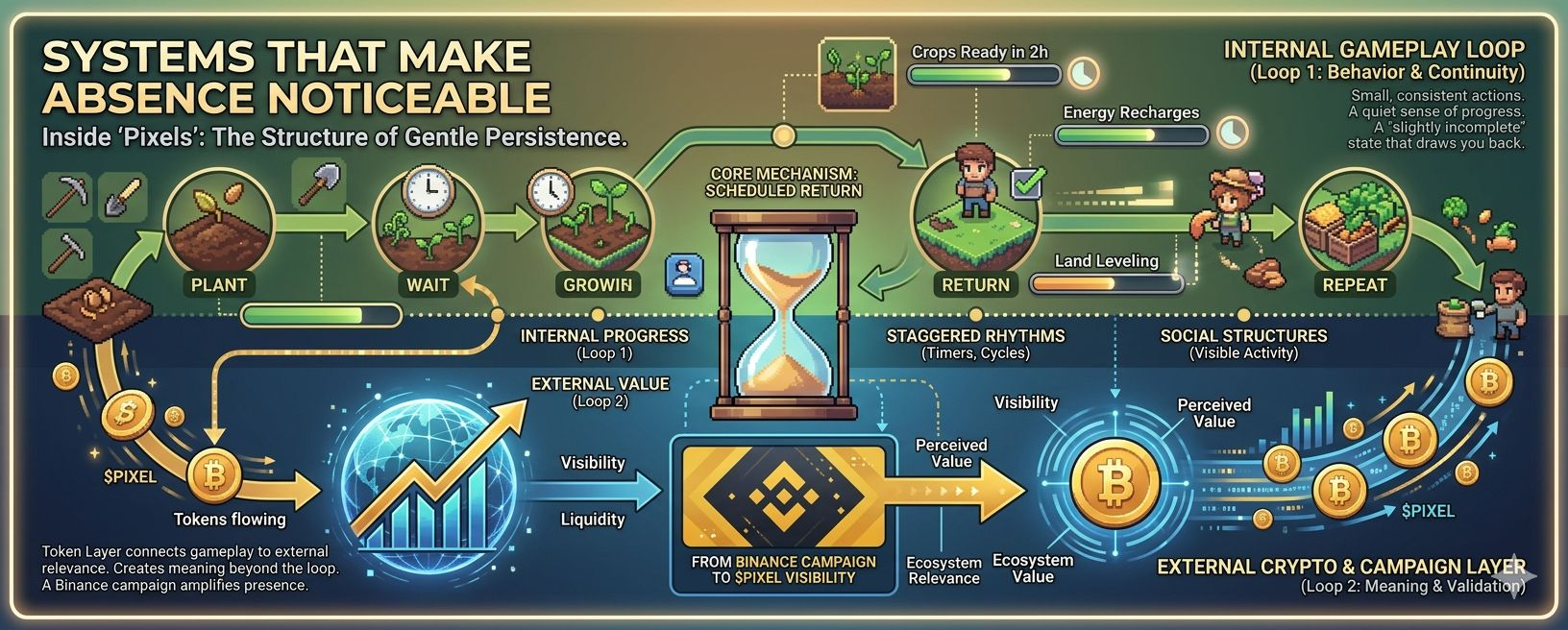
The entire system revolves around a loop that appears harmless on its own: plant, wait, return, collect, repeat. There’s no urgency built into any single step. The waiting period feels natural, almost relaxing. But that waiting is not just a gap between actions.
It is the mechanism.
The delay creates a reason to come back. The unfinished state lingers quietly in the background. Not enough to create pressure, but enough to remain present. Over time, the system doesn’t need to demand attention. It simply ensures that attention drifts back on its own.
This is where Pixels begins to separate itself from many other Web3 gaming environments.
There isn’t just one loop operating here. There are two, running in parallel.
The first loop is internal. It’s the gameplay layer — farming, crafting, progression, land management. This loop keeps the system alive. It provides structure, direction, and a sense of ongoing activity. It’s where users spend their time, make small decisions, and feel incremental progress.
The second loop exists outside the immediate gameplay. This is where $PIXEL and the broader crypto ecosystem come into play, particularly within the context of a Binance campaign. This layer connects the internal activity to something external — visibility, liquidity, and perceived relevance beyond the game itself.
One loop sustains behavior.
The other sustains meaning.
Without the first, there’s nothing to return to. Without the second, there’s nothing that extends beyond the system. Together, they create a closed environment that feels both self-contained and externally validated at the same time.
This dual structure is subtle, but important.
It explains why engagement doesn’t rely on intensity. There’s no need for constant excitement or high-stakes interaction. The system works through continuity instead. Small actions, repeated over time, supported by a token layer that keeps the activity anchored within a broader crypto narrative.
And then there’s the layering.
Timers are the most visible element, but they’re not the only one. Progress bars, resource cycles, and upgrade paths all operate on slightly different timelines. None of them demand immediate attention, but together they create a staggered rhythm. Something is always in progress. Something is always about to complete.
Social structures add another dimension. Shared land, guild interactions, and visible activity from other participants create a sense that the system continues even when you’re not actively present. It doesn’t create urgency, but it does create awareness.
You’re not required to return.
But the system makes absence noticeable.
This is where the design becomes more interesting.
Individually, each component feels neutral. A timer is just a timer. A reward is just a reward. A token is just a unit of value. But when combined, they form a structure that gently aligns behavior over time. Not through force, but through consistency.
The Binance campaign layer amplifies this effect. It introduces moments where external attention converges on the system. Visibility increases. Activity feels more significant. The internal loop remains the same, but the external context shifts, reinforcing the idea that what happens inside the system has weight outside of it.
This doesn’t change the mechanics.
It changes the perception of those mechanics.
And that’s where a quieter question begins to form.
At what point does returning stop being a simple choice and start becoming a pattern?
There’s no clear line. No moment where the system changes its nature. The actions remain the same — log in, collect, replant, continue. But over time, the reason for returning becomes less about any single decision and more about maintaining continuity.
Not returning doesn’t break anything.
But it interrupts something that was already in motion.
That distinction matters.
To be clear, none of this implies that the system is flawed. In many ways, it reflects a strong understanding of design. The structure is accessible. The pacing is manageable. The loops are easy to understand without being overly simplified. Compared to many Web3 gaming projects that prioritize complexity or short-term hype, Pixels takes a more measured approach.
It doesn’t overwhelm users with mechanics.
It organizes behavior through repetition.
That alone sets it apart in a space where many crypto ecosystem experiments struggle to retain attention beyond initial curiosity. Most systems chase spikes — sudden growth, rapid engagement, temporary excitement. Few focus on what happens after that initial moment fades.
Pixels, by contrast, leans into persistence.
But persistence has its own trade-offs.
When engagement is built on repeated cycles, there’s always a risk that activity becomes passive. Actions are performed not because they’re actively chosen each time, but because they fit into an existing pattern. The system doesn’t lose users abruptly. It slowly absorbs them into a routine.
Again, this isn’t inherently negative.
It’s structural.
The system does exactly what it’s designed to do.
And in the broader context of Web3 gaming, this raises a larger observation. As projects evolve, the focus is gradually shifting away from pure novelty and toward behavioral design. It’s no longer just about what users can do, but about how often they return, how long they stay, and how seamlessly their activity connects to external value layers like tokens and exchange visibility.
Pixels is part of that shift.
Not as an outlier, but as an example of where the space is heading.
It shows what happens when gameplay loops and token ecosystems are aligned in a way that doesn’t rely on intensity or speculation alone. Instead, it builds a system where engagement is steady, almost quiet, reinforced by both internal structure and external context.
And that brings everything back to where it started.
Systems don’t always need to demand attention to hold it. Sometimes, they just need to create a state where leaving feels slightly incomplete.
The system doesn’t force participation.
It simply makes absence feel noticeable.