
I have spent enough time reading @Pixels whitepapers and watching the inevitable collapse of play-to-earn game economies to be naturally skeptical whenever a new model is introduced. The pattern is almost always the same. A token launches, players flood in to extract as much value as possible, and the economy inevitably enters a death spiral because there is no sustainable sink for the rewards.
So when I started looking into Pixels and what they are building with the Stacked ecosystem, my initial reaction was hesitation. It just sounded like another attempt to delay the inevitable. But as I spent more time reading through their documentation and looking at the actual smart contract architecture, my perspective started to shift. I realized they are not just trying to build another farming game, but are actively reverse-engineering the failed models of the past to build a live infrastructure.
What really caught my attention is how they handle the technical friction of reward distribution. In most Web3 games, rewarding players is a blunt instrument. Everyone gets the same tasks and the same payouts, which is exactly what attracts bot farms and drains the treasury. Stacked changes this by using what they call an AI Game Economist. This isn't just a buzzword thrown into a pitch deck. It is an actual data modeling layer that analyzes player cohorts to understand why people drop off and how to retain high-value users, or whales. By leveraging machine learning, it identifies genuine players based on how they actually play, matching specific tasks and rewards to their behavior. This means transparent, targeted distribution where real value is given out for actual engagement, bypassing the generic spam quests that ruin economies.
Seeing this operate in a live environment fundamentally changes how I view user acquisition in this space. Instead of throwing massive marketing budgets at traditional ad platforms where a huge percentage is lost to fraud or temporary views, Stacked redirects that ad spend directly into the pockets of the actual players. As someone analyzing these systems, this simply makes more economic sense. It turns marketing spend into a direct liquidity injection for the community, rewarding the people who actually keep the ecosystem alive.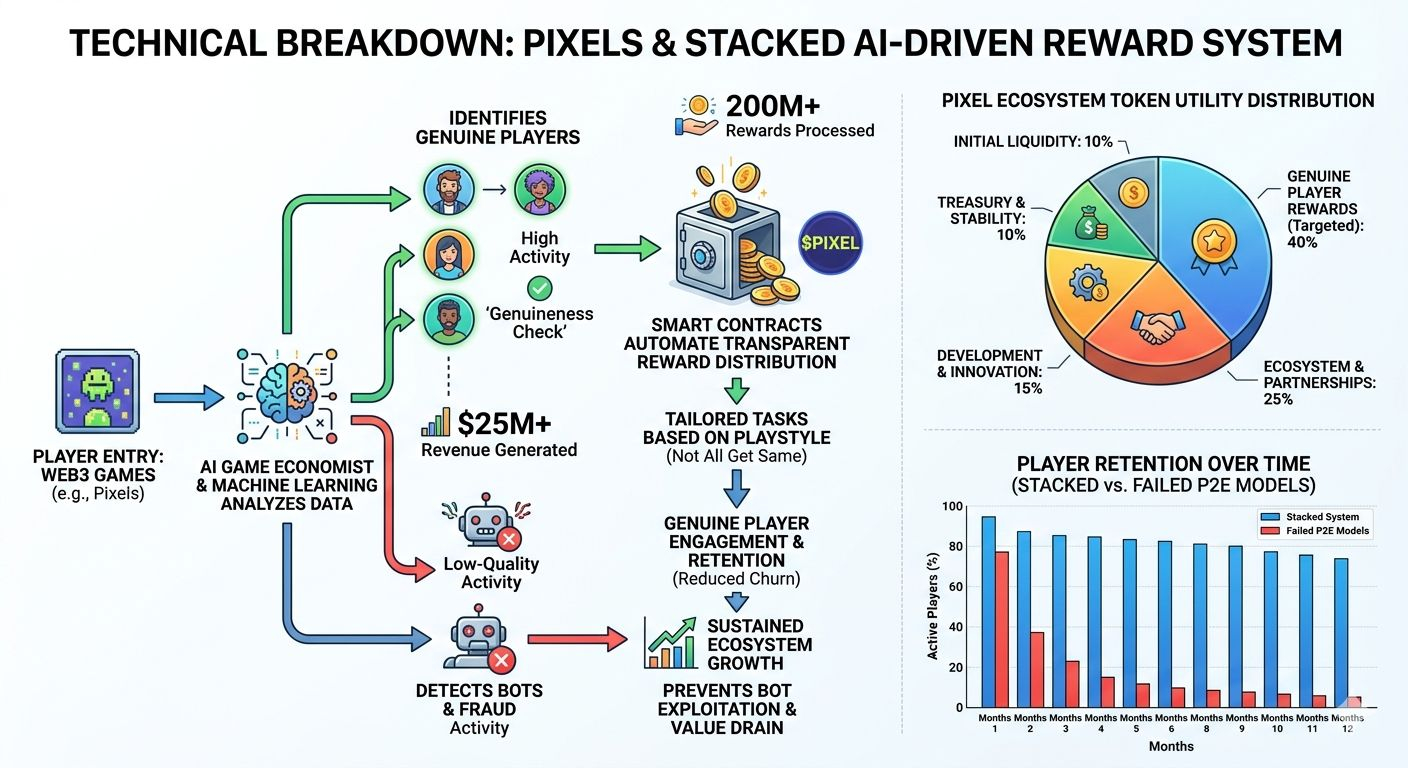
I have to be realistic, though. This is not some flawless magic fix. Balancing game economies is notoriously difficult, and the introduction of machine learning does not completely remove human error. If the external studios plugging into this infrastructure fail to configure the AI tools correctly, or if they misjudge their reward emission rates, their specific economies can still bleed out. The smart contracts can execute transparently, but they only follow the rules they are given. It takes a lot of active monitoring to keep these systems stable over time.
Despite those risks, the transition of the PIXEL token from a single-game currency to a B2B cross-ecosystem loyalty layer is what makes this an interesting study. Its survival is no longer tied strictly to the popularity of one farming game. With over two hundred million rewards already processed and over twenty-five million in revenue generated, this is infrastructure being built and tested in production.
My current mindset is to just watch how this plays out over the next few quarters. I want to observe how external studios adopt this LiveOps engine and see if it actually improves player lifetime value over a multi-month period. Ultimately, real usage and verifiable on-chain metrics matter a lot more than marketing narratives, and seeing a project prioritize a built in production approach over pure hype is refreshing.
