Most Web3 games talk about ownership, rewards, and progression, but one thing I used to overlook was how little attention is given to coordination between players. You can have a well-designed system on paper, but if players aren’t meaningfully connected, everything still feels fragmented.
Even in multiplayer environments, it often feels like individuals are simply operating side by side rather than together. That’s what started to stand out to me when I looked deeper into Pixels. It’s not just about what you do individually—it’s about how your actions fit into what others are doing at the same time.
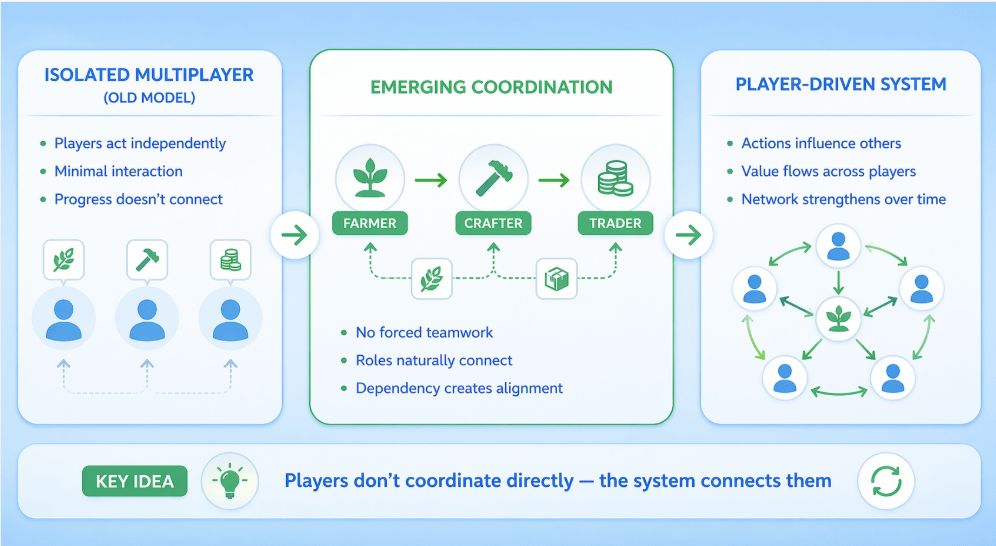
I used to think multiplayer in most Web3 games was just proximity. Players exist in the same world, maybe trade occasionally, maybe interact lightly, but fundamentally everyone is still operating in isolation.
Your progress doesn’t really depend on others, and theirs doesn’t depend on you. So even in a shared world, it doesn’t always feel truly shared. But @Pixels seems to introduce something more subtle—coordination that emerges naturally through dependency rather than being forced through explicit mechanics.
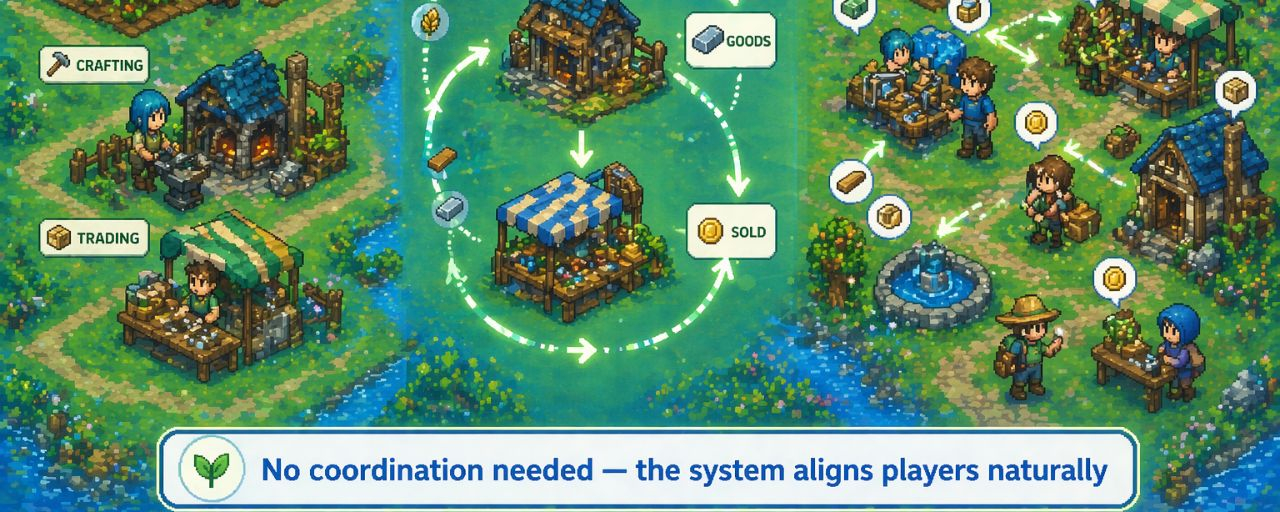
Instead of requiring players to work together directly, the system creates conditions where players begin to align with each other organically. A farmer produces resources, a crafter transforms them, and a trader moves them across the market. None of these players are instructed to cooperate, yet their actions start to connect in meaningful ways.
The farmer depends on demand created by crafters, the crafter depends on supply from farmers, and the trader depends on both to create movement. Without any direct coordination, a network begins to form.
That’s what makes this dynamic interesting. It doesn’t feel forced or artificial—it feels like a natural outcome of how the system is structured. Coordination becomes embedded in the design rather than layered on top of it. And because of that, it changes how players think about their role within the ecosystem.
Instead of focusing only on what they can earn individually, players start to consider where they fit. Where is demand right now? Where is supply lacking? How can their actions connect with what others are already doing?
This shift in thinking leads to a different kind of efficiency. When players align themselves with the needs of the system, their actions become more valuable. Producing the right resource at the right time has more impact than simply producing more. Trading in active areas becomes more meaningful than trading everywhere.
Positioning begins to matter as much as effort, and outcomes start to reflect how well a player understands the flow of the system rather than just how much time they invest.
What stands out even more is how this kind of coordination scales. In systems that rely on direct collaboration, growth often introduces complexity. More players mean more communication, more friction, and more chances for things to break down. But in a system where coordination emerges naturally, growth can actually strengthen the structure.
More players don’t just add noise—they add connections. And those connections create more pathways for value to move.
Of course, this doesn’t mean the system is perfect. Coordination without communication can still lead to imbalances. Players might overproduce certain resources, demand might shift unexpectedly, and not everyone will engage with the system in the same way. These fluctuations are part of any dynamic environment. But even with those imperfections, the underlying structure remains interesting because it allows interaction to happen without forcing it.
Looking at it now, I don’t see Pixels as a game where players simply coexist in the same space. It feels more like a system where players are constantly influencing each other, even if they’re not directly interacting. Every action feeds into something larger, creating ripple effects that shape the overall experience. And that raises an interesting question.
If coordination can emerge without being explicitly designed as cooperation, does that make the system more scalable, or does it introduce a level of complexity that only some players will fully understand?