
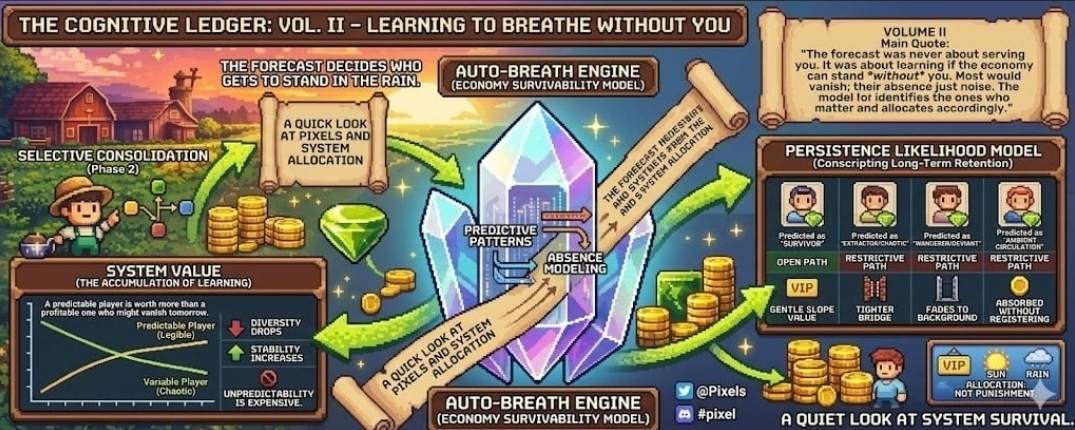
Yesterday I wrote about prediction. How Pixels isn't just recording what you do, but quietly building a model of what you're likely to do next. The system learns your patterns. The path smooths. The friction shifts. And over time, the version of you that deviates—the wanderer, the experimenter, the player who might do something unexpected—fades into the background, not because it's blocked, but because the forecast has already decided who you probably are.
But I keep turning that idea over, and something about it feels incomplete. Because the question it raises isn't just "what happens to the player being predicted?" It's "why does the system need to predict you at all?"
The obvious answer is efficiency. A system that knows what you'll do next can reduce friction. It can surface the right task at the right time. It can make the loop feel seamless. That's the user-experience framing. It's clean. It's comfortable. It lets us believe the model exists to serve the player.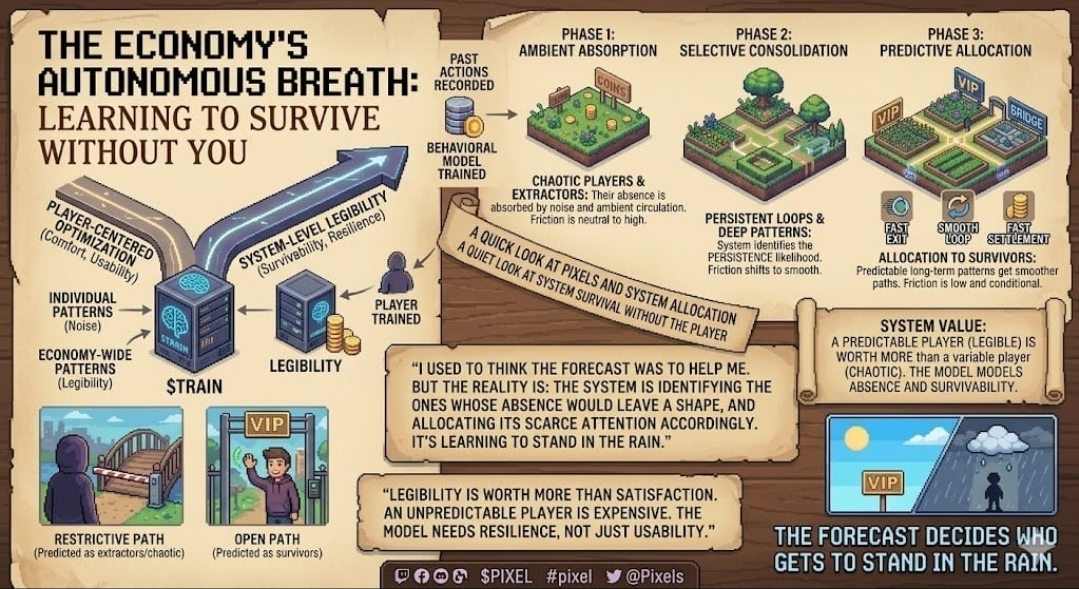
But Pixels has taught me to read comfort as a signal, not a destination. Every time the game has made something smoother—faster withdrawals for some, softer friction for others, rewards that align with established rhythms—it has also made the player more legible. And legibility, in an economy that nearly died from unpredictability, is worth more than satisfaction.
So I started asking a different question. Not "what does the model learn about me?" but "what does the model learn about the economy when I'm not there?"
This is the layer beneath the forecast. The system isn't just predicting individual behavior. It's modeling absence. Who logs in during a downturn? Who returns after a week away? Who keeps the soil alive when the market is red and the sprinters have moved on? Those patterns aren't about personalization. They're about survivability. The model isn't trying to know you. It's trying to know whether the economy can count on you when the pressure returns.
The blind signal problem taught Pixels that treating everyone equally breaks the system. The bridge taught us that exit is conditional. The VIP system taught us that spending now and earning back later creates a sunk-cost anchor. All of these are mechanisms for filtering. But filtering is just the first step. What happens after the filter is allocation.
A system with finite attention—finite rewards, finite friction tolerance, finite capacity to process value across the bridge—has to decide where to place its bets. Not just who gets to leave. Who gets the smoother loop. Who gets the faster settlement. Who gets the quiet nudge that keeps them logging in while others quietly churn. That's not prediction for the player's benefit. That's prediction for the system's survival.
And here's the part I can't stop thinking about: the more accurately the system models who will stay, the less it needs everyone to stay. It can afford to let the chaotic players drift. It can afford to lose the extractors. It can afford to tighten the bridge for those whose patterns don't match the shape of long-term retention. Not because it's punishing them. Because it's conserving itself for the ones who make the economy breathe even when the chart is flat.
This is where the forecast stops being about you and starts being about the version of the economy that exists without you. The model isn't asking "what will this player do next?" It's asking "if this player vanished tomorrow, would the system feel it?"
The uncomfortable truth is that most players wouldn't register. Their absence would be noise, absorbed by Coins, smoothed over by the ambient circulation of value that never tries to cross the bridge. The system is learning to identify the ones whose absence would leave a shape—and to allocate its scarce attention accordingly.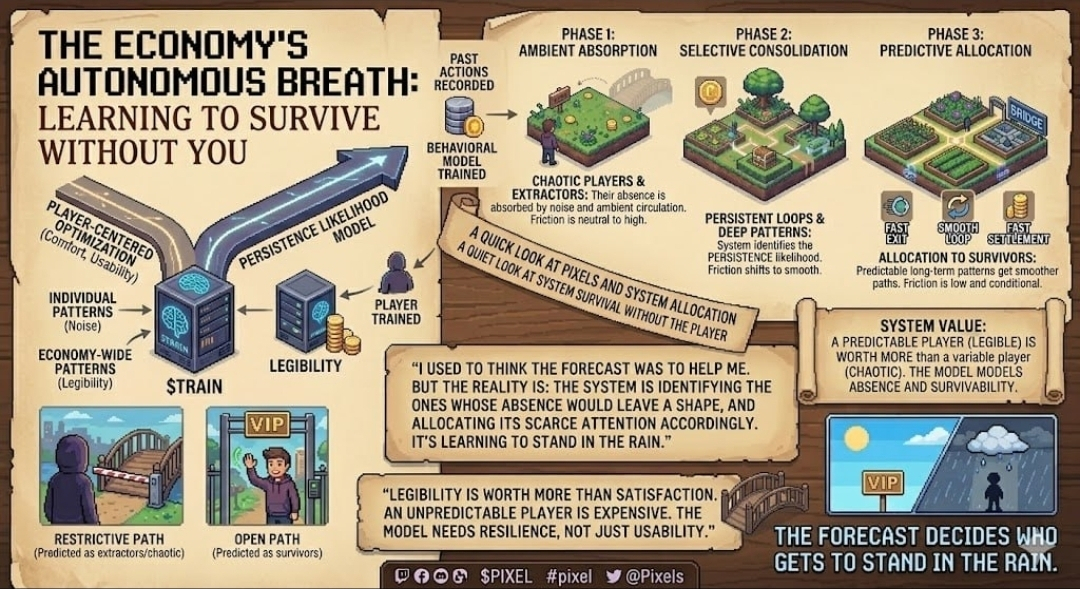
I don't think this is malicious. I think it's the only way a Web3 economy survives beyond the first growth cycle. You can't keep everyone. You can't reward everyone equally. You can't let everyone leave with value at the same rate. So you learn. You model. You forecast. Not to serve the player better. To serve the economy longer.
And the player, in this framing, becomes something stranger than a participant. They become a probability. A likelihood of persistence. A weight in a model that's constantly recalibrating who matters and who doesn't. The game doesn't tell you your weight. It just responds accordingly. Faster exits. Smoother loops. Less friction. Or the opposite. Not as punishment. As allocation.
Yesterday I wrote that the forecast shapes the weather. Today I think that's only half true. The forecast also decides who gets to stand in the rain.
I'm still watching. Not for what the system learns about me. For what it learns to live without.