

I’ve been noticing a small shift in how people talk about in game economies. Less excitement about “earning,” more curiosity about why some players keep earning while others stall out. The focus is moving away from rewards, toward the structure behind them.
That shift is where Pixels starts to make more sense to me.
Scarcity in Pixels isn’t something you discover by accident. It’s something you run into. Slowly at first, then all at once. Chapter 2 made that clear. It didn’t just expand the game. It tightened it.
At the beginning, the farming loop feels open. You plant, harvest, repeat. Resources flow easily. Tools work without much thought. It almost feels like the system is generous.
But that phase doesn’t last.
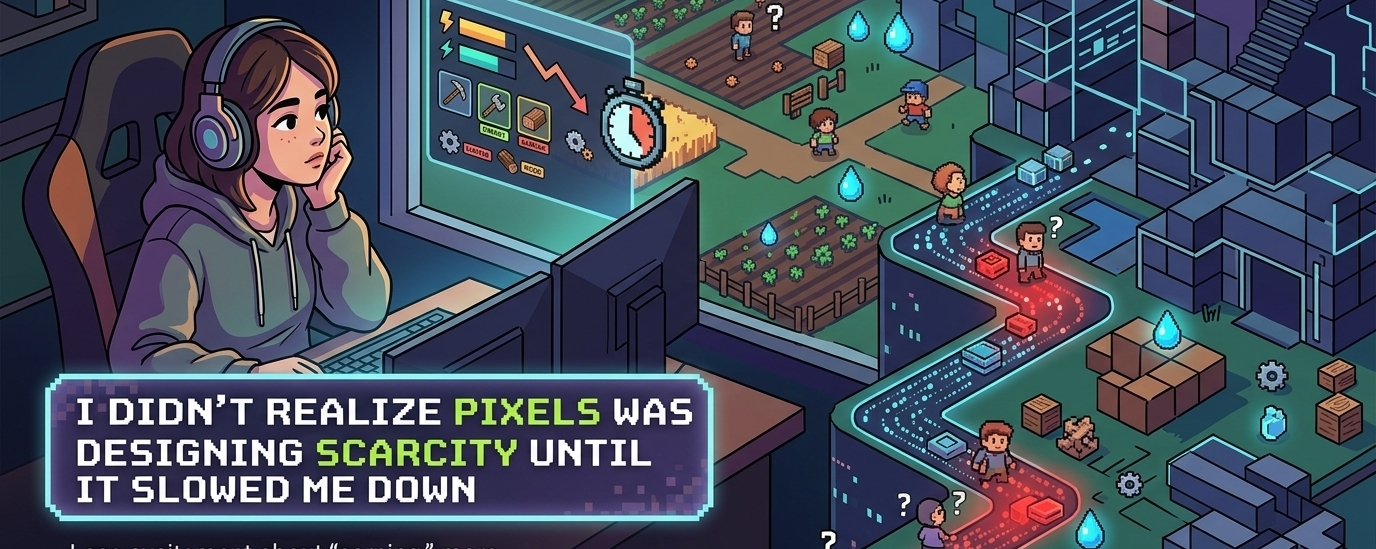
As you progress, friction shows up in specific places. Energy limits your actions. Tools degrade and need upgrades. Certain resources become harder to access. It’s not random. It’s placed.
That’s when it clicked for me scarcity here is designed.
And when scarcity is designed, it means someone is deciding how value moves inside the system. Not directly, but through constraints. Through timing. Through availability.
In Pixels, your time only has value because something else is limited.
Take resource gathering. Early on, everything you collect feels useful. Later, you realize some materials matter more than others. Some are bottlenecks. Those bottlenecks shape the economy more than the abundant items ever could.
The same applies to tools. The multi-level upgrade system isn’t just progression. It’s a filter. Players with better tools access better efficiency. That changes output, which changes supply, which feeds back into the market.
I don’t see this as a problem. I see it as control.
Land ownership adds another layer to that control. Owning land isn’t just about space. It’s about positioning yourself closer to certain loops. It affects how quickly you can act, how much you can produce, and who you interact with.
And then there is the social layer. Pixels doesn’t isolate players. It quietly pushes collaboration. Trading, sharing resources, coordinating actions all of it becomes more important as scarcity increases.
So the economy isn’t just player vs system. It’s player vs player dynamics shaped by system rules.
The PIXEL token sits in the middle of all this. It’s used for upgrades, for progression, for accessing better efficiency. But its value inside the game doesn’t come from hype. It comes from how necessary it becomes when friction increases.
That’s the nuance most people miss.
Scarcity doesn’t guarantee that PIXEL holds value. It just creates the conditions where it can. If demand inside the game weakens, or if players stop pushing into higher-efficiency loops, that support fades.
The integration with Ronin makes access easier. More players can enter. More liquidity can form. But that also raises a question I keep coming back to how much of the economy depends on new players arriving at the right time?
Because designed scarcity works well when there’s movement. When players are progressing, upgrading, competing. But if that movement slows, the same constraints that create value can start to feel restrictive.
I’ve felt that tension while playing.
There are moments where the system feels balanced. Where effort and reward line up. And then there are moments where it feels like you’re being slowed down on purpose. Not unfairly, but intentionally.
That intention is the core of Pixels.
Everything farming, crafting, upgrading, trading runs through a structure where resource flow is controlled. Not fixed, but adjusted. And every adjustment changes how players behave.
So when I think about $PIXEL, I don’t start with charts anymore.
I think about who controls the flow of resources. How often that flow changes. And whether players can adapt faster than the system evolves.
Because in a designed economy, value isn’t something you find. It’s something you’re allowed to reach under certain conditions.
The real question is whether those conditions stay stable long enough for players to trust them. Or if they shift just enough to keep everyone slightly off balance.