There is a particular moment in a long-running game economy when the mechanics of progression stop being additive and start being substitutive, and it is worth paying attention to when that moment arrives because it usually signals something about where the design pressure in the economy has shifted. In Pixels, that moment has a name. The Tier 5 update requires players who want to access the new crafting materials to feed their existing Tier 1 through Tier 4 industries back into what is now called the Deconstructor. The building that previously served a peripheral function has been renamed, expanded, and moved toward the centre of the progression loop. Players who built carefully through the earlier tiers now find that those earlier investments are no longer the foundation they are standing on. They are the fuel.
I want to think through what this kind of design choice means, because the surface framing and the underlying mechanics are not obviously in agreement, and the disagreement between them is where the more interesting question lives.
The stated purpose of this kind of mechanic in game economy design is what is usually called a sink. A sink is a mechanism that removes resources, items, or assets from circulation in order to prevent inflation, maintain scarcity, and keep progression meaningful over time. Without sinks, a long-running economy accumulates. Time in the economy compounds. Players who were already inside when the game was smaller have had years to accumulate, and the distance between them and anyone joining later has widened at roughly the same rate. Newer players arriving into that state find themselves entering an economy where the ground is already taken, and the sense that there is still room for them to build something of their own begins to thin. The economy becomes top-heavy, and eventually, it stops functioning as a shared progression system. A well-designed sink corrects for this by consuming resources in exchange for something players genuinely want, restoring flow to the economy and keeping the difference between early and late participants within a range that still feels navigable.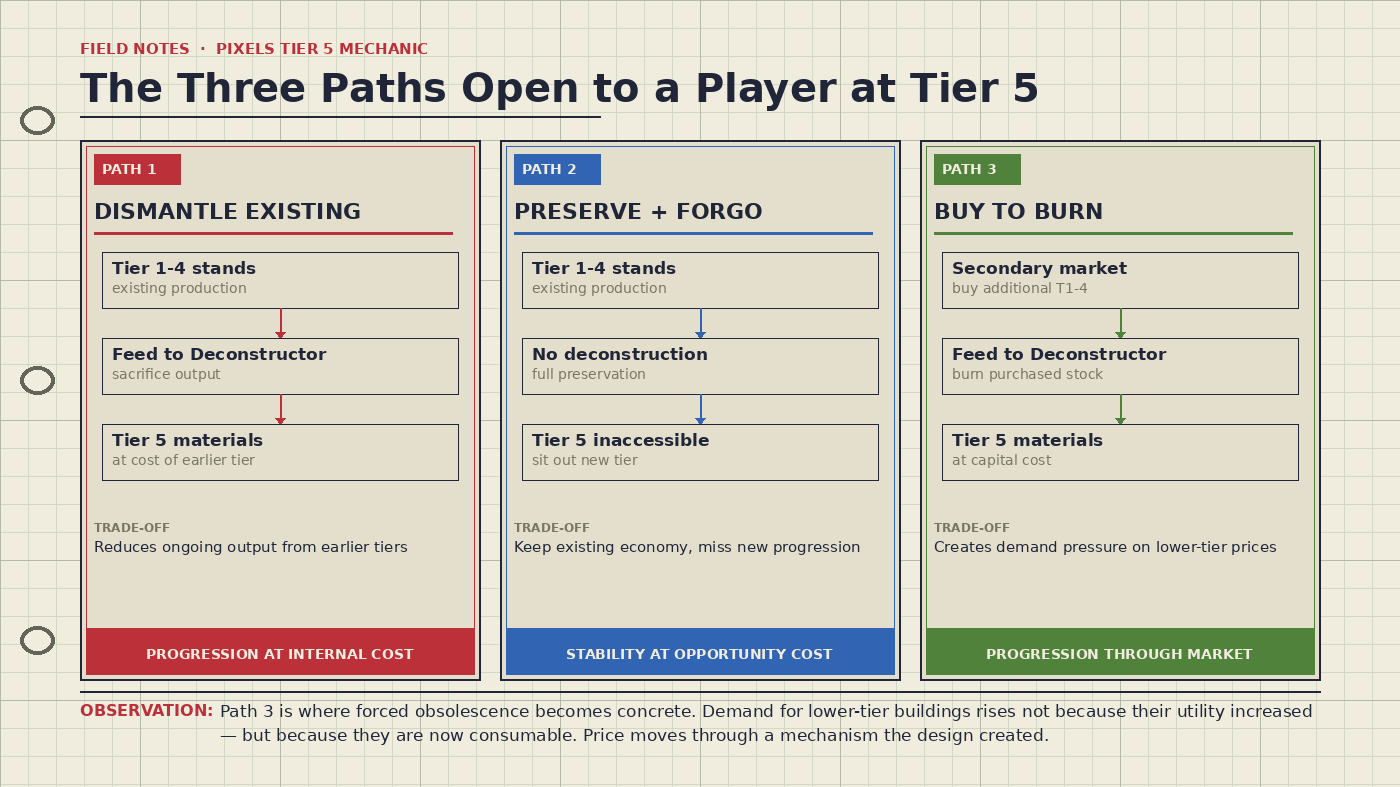
That is the legitimate case for the Deconstructor. Pixels has been running for long enough that Tier 1 through Tier 4 industries have been built out extensively across the player base. Players who invested early have significant accumulations of these industries. A pure accumulation model would allow those players to remain at the top indefinitely, which would make Tier 5 content functionally inaccessible to anyone who had not already been playing for a long time. Requiring deconstruction creates a consumption point that keeps progression moving and prevents the economy from ossifying around early participants.
The counterargument, which is the part the article needs to take seriously, is that sinks can be designed to consume things players do not value losing, or things players do value losing, and the difference between those two cases is a meaningful indicator of whether the sink is serving the economy or serving the emission schedule. A sink that consumes surplus materials, unused resources, or items that were already trading below their production cost is doing economic work without forcing a difficult trade-off on the player. A sink that requires players to destroy the productive infrastructure they built over months of play is doing economic work of a different kind, and the work it is doing is visible in the specific emotional register players tend to react with when it is introduced.
To trace the mechanic at each stage of its operation, the workflow goes roughly as follows. A player arrives at Tier 5 with their earlier industries still intact and discovers there is no way to craft the new materials by adding to what they already own. The path forward does not go around the existing economy. There is only one route through, and it runs by way of the Deconstructor. Earlier-tier buildings have to be given up in order for the Tier 5 materials to appear. The player faces a choice. They can dismantle part of their existing production capacity to access the new tier, which reduces their ongoing output from the earlier tiers. They can preserve their existing industries and forgo access to Tier 5 entirely. Or they can acquire additional Tier 1 through Tier 4 industries on the secondary market specifically in order to deconstruct them, which functions as a demand driver for those lower-tier buildings and, depending on how the marketplace responds, can lift prices across the earlier economy.
That third path is where the forced obsolescence question starts to become concrete. If the Tier 5 progression requires deconstruction at volume, and the Tier 1 through Tier 4 economy cannot produce buildings fast enough to meet that new demand, then the earlier buildings become more expensive, not less. Players who held them as productive assets find their value rising through a mechanism the design created rather than through any increase in the buildings' underlying utility. This can be framed as a healthy economic rebalancing, and from certain angles it is. It can also be framed as a mechanism that generates demand for earlier-tier assets by making them consumable, which is a different framing with different implications for how players experience their investments.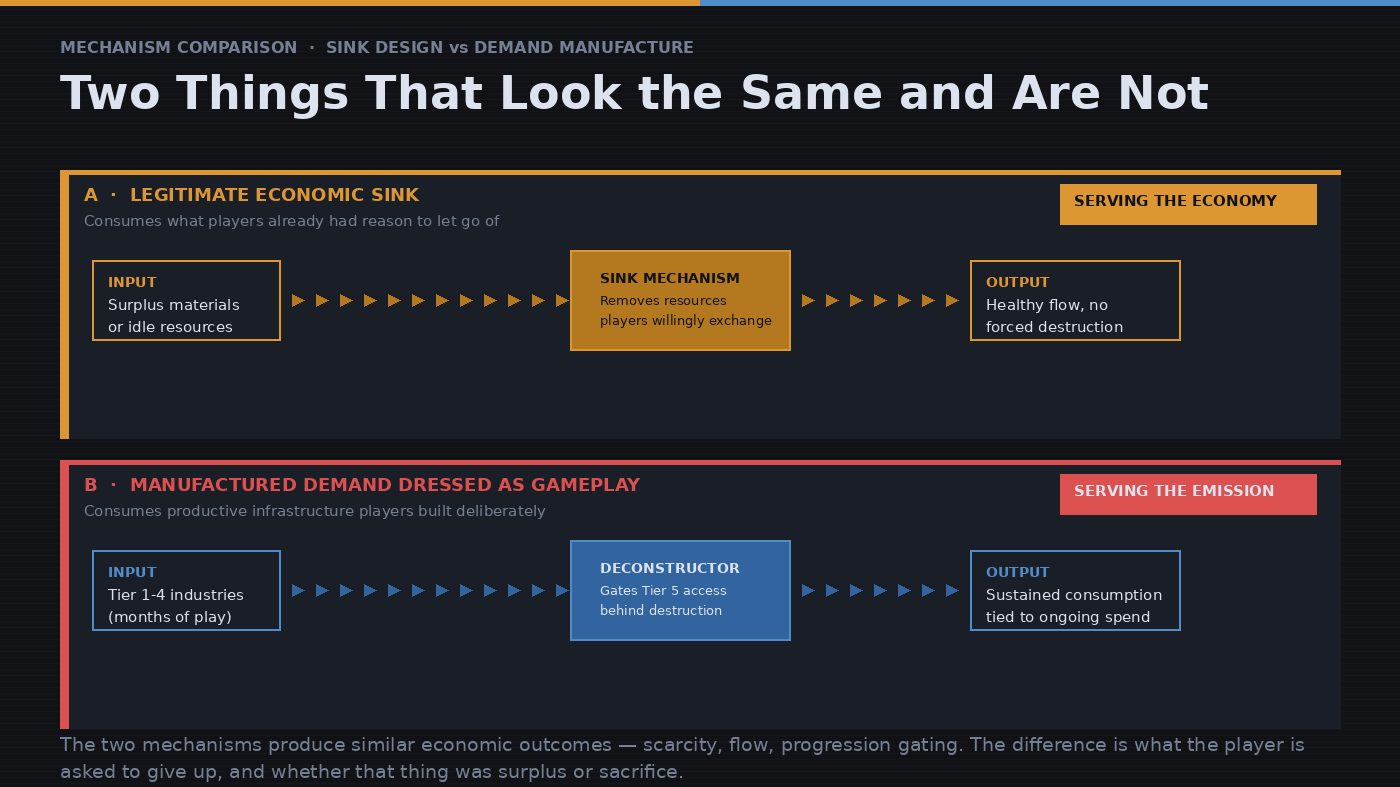
There is a further layer that is worth being direct about. Game economies that depend on ongoing player spending have a structural interest in mechanics that keep demand active. A player who has fully built out their economy and is no longer purchasing new resources is, from a revenue perspective, a solved case. A player who is constantly cycling resources through consumption mechanics is not. Forced obsolescence, whether it arrives in the form of expiring items, rotating meta-games, or deconstruction-gated progression, produces a steady stream of consumption events that correlate well with continued spending. Whether that correlation is the primary design driver or a secondary consequence of legitimate economic design is rarely something that can be determined from the outside, and the honest answer is that it is probably some mixture of both in most cases.
What makes Pixels' implementation worth examining specifically is that the Deconstructor's prior existence as a peripheral mechanic has now been moved to the centre of the progression loop. That is a design decision, not an emergent property of the economy. The team chose to tie Tier 5 access to the deconstruction of earlier tiers rather than to any of the other available sink mechanisms burn fees, crafting costs, time-gated decay, or optional upgrades that consumed specific categories of surplus. Choosing this particular sink creates a particular kind of player experience, and the experience it creates is one in which progression feels less like building and more like feeding.
What I am left wondering is whether the players who encounter this mechanic for the first time will read it as a legitimate economic adjustment that keeps the game alive for new participants, or as a reframing of their earlier investments as raw materials for the next round of emissions and whether the difference between those two readings is something the mechanic itself can resolve, or something that will depend on how the economy behaves over the next several months of Tier 5 operation.

Article
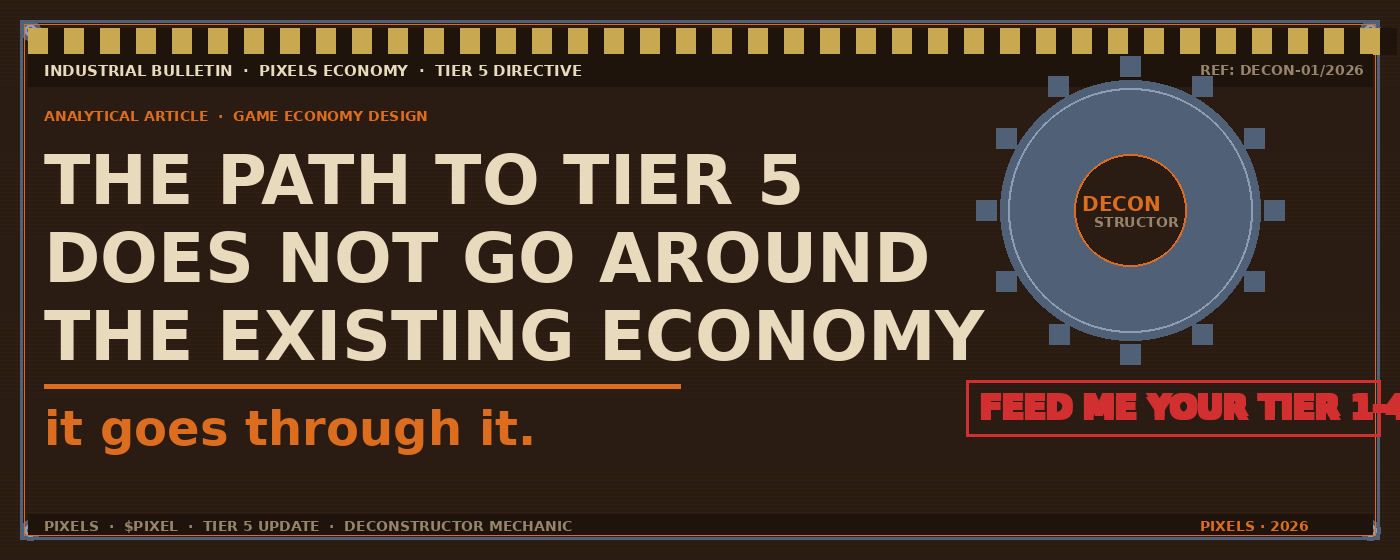
The path to Tier 5 does not go around the existing economy, it goes through it
--
Disclaimer: Includes third-party opinions. No advice. Binance AI may be used without guarantee. See T&Cs.