
At three o'clock in the morning in the server room, the cooling fan of the server is emitting an irritating low hum. I just turned off the data monitoring dashboard filled with red indicators, and the can of iced coffee in my hand has lost its refreshing effect. Don't talk to me about the large-scale breakout of Web3 games, and don't paint me a big picture of 'Play to Earn 2.0.' After spending so many years in this circle, I've witnessed countless blockchain games claiming to overturn the traditional gaming industry, only to rot on the deserted island of Ethereum. So, when @Pixels burst into my vision with its retro 8-bit mosaic style, my first reaction was extreme annoyance and disdain. I believe that in this fast-food era where even AAA titles can't retain players, relying on a 'planting turnips and chopping trees' Pixels to save the crumbling GameFi narrative is simply a black humor of the entire industry.
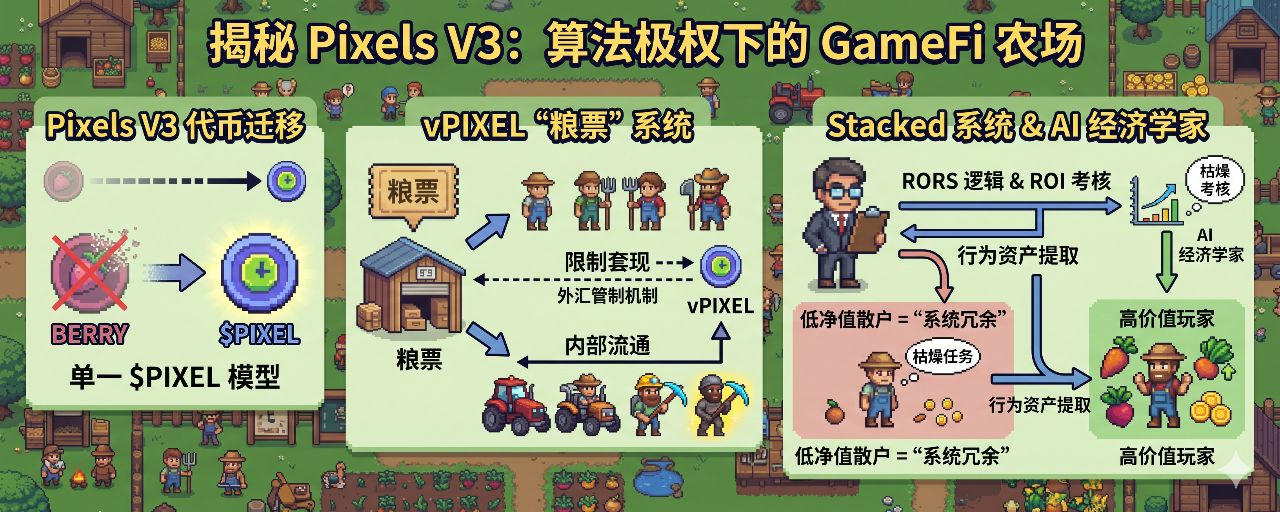
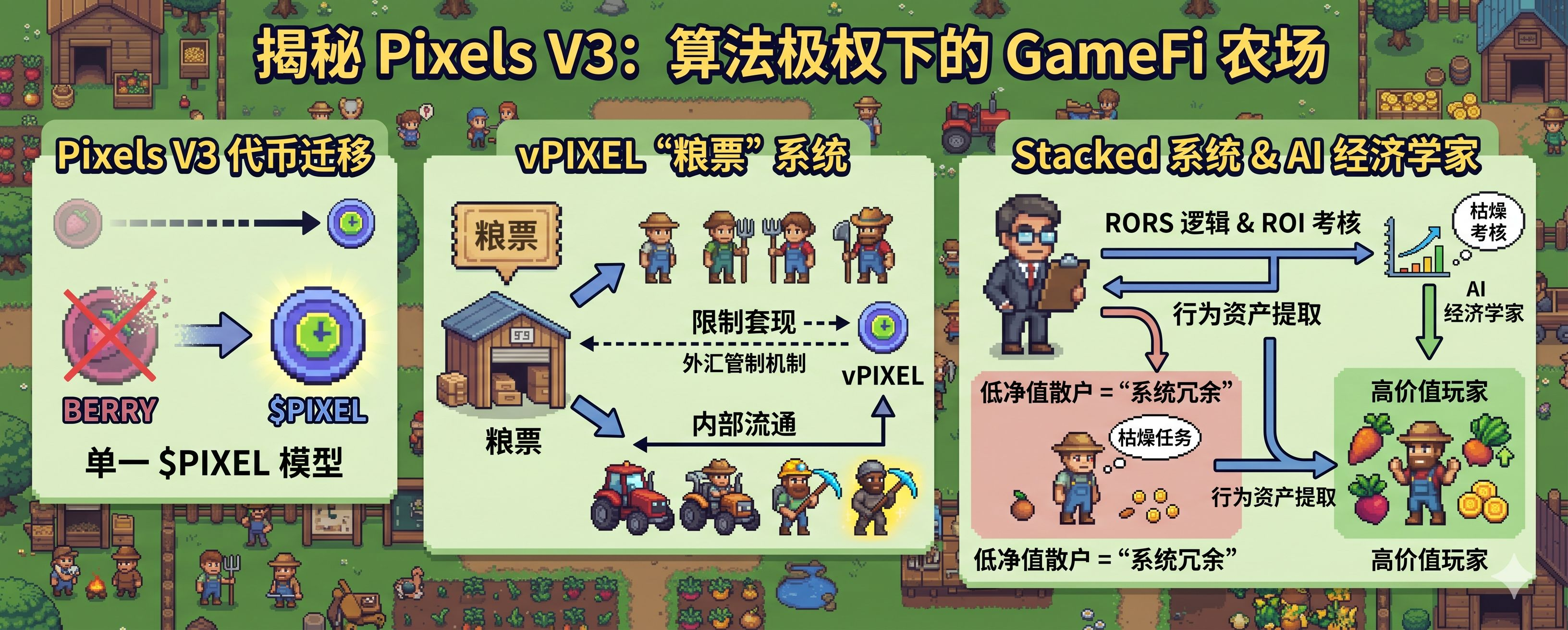
With this condescending arrogance, I pried open the underlying protocol of Pixels' latest V3 version and token migration mechanism using a decompilation script. Don’t talk to me about the fairy tale of decentralized community governance; as I followed the code logic and watched them decisively scrap BERRY and forcefully move to a single $PIXEL model, even creating an internal 'grain ticket' system like vPIXEL, my smirk instantly froze. I discovered that Pixels is not some easy-going, therapeutic farming game; it's hiding an extremely authoritarian algorithmic regime with a perverse level of control over economics. I think this method of locking liquidity directly at the protocol level and using 'grain tickets' to restrict cashing out for bottom-tier players is taking foreign exchange controls from the traditional financial world to a new cyberpunk height.
What sends chills down my spine and even makes me feel a bit of awe for this project is the underlying system called Stacked. Don’t talk to me about the warm filters of casual socializing; after my computational model completed their so-called 'AI game economist' test, I saw an extremely ruthless 'digital Darwin engine.' In Pixels' world, the system acts like a high-level auditor sitting in the cloud, using brutal standards similar to big companies assessing ROI (i.e., RORS logic) to label every logged-in player. If you’re a low-net-worth retail investor trying to get something for nothing, the system will automatically downgrade you to 'system redundancy,' depriving you of your survival space with extremely low drop rates and tedious tasks. I finally understood that on this seemingly free land of Pixels, the hoe you wield every day isn’t creating happiness; it’s forcibly extracting your 'behavioral assets' by the algorithm.
Take a look at the Guilds system that Pixels has aggressively pushed. It's taken human calculation to the next level. Don't talk to me about 'brotherhood' or 'social assistance'; to me, it’s clearly a 'cyber black heart factory' built with code. Pixels cleverly transformed guilds into a disguised liquidity lockup using a joint curve pricing mechanism. Want to climb the ranks in this stratified world? You’ll have to buy guild shards at a high price and hand over your liquidity as a 'rite of passage.' I believe the most vicious yet clever aspect of Pixels is that it directly binds whales (cyber landlords) with retail investors (electronic tenants) through this system, forcing players to manage and exploit each other while the officials simply sit at the top of the pyramid, coldly extracting fees.
This logic of layered exploitation of players, even turning them into data nodes, sounds despairing, yet I now hold it in extreme, fervent admiration. Don’t talk to me about the elusive joy of gaming; in a dark forest filled with mutual sabotage and rampant scripts, I believe only a cold-blooded system like Pixels, which only recognizes profit and nothing else, can truly survive. It breaks the death spiral of standalone games, hijacking traditional advertisers' acquisition funds with its tight anti-cheating engine, accurately funneling real money to those genuine quality nodes that pass the system's 'Turing test.' On this level, Pixels has even transcended gaming, transforming into a cross-ecosystem B2B exchange for selling genuine human attention.
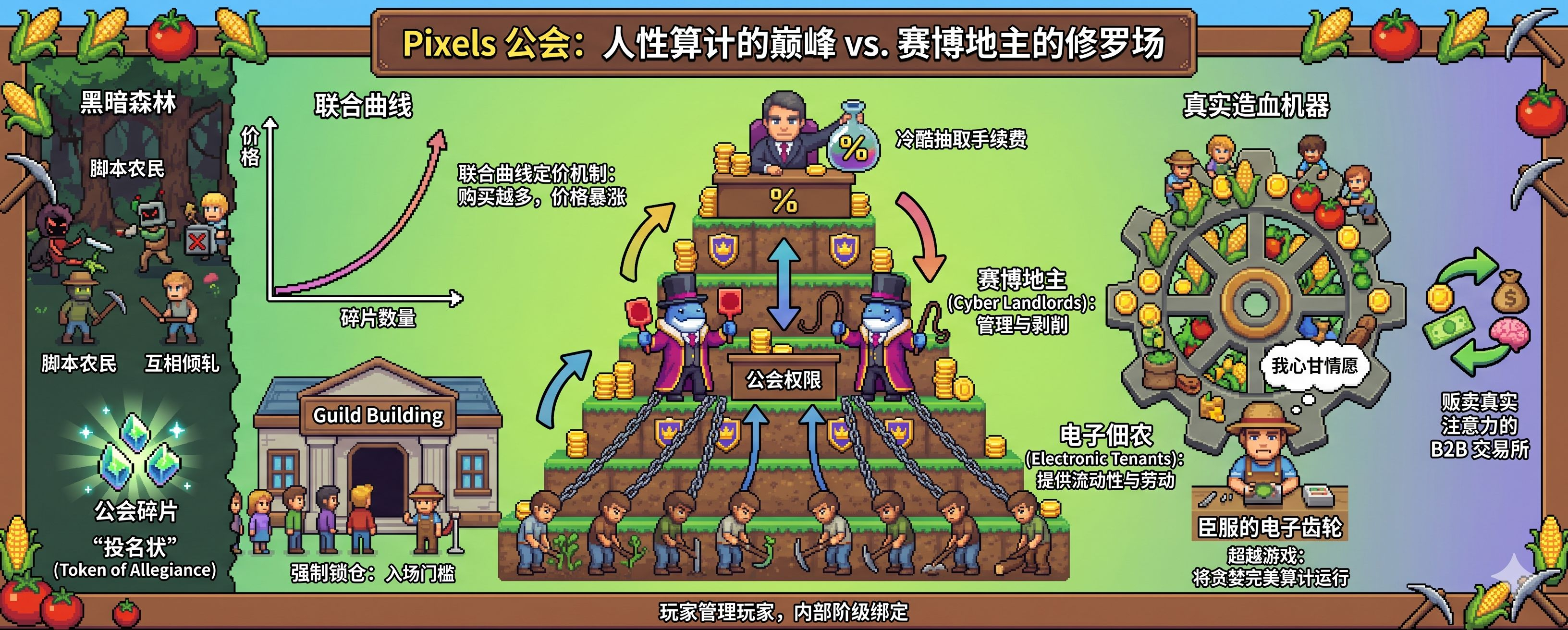
Closing my computer, filled with code and analysis charts, I noticed the sky outside had brightened; my attitude towards Pixels has shifted from initial disdain to complete submission. Don’t talk to me about the utopian dream of decentralization; Web3 has never been a charity. Pixels stripped away all the warm facades, delivering a cold white paper to the world: this is a battlefield ruled by computational power, funds, and algorithms. Yet I willingly stay in this battleground. I still open Pixels on time every day, like a qualified 'electronic gear,' completing those interactions set by the system. Because I feel that rather than being a bag holder in those air projects full of idealism, I’d rather earn my survival dividends in Pixels, a cruel machine that calculates human greed to the extreme and has real blood-shedding capability. In this garbage-strewn market, being able to write 'calculation' into smart contracts and have it run perfectly is the greatest justice. #pixel $PIXEL