
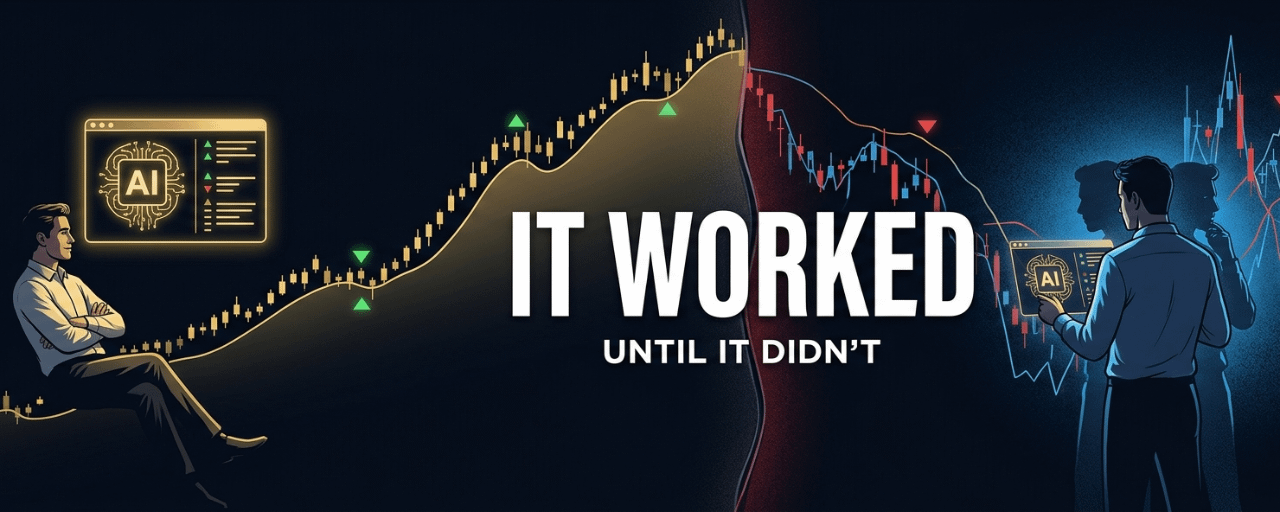
I see many people approaching AI trading for a quite reasonable reason: the more you use it, the better the system understands you, the better it optimizes, and the larger the edge it creates. This is not unfounded. It is built on how we observe machine learning systems in other fields, the more data, the better the model; the more feedback, the more accurate the output. That logic makes sense in many contexts. But trading is not one of them, at least not in the linear way we think it is.
And this is the part that is least openly discussed when people talk about AI in trading.
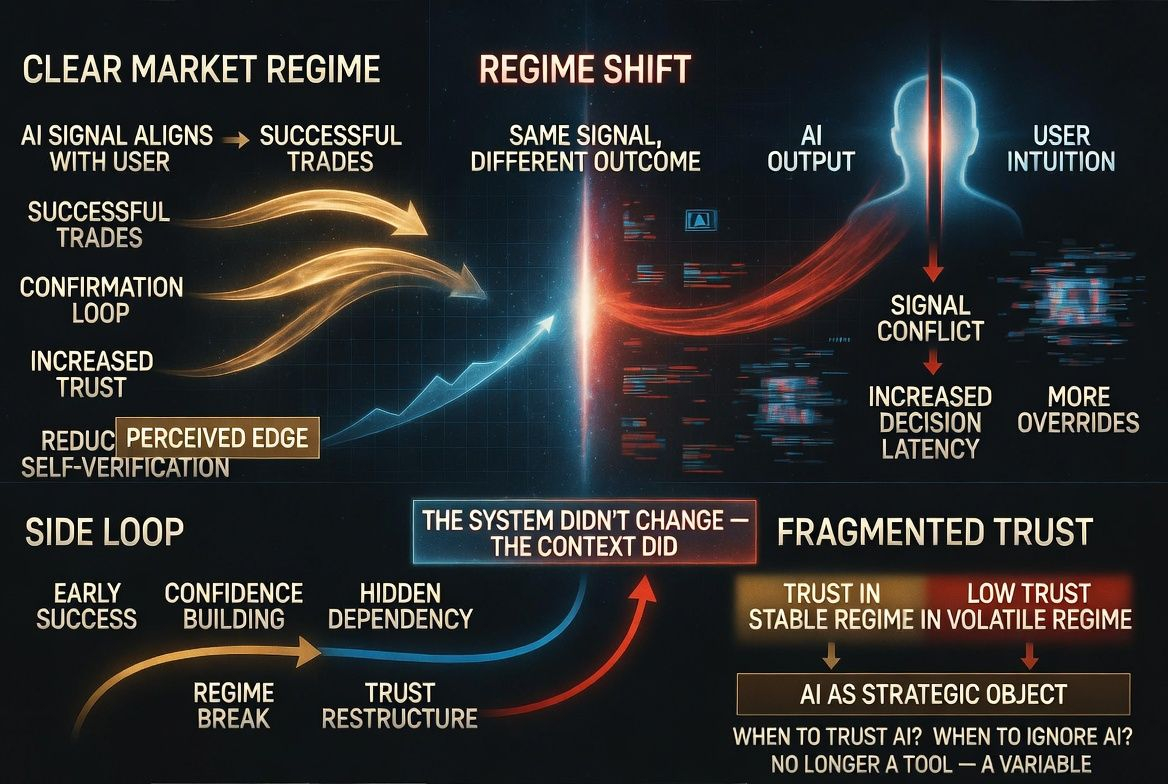
In the early stages of using a system like Binance AI Pro, it often creates a very pleasant feeling. The market is in a readable regime, the trend is clear, noise is low, and AI output almost always aligns with what you're thinking. Clean signals. Entries look reasonable. Every decision feels like it’s being validated. You win a few trades, you trust more, and you start to reduce self-checking your judgment because why check when everything is working.
But this isn't the system getting better. This is a confirmation loop accumulating. Early success is not evidence of system quality; it's evidence that market conditions are favorable for that type of signal. The two may look the same from within but are entirely different when the market shifts.
And the market shifts.
It's not like you see a clear breakdown and then adjust. It changes in a way where the same signal no longer leads to the same outcome. Volatility clustering appears. The correlation structure starts to break down. AI Pro still outputs reasonably at each local point, but at the system level, it's failing. And since each individual step still looks fine, you don’t realize it immediately. You only see results starting to deviate without knowing where the deviation is coming from.
This is when something more interesting starts to happen within the user.
You don't abandon the system. You start to separate it. In your mind, there begin to exist two parallel reference points: one is what AI Pro is suggesting, and the other is what your intuition is saying. Initially, these two are aligned, which is why the early phase feels so smooth. But after the regime changes, they start to diverge. You look at the AI suggestion, then back at the chart, then back at the suggestion. Decision latency increases. The frequency of overrides increases. And each time you override, it brings along an unspoken question: am I right this time, or is the system right?
That loop is exhausting. And it’s not designed to be resolved by any technical features, as it happens entirely within the user.
What complicates this phase further is that AI Pro isn't wrong by much in absolute terms. The amount of deviation may not increase. But each small deviation is overweighted by the new context. The same mistake, but occurring in a volatile regime has a much greater psychological impact compared to when it happens in a trending regime. The system doesn't change, but the environment around it does, and users start to interpret the same output very differently depending on when it is.
At this point, Binance AI Pro is no longer a decision-making tool in the simple sense. It becomes an unstable reference point, something you look at not to make decisions but to compare against decisions you’ve almost already made.
And from there, trust starts to fragment in a very specific way.
It's not that you lose faith in the system. It's not that simple. You still believe, but conditionally. In a stable regime, you trust more. In a volatile regime, you trust less. Gradually, you no longer evaluate AI Pro as a good or bad quality system; instead, you assess it as something trustworthy under certain conditions and untrustworthy under other conditions.
This is a form of practical understanding, but it also indicates that the relationship between the user and the system has structurally changed.
Because once you reach that level, you're not using AI to make decisions anymore. You’re adding another layer of awareness to decide when to use AI. The system is no longer a tool; it becomes an object of strategy. You're strategizing about it instead of strategizing with it. And the question is no longer 'What does AI suggest?' but rather 'Should I listen to AI right now?'
That's quite a shift.
After enough cycles like this, the system converges to a state that I find quite common but not accurately described. Binance AI Pro isn’t abandoned. Users still use it. But only under a subset of conditions. The authority of the system is permanently fragmented according to the regime. It’s not zero trust but fragmented trust; trusting one part while distrusting another, and the boundary between those two parts is drawn differently by each individual depending on their trading history.
AI Pro doesn't lose value in an absolute sense. But it loses universality; it loses that initial feeling that this is a system that can be consistently trusted across all conditions.
What I find notable is that the design direction of AI Pro seems to not deny this. Segregated accounts, limited capital, operational scope defined from the start—these things aren’t random. They are the system's way of acknowledging that it is not a universal authority but rather a tool with a defined range. When the range is defined from the outset, fragmented trust is no longer a failure of the system but a way it is designed to be used.
But that requires users to understand this from the beginning, not after going through all the steps above for months. And most users don’t start from that point; they start with linear expectations, from early confirmation loops, and then they arrive here after many cycles.
I don't have enough data to say that AI Pro can handle everything I described above. The narrative also doesn’t answer that question. The only thing that can answer it is how users actually navigate through each phase, how the system supports them when trust begins to fragment, and how it maintains value when universality is no longer something to rely on.
I'm still keeping an eye on that.
Trading always carries risk. The suggestions generated by AI are not financial advice. Past performance does not reflect future results. Please check the availability of the product in your area.
$XAU @Binance Vietnam #BinanceAIPro