

Two players started Pixels the same week I did.
Same energy.
Similar effort.
Roughly the same loops.
By day eight, one was still farming.
The other was gone.
I remember checking whether something obvious had broken for them.
Nothing had.
The game looked the same.
Rewards hadn't changed.
No visible reason for the exit.
That’s what stayed with me.
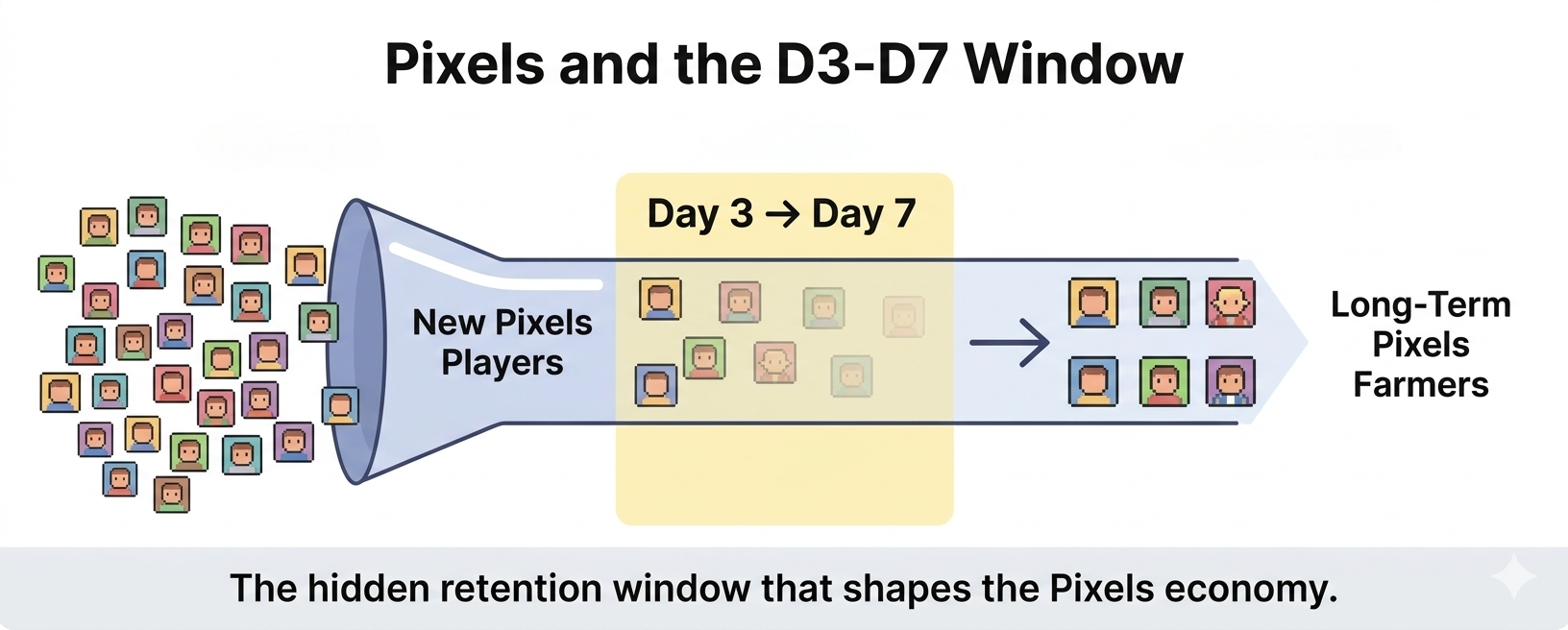
Somewhere between day three and day seven, one of them cleared something the other didn’t.
I’ve watched that gap swallow enough players that it stopped feeling like coincidence.
I keep thinking of it as the D3-D7 window.
Not because it’s a formal term.
Because once you notice it, you start watching for it specifically.
Players who quit before day three usually look decided early.
Players who make it well past day seven often last much longer.
But the ones in between are different.
Active enough on day three that continuation feels likely.
Gone by day seven with no explanation that fully fits.
That’s usually where the real leak seems to sit.
And it rarely shows up in headline numbers.
What made this uncomfortable was how hard it was to spot from the outside.
Effort looked similar.
Session frequency looked similar.
Nothing obvious in their loops explained the split.
Which suggests the deciding factor may not live in visible behavior at all.
Maybe it’s what the game asks of them in that specific stretch.
Maybe it’s whether anything meaningful arrives at the right moment to justify one more session.
Maybe it’s friction that compounds quietly until it wins.
I’m not certain.
I’ve just stopped assuming it’s random.
This is where Stacked starts looking different to me.
Most descriptions focus on outputs.
Cohort charts.
Churn signals.
Reward targeting.
Useful tools.
But tools can be built.
Dashboards can be copied.
Analysts can be hired.
What’s harder to replicate is years of watching the same retention window play out in production until you understand where the cliff usually hides.
Pixels had real players.
Real exits.
Real sessions that almost converted and didn’t.
That kind of learning is slower, messier, and more valuable than most planning documents admit.
What breaks when studios miss this is usually quiet.
Total player count can look fine.
Growth campaigns keep running.
Topline numbers stay presentable.
Meanwhile the D3-D7 gap keeps draining future long-term users underneath the surface.
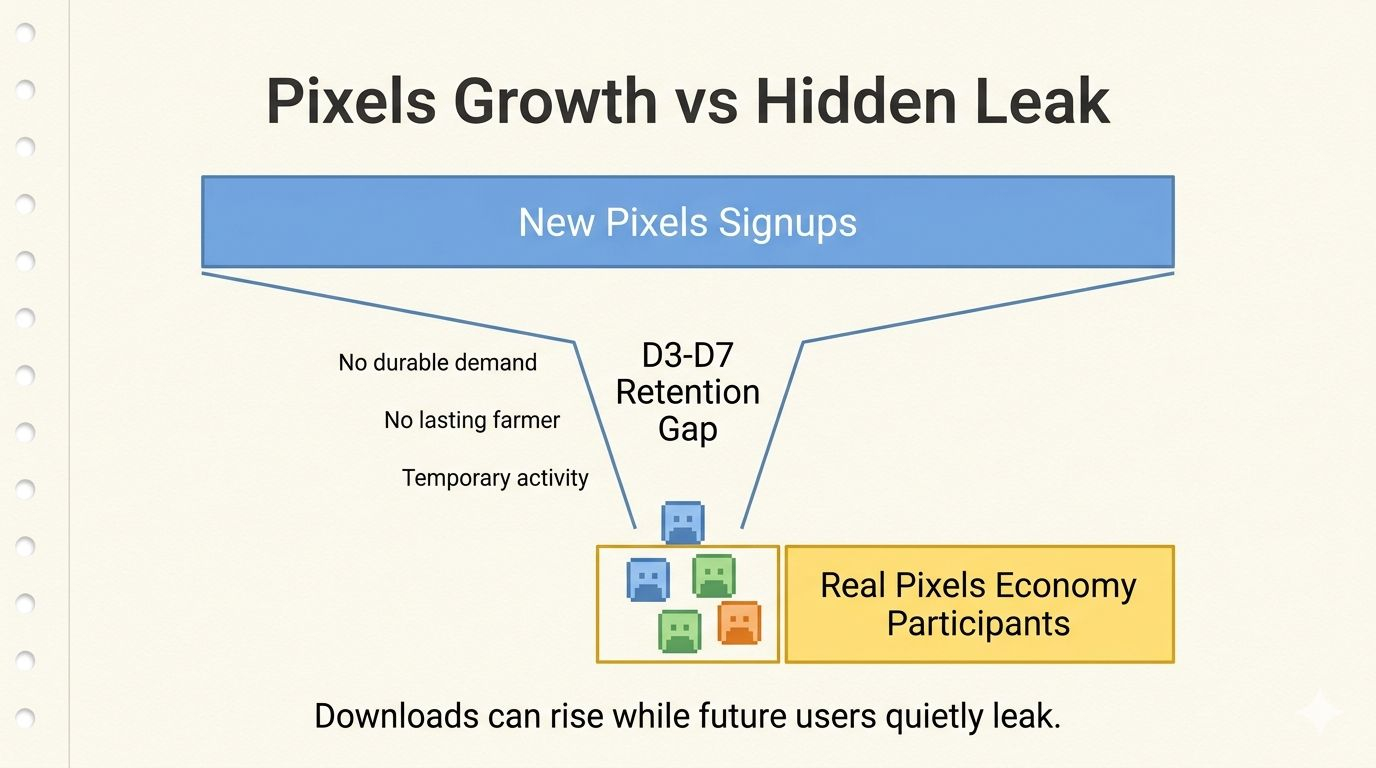
Every player lost there may have been acquisition cost that never became a real economy participant.
No lasting farmer.
No durable demand.
Just activity that looked like growth for a moment.
That’s where $PIXEL sits inside this.
Not downloads.
Not installs.
Retention.
A player who clears the D3-D7 window has a chance to actually enter the economy.
A player who doesn’t may never have really joined it.
So every player Stacked helps move across that gap may matter more than a new signup ever does.
$PIXEL only grows sustainably if that window keeps narrowing.
Acquisition without retention is expensive churn with a token attached.
The test I keep coming back to is whether this learning transfers.
Pixels learned its own version of the D3-D7 cliff through years of live production.
An outside studio using Stacked may inherit infrastructure built from those lessons.
But do they inherit the timing of their own cliff too?
Or does every game have a different version of the window —
different friction,
different moment,
different reason a player decides one more session isn’t worth it.
If the pattern generalizes, Stacked could compress years of painful learning into onboarding.
If it doesn’t, it may still help — just more slowly than the pitch implies.
I don’t know which one is true yet.
But the answer shapes what $PIXEL can become across ten games versus one.