


Let me first share an observation that makes me a bit restless: during this time, almost all discussions about $PIXEL have focused on token economics, reward mechanisms, and unlocking pressure. These aspects are important, I don't deny that, but I feel everyone is looking in the same direction, which instead overlooks something that might be more critical. I call this phenomenon 'collective perspective lock'—when everyone is fixated on the same place, the truly important information often resides in the corner that no one is watching. In real-life research, prioritizing survival, my habit is to look towards places with fewer people, not because I am particularly smart, but because the things everyone is focusing on usually have many expectations built into their prices, while the things that no one notices have the real information gap.
In a paragraph of the Pixels white paper that most people skip, I found a sentence: Core Pixels Mobile, planned for exploration in 2026, is a streamlined version of Core Pixels designed specifically for mobile platforms, aiming to replicate the success of the flagship product in a more user-friendly manner. Just this one sentence has kept me thinking for quite a while. Do you know why? Because if this sentence truly aligns, it means that what @Pixels is doing will transform from 'a PC chain game centered around farming exploration on the Ronin Network' to 'an application that can be installed on everyone’s phone.' On the surface, these two things only differ by a platform, but in reality, the difference is in the scale of the user base — the user pool for PC chain games consists of 'crypto users who can use a wallet,' while the user pool for mobile is 'everyone on Earth with a smartphone.' I am not exaggerating; I am doing a very simple calculation: Web3 games have always drawn from the same pool, and the ceiling of that pool is the total number of global crypto users; once the mobile side opens up, the ceiling becomes the total number of global smartphone users, which is at least an order of magnitude larger.
But what I want to convey is not just that 'mobile users are numerous,' which everyone knows and stating it is pointless. I want to discuss the specific impact of the mobile end on the demand structure for $PIXEL. Currently, the demand for $PIXEL mainly comes from heavy users on the computer side; this group is limited in number, behavior is predictable, and has been repeatedly studied, leaving little information gap. If the mobile side takes off, it will introduce a completely different group of users — more casual, more fragmented, and harder to be completely drained in one go. The gaming behavior of these individuals is entirely different from that of PC players; the data they generate will be new training material for Stacked's AI economists, and their consumption patterns will add a new dimension to the demand side of $PIXEL. More critically, Pixels is already concurrently developing Pixels Pals, a mobile game specifically targeting mainstream users, which only requires linking a wallet after seven days of play. If these two products work in synergy, the cold start resistance of the mobile side will be much smaller than that faced by any other chain game project, because Pixels Pals will first attract users, and Core Pixels Mobile will then facilitate deeper conversion. This is a thoughtfully designed user funnel, not just casually throwing out a product and claiming a mobile version is available.
At this point, I have to mention the aspects that make me uneasy; otherwise, this article would be nothing but fluff. The number of dead projects in mobile gaming surpasses those in Web3 chain games, and the ways they fail are even more severe — installed but not played, played for two days and uninstalled, removed from the Apple App Store, tightened Google Play policies, and the mobile experience is far inferior to that on PC, resulting in dissatisfaction among users on both ends. The description of Core Pixels Mobile in the Pixels white paper is just a sentence: exploration planned for 2026. The term 'exploration' is a very conservative expression in the context of product development, meaning that it has not yet been determined how to proceed, and it may even be uncertain whether to pursue it wholeheartedly. Therefore, this card is still just a card on paper; whether it can become a tangible product, I do not know. This is a variable I have observed over a long time, and it's not something that can be concluded today.
$PIXEL Currently priced at $0.00773, with a 24-hour increase of +2.66%, a 24h high of $0.00775, a low of $0.00740, a trading volume of 129 million PIXEL, and a transaction amount of 969,000 USDT, the trading volume has severely shrunk. The MA7 is at 0.00764, crossing above the MA25 at 0.00755, but the MA99 is pressing down from 0.00767, with the three lines beginning to intertwine, and the direction is unclear. A small increase without volume indicates a turnover rather than a trend; I will not take it as any signal. Real-life research prioritizes survival; today’s K-line has no impact on my judgment of the long-term logic of $PIXEL. Whether Core Pixels Mobile can truly land in 2026 is the core reason for my continued attention; the price will speak for itself, and I cannot control it.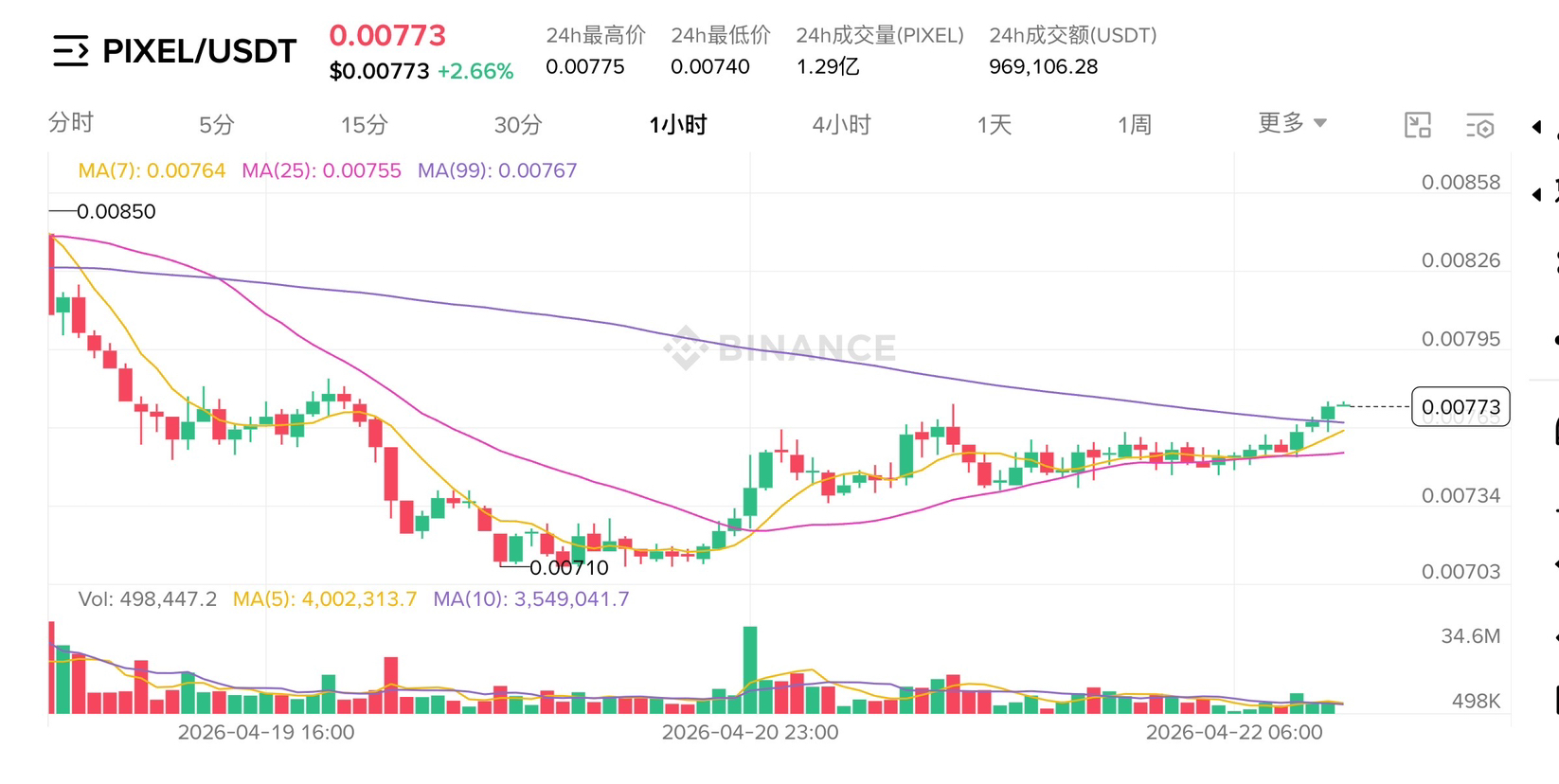
Finally, let me say something very real: I fear two types of people in this industry — one type charges ahead without looking at any information, and the other knows everything but is always waiting. The former relies on emotions, while the latter depends on procrastination; both are essentially avoiding making judgments in some way. I write these things to escape my own retreat from making judgments, to carefully consider every variable worth tracking, and to establish logic before the information is fully priced into the market. Currently, I believe that the Core Pixels Mobile card is one that is severely underestimated in the long-term narrative of $PIXEL — not because it will definitely succeed, but because almost no one is discussing it seriously, and things that aren't talked about hold real information gaps. Real-life research prioritizes survival; this is everything I wanted to say today.