
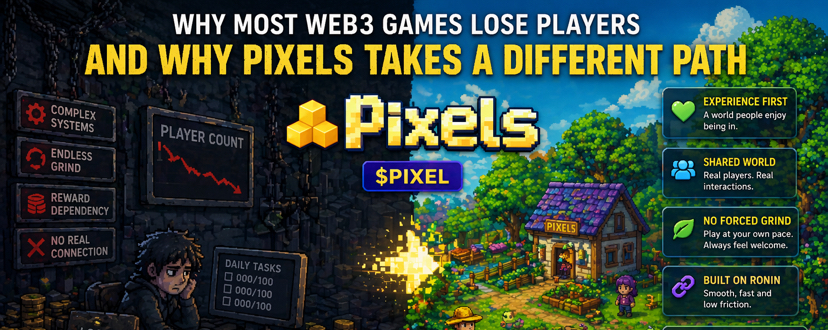
If you look at Web3 gaming today, one pattern shows up again and again.
Games manage to attract attention at the beginning, sometimes even strong attention. Users join quickly, activity spikes, and everything looks promising on the surface.
But after a short period, things start to change.
Engagement drops. Players leave. Activity slows down.
The usual explanation points to token prices or reward structures, but the real reason is often more fundamental.
The experience doesn’t create attachment.
Many Web3 games are designed around systems instead of players. The focus is on mechanics, incentives, and economic loops. While these elements are important, they are not enough on their own to sustain long-term engagement.
Because players don’t stay for systems.
They stay for experience.
Pixels takes a different approach by prioritizing the experience first.
Instead of building a game around financial mechanics, it builds a game around presence and interaction. The environment is simple but intentional. Farming, exploring, and interacting with the world are designed to feel natural rather than forced.
There is no constant pressure to optimize every action or chase every reward cycle. The player is not pushed into over-engagement.
That creates a different relationship with the game.
You don’t feel like you are managing a system.
You feel like you are inside a world.
Another important element is the social layer.
Pixels is not isolated gameplay. It is a shared environment where players exist within the same space. This creates continuity that extends beyond individual sessions. Even when you are not actively doing something, the world continues to feel alive.
That sense of shared presence increases attachment without forcing it.
The technical structure also supports this experience.
Built on Ronin, Pixels benefits from smoother interactions and reduced friction. This might seem like a secondary detail, but in practice it directly affects how long players stay engaged. Small delays and interruptions can break immersion faster than most people realize.
But the most important shift Pixels introduces is not technical or visual.
It is structural.
It changes the order of priorities.
Instead of building around rewards and adding gameplay on top, it builds gameplay first and lets rewards exist as a support layer. That subtle difference changes how the entire system behaves.
From a broader perspective, this reflects something important about Web3 gaming as a whole.Sustainability does not come from incentives alone. It comes from designing experiences that people naturally return to.
Pixels represents that direction.
It does not try to force engagement.
It creates conditions where engagement happens naturally.
And in the long run, that difference is what determines whether a game fades or stays relevant.
