

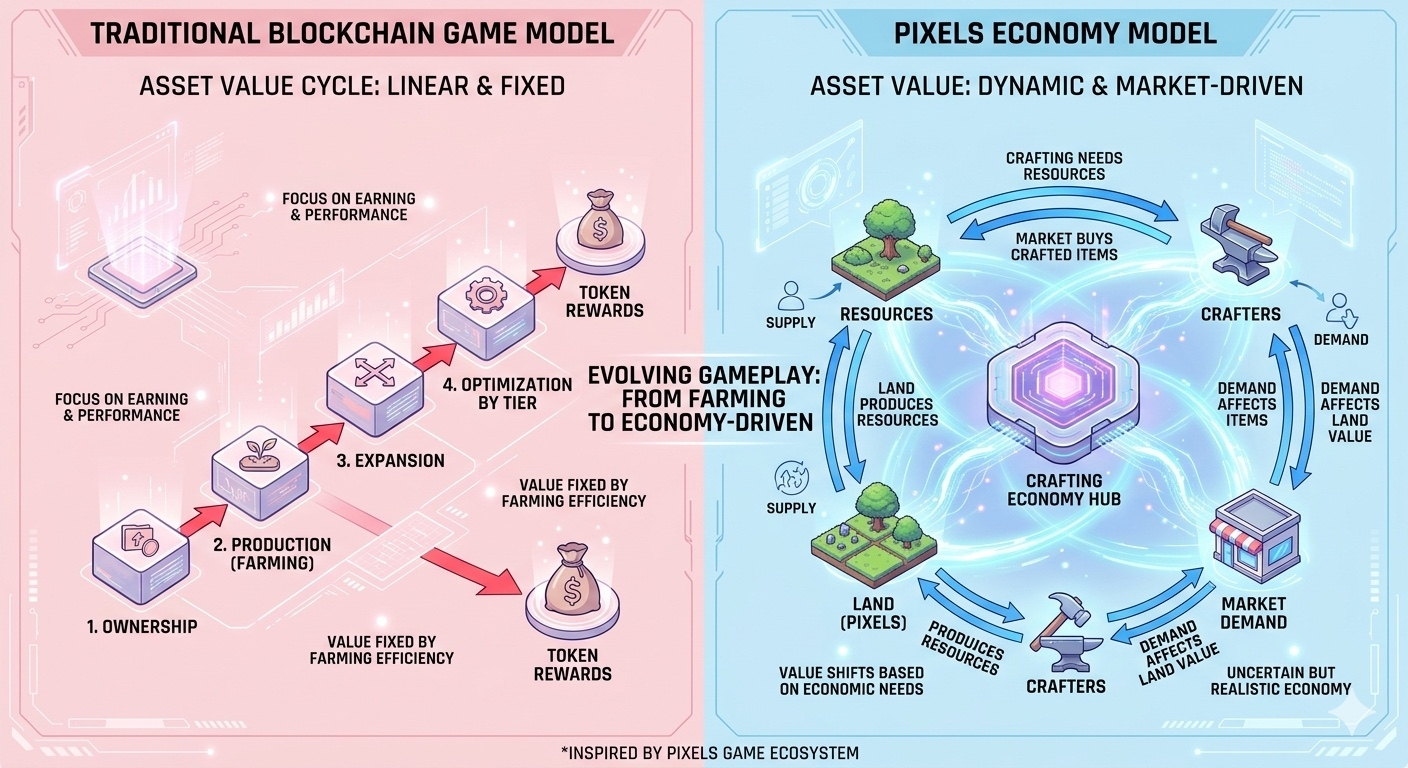
I used to think land in Pixels was just a simple asset: own → produce → expand → optimize by tier. I really believed in that "formula," thinking that as long as I followed it, everything would be fine, no need to overthink. But the more I traded, the more I realized... it’s not as solid as I thought. When I started to take a closer look at how the ecosystem in the game operates, I realized the value of land isn’t fixed at all. It fluctuates based on the demand of the crafting economy inside, and there were times when I noticed it changed really fast; like, yesterday it was "sweet," today it’s not optimal anymore.
In the context of blockchain games increasingly shifting from 'earn from farming' models to 'economy-driven gameplay', elements like resource ecosystems and demand cycles are no longer 'secondary mechanisms', but are gradually becoming the core determinants of asset value. Compared to early Axie Infinity games - where value revolved clearly around token rewards and farming efficiency - Pixels feels... less certain. But honestly, that very 'uncertainty' feels more realistic.
Because here, value no longer follows a straight line; it fluctuates based on how the internal economy operates.
Reading how Pixels designs ecosystems like forests and deserts and the differences in resource output, I see this as a rather sophisticated approach to creating a dynamic economy. Pixels is going in a different direction, where the same type of land can jump from 'low value' to 'strategic asset' just because of a crafting cycle changing direction, or an event shifting demand. Sometimes I find it quite frustrating, like you can't just 'set and forget' like in the old games - when things are stable, you suddenly have to reevaluate everything. But thinking back, it feels more like a real market than a simple game.
An example: in traditional blockchain game land models, high-tier land always retains a stable advantage. Technically, this logic is valid since productivity is fixed. But the issue isn't with the production system; it’s with the layer that defines value controlled by the economy and game design. Unlike those games, Pixels gives me the impression that 'safety' doesn’t last long - nothing can stay the same for too long. There are things that today seem useless, almost overlooked... but just a shift in crafting meta can turn them into core assets the next day. Sometimes it’s a bit dizzying 😅.
Pixels is aiming to tackle the issue of 'land = static asset' in the game economy, but on a scale where hundreds of thousands to millions of players interact within a shared economy. Compared to previous sandbox systems I've played, Pixels has less 'virtual free choice', but it pushes players to read the system with more economic thinking.
However, Pixels doesn't eliminate value volatility. It just redistributes value through the demand and crafting cycles. Before value is formed, there still needs to be a layer of the system that defines what is 'needed' at that moment. And I’m starting to wonder: if this layer changes, does the entire 'right or wrong' in strategy still hold meaning? And more importantly, who or what is controlling that demand?
This isn't necessarily a design flaw, but more of a structural risk - something that demand-driven economies nearly always face. It’s like a misalignment between production and consumption signals. To put it simply based on my experience: you produce based on some assumptions, but by the time you output, the demand has changed - and then everything is off, and you realize it doesn’t match up anymore.
With hundreds of thousands of players optimizing resources, if the demand signal is skewed or misled, the entire valuation of land can be distorted. No system can self-balance if the 'input demand' has been defined incorrectly from the start. And the question I often ponder is: are players reacting to the market, or are they actually just responding to a 'designed market'?
Traditional economic systems fail when they focus too much on fixed structures and rigid tiering. Fully trustless systems are difficult to implement due to a lack of demand coordination mechanisms. Pixels follows a 'third path' - a dynamic economy, being pulled back and forth by crafting cycles and the resource ecosystem. Compared to the 'fixed meta' games I’ve played before, the feeling in Pixels is that it... never stands still. There’s always something subtly shifting underneath, not always immediately visible, but you can sense it after playing for a while.
The value of land doesn’t lie in its location, but in the moment the economy needs it. To put it simply based on my gaming experience: there are times when you hold a piece of land that feels ordinary, even somewhat 'useless', but just a shift in crafting meta or demand resource makes it suddenly valuable.
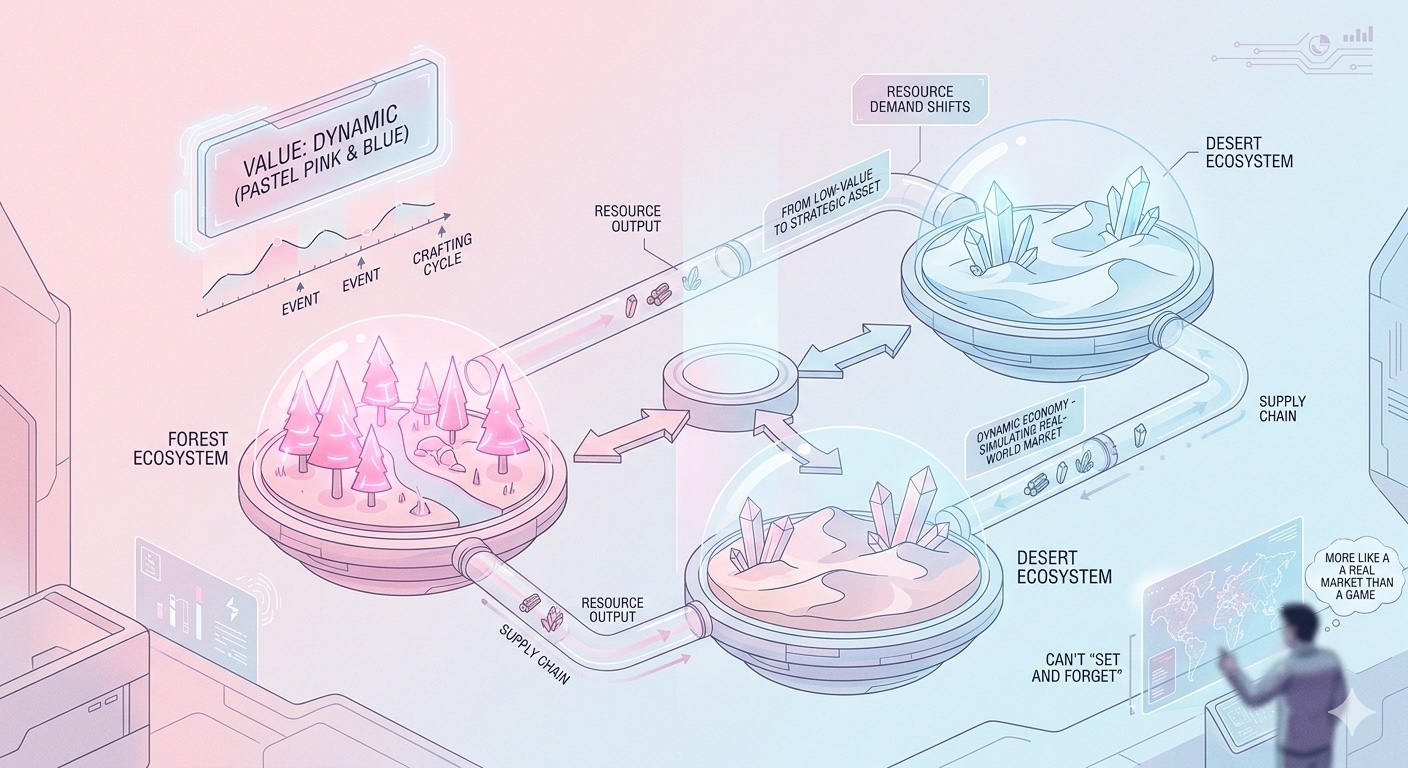
That's why I'm still keeping an eye on how Pixels operates its land ecosystem, especially how the demand cycles are created and change. At a deeper level, what’s noteworthy isn’t each piece of land, but how the system decides what is considered 'valuable' at any given moment.
A thought to consider: when a game economy is large enough to reflect real market behaviors, where does the power to define 'value' truly lie - with the system, the players, or the mechanisms behind creating demand? And if one day all players optimize in the wrong direction, is it the players' fault... or the fault of the 'value logic' that the system is creating?