

I’ve seen exploits come and go in crypto, and most of them follow a familiar pattern. A protocol gets drained, people panic for a day or two, and then the market slowly moves on.
This one didn’t feel like that.
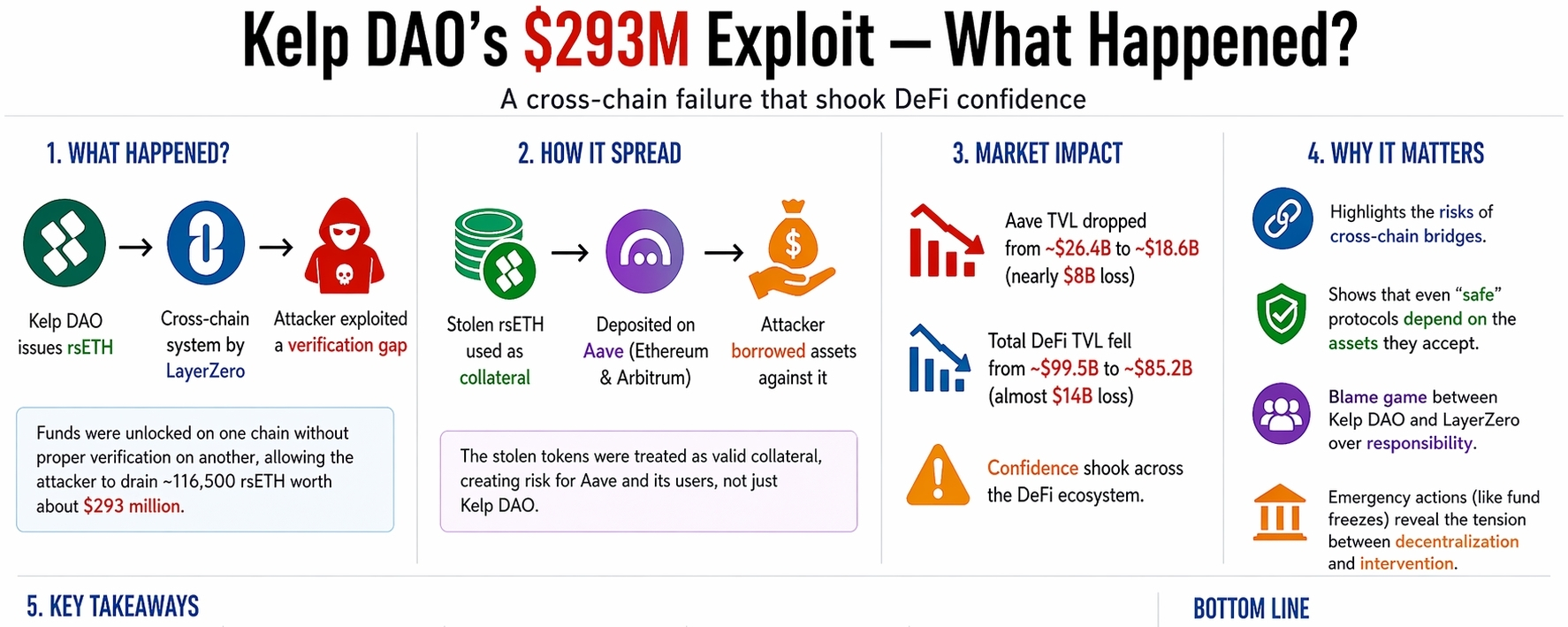
On the surface, it’s a $293 million exploit tied to Kelp DAO.But underneath, it exposed something deeper — not just a vulnerability in one system, but a weakness in how DeFi as a whole relies on trust it rarely acknowledges.
What actually happened
Kelp DAO offers a restaking token called rsETH.It’s designed to move across chains and still represent underlying ETH — flexible, efficient, and widely usable.
That flexibility is exactly where things broke.
The issue didn’t come from a simple smart contract bug. It came from the cross-chain infrastructure, powered by LayerZero Labs.
In simple terms, the system allowed funds to be unlocked on one chain without properly verifying that they were burned or accounted for on another. That gap — small in design, huge in consequence — is what the attacker exploited.
How it spread beyond one protocol
What made this worse is what happened next.
Instead of dumping everything immediately, the attacker used the stolen rsETH inside Aave.
That’s where things escalated.
The system treated rsETH as valid collateral. Loans were taken against it. And suddenly, the problem wasn’t isolated anymore.
It moved from Kelp DAO into one of the biggest lending systems in DeFi.
And once that happened, it wasn’t just a hack — it was a systemic risk.
The moment confidence slipped
You could feel the shift almost instantly.
It wasn’t just about the money lost. It was about what people started questioning.
If a token used as collateral can suddenly become unreliable, what does that say about everything built on top of it?
DeFi depends heavily on layered trust. Assets move across chains, get reused, leveraged, and stacked into complex strategies.
When one layer fails, the rest don’t stay unaffected.
They wobble.
The real issue: bridges
This incident brings the focus back to something the space has struggled with for years — bridges.
Bridges try to do something incredibly difficult: prove that something happened on one chain to another chain.
In this case, that verification process wasn’t strong enough.
It appears the setup relied on a narrow validation path — fewer checks, faster execution, but also more risk.
That trade-off is common in DeFi. Efficiency often comes at the cost of redundancy.
And when things go wrong, that cost becomes very real.
The blame game begins
After the exploit, the conversation quickly shifted.
LayerZero Labs pointed toward configuration choices.
Kelp DAO pushed back, suggesting the setup followed expected defaults.
From the outside, it’s hard to say where responsibility fully lands.
But that’s part of the problem.
DeFi systems are modular. Different pieces are built by different teams. When something breaks, accountability becomes blurred.
For users, though, that distinction doesn’t matter much. Loss is still loss.
Aave under pressure
For , this wasn’t a direct exploit — but it still became a serious test.
The protocol had to react quickly.
Markets involving rsETH were frozen. Liquidity tightened. Risk models had to adjust in real time.
Everything worked as designed — but the assumptions behind the collateral didn’t.
And that’s the uncomfortable truth.
Even the most secure systems depend on the quality of what they accept.
The bigger picture
On the surface, DeFi looks like a highly efficient system.
Assets move freely. Capital is reused. Opportunities stack on top of each other.
But underneath, that efficiency is built on connections.
And every connection adds dependency.
More integrations mean more growth — but also more hidden risk.
Most of the time, those risks stay invisible.
Until something like this happens.
The contradiction no one talks about
There’s another layer to this that often gets overlooked.
In moments of crisis, parts of the ecosystem stepped in to contain damage, freeze activity, and limit losses.
It helped.
But it also revealed something important.
DeFi promotes decentralization — but when things go wrong, it often leans on coordination and control.
Users want freedom, but they also want protection.
Protocols want neutrality, but they also need to respond.
That tension isn’t going away.
Is this really a crisis?
Calling it a crisis might sound dramatic at first.
But it makes more sense when you look at what actually broke.
Not just a system — but assumptions:
That bridged assets are always reliable
That collateral always holds value
That composability doesn’t amplify risk
When those assumptions crack, the impact spreads far beyond one protocol.
Final thoughts
What happened with Kelp DAO isn’t the end of DeFi.
But it is a reminder of what DeFi really is.
Not a finished system. Not a risk-free alternative.
But a constantly evolving network of incentives, trade-offs, and shared trust.
On the surface, everything looks smooth — liquidity flows, yields stack, systems connect.
Underneath, it’s still a balancing act.
And sometimes, it takes an event like this to remind everyone just how delicate that balance really is.