
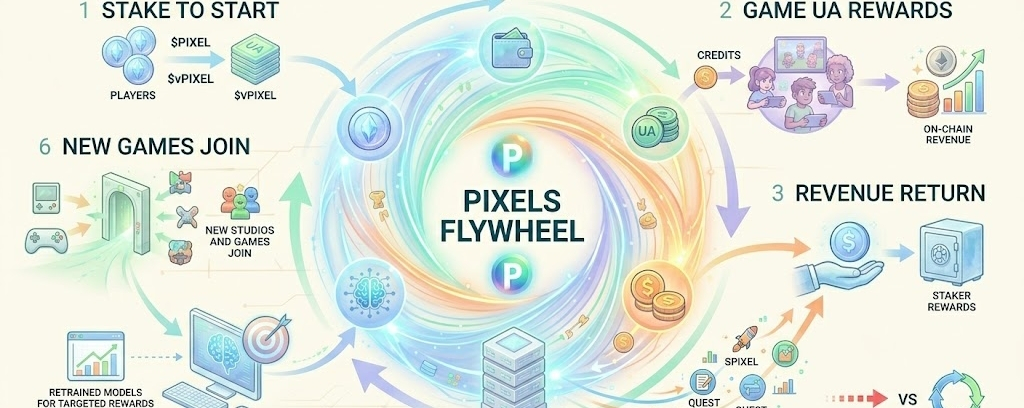
I have been studying how modern gaming economies actually work behind the scenes, and one thing becomes very clear very quickly. Most gaming ecosystems today are built on systems where value moves in one direction only. Money enters through ads, user acquisition, or token incentives and then slowly leaks out of the system with very little long term return.
After going through how Pixels is structured and how its internal flow operates, I started noticing something different. It is not just another gaming economy. It feels closer to a self recycling system where value does not exit easily but instead keeps circulating between players, games, and data.
The interesting part is that the same PIXEL does not stay fixed in one role. It keeps transforming its function inside the ecosystem. At one stage it acts like staking power, then it becomes growth fuel, then player rewards, later revenue feedback, and finally behavioral data that shapes the next cycle.
What makes this system worth attention is not any single mechanism alone. It is how all these parts connect into one continuous loop that keeps reinforcing itself over time. That is where the idea of a self sustaining growth flywheel starts to make sense.
1. Stake Becomes UA Credits
Everything starts with staking. Players lock their PIXEL or 1 to 1 backed $vPIXEL into a game they believe in. This is not only a financial action. It is also a signal of trust, attention, and long term confidence.
When staking happens inside a game it creates something powerful. It converts directly into UA credits. UA means user acquisition. Normally studios pay platforms like Facebook or TikTok for this. Here, the budget comes directly from the community.
The size of the staking pool directly influences the UA budget. Bigger stake means stronger growth capacity for that game. In return, strong games naturally attract more staking, which further increases their growth potential.
Marketing here shifts from external spending to internal support driven by player belief.
2. UA Credits Turn Into Real Players and Revenue
Once a game has UA credits, it uses them as in-game rewards. These rewards are not random. They are designed to bring new players in and reactivate old ones.
A player might receive rewards for completing early missions or for returning after a break. These small incentives pull users back into the game loop and increase engagement naturally.
As players engage, they start spending inside the game. That spending becomes real revenue. The important part is that this revenue is recorded on-chain inside the same system that created the UA credits.
This creates full transparency. You can clearly see how much was spent versus how much was used to acquire users. It turns user acquisition into something measurable instead of guesswork.
3. Revenue Comes Back as Staker Rewards
The cycle continues when revenue flows back to the people who staked in the first place.
Each game defines its own reward structure. Some reward early supporters more, others focus on long term holders. This flexibility allows different economic models to exist within the same system.
A key dynamic appears here. As a game becomes healthier and more stable, it can offer better rewards. Better rewards attract more staking, which increases UA capacity again.
This creates a natural competition between games. Stronger games grow faster because their internal feedback loop is more efficient, not because of external force.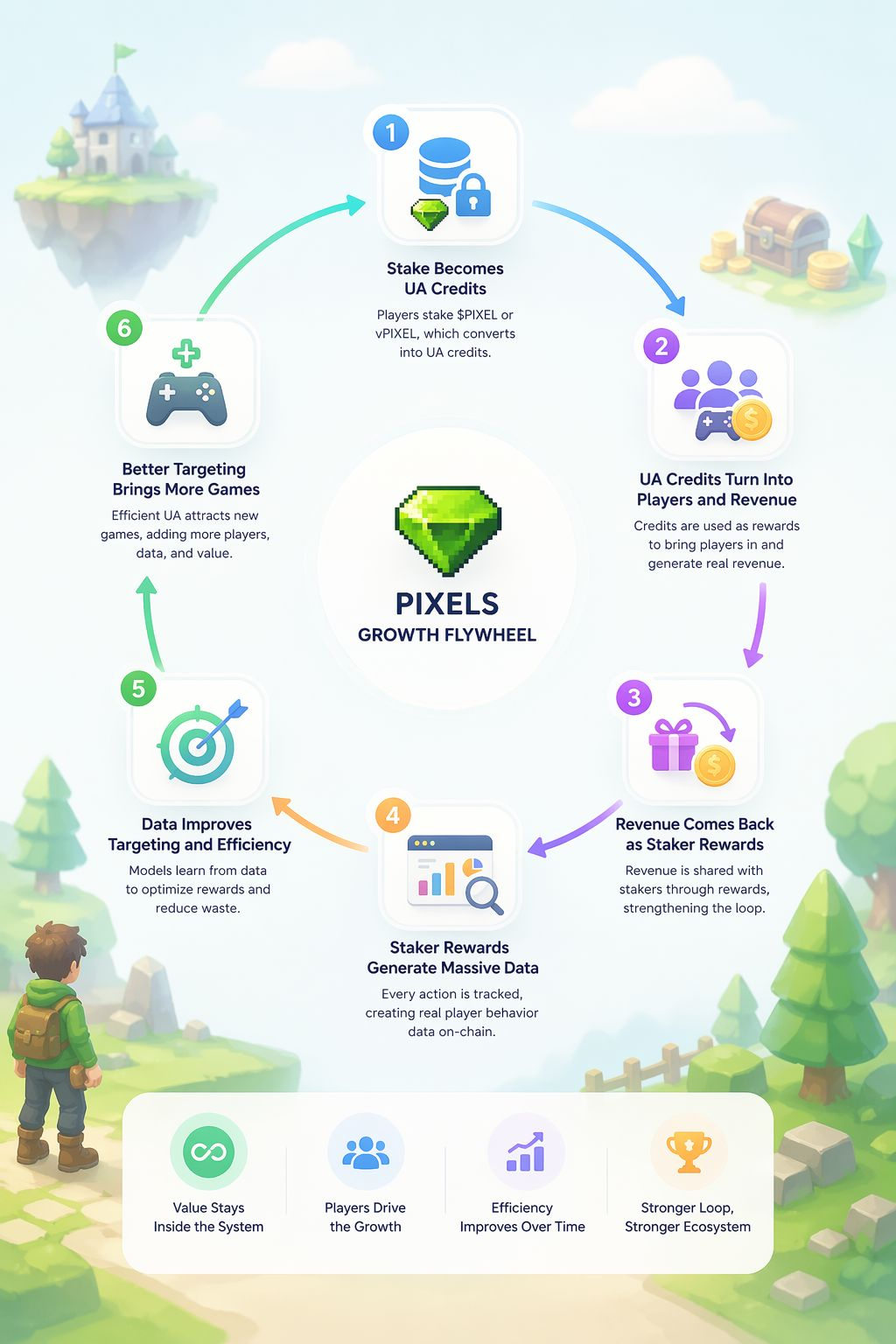
4. Staker Rewards Generate Massive Data
Every interaction inside the system creates data. Every purchase, quest, trade, or withdrawal is tracked through the Pixels Events API.
This is not basic tracking. It becomes a live behavioral dataset that shows how players actually behave in real time.
You can see retention patterns, session length, spending behavior, churn signals, and even detect unusual activity like fraud or extraction behavior.
Because this data comes directly from gameplay, it is first party and far more reliable than external tracking systems. Over time, it becomes one of the most valuable layers of the ecosystem.
5. Data Improves Targeting and Efficiency
Once collected, this data is used continuously. Models are retrained regularly to decide how rewards should be distributed.
The system learns which players respond best to incentives, when they are most active, and what type of rewards create real engagement.
High retention groups may receive stronger incentives. Low value or extraction-heavy groups may receive reduced rewards.
This improves overall efficiency. Instead of spreading rewards randomly, the system focuses on high impact moments and high value users.
Over time, this reduces waste. Rewards go more toward real players and less toward behavior that does not contribute to long term growth. The result is stronger retention and better return on every incentive spent.
6. Better Targeting Brings More Games Into the System
As efficiency improves, the system becomes more attractive for new studios.
Traditionally, user acquisition is expensive and unpredictable. But here, UA performance is visible on-chain. Studios can estimate growth potential before launching.
This reduces uncertainty and makes launching easier for new games.
Each new game adds more players, more behavior data, and more activity into the ecosystem. This does not only benefit the new game. It strengthens the entire network.
More games means more staking, more data, and better targeting models, which further improves the system for everyone.
Why This Is a Flywheel Not a Simple System
Most gaming or crypto systems behave like treadmills. You spend effort or money, but long term progress does not compound. Once spending stops, growth usually stops too.
This system works differently. It behaves like a flywheel.
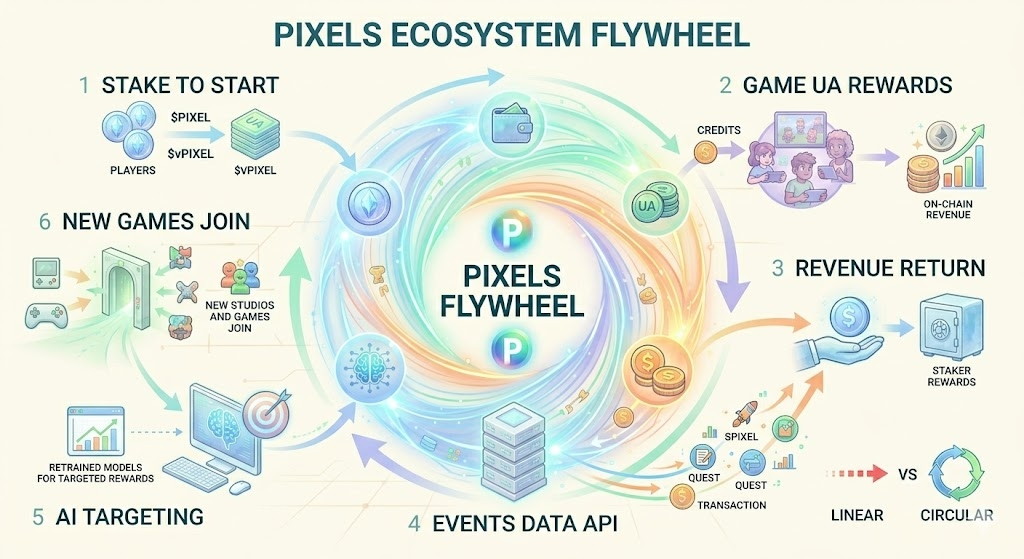
The same $PIXEL moves through multiple stages. It is staked, then becomes UA credits, then turns into player rewards, then becomes revenue, and finally returns as staking rewards. Along the way, it also becomes data that improves the next cycle.
Each rotation makes the system more efficient than the last one. Not because of external input, but because each layer improves the next.
Nothing exists in isolation. Each part supports another part, creating continuous feedback instead of one time output.
The Real Impact of the Cycle
The real strength of this model is compounding. A single cycle is useful, but repeated cycles create exponential improvement over time.
Players get better incentives. Games get better targeting. Studios get clearer growth signals. And the ecosystem becomes more efficient overall.
Value does not leave the system easily. It keeps circulating and getting reused in different forms.
Users are no longer just participants. They become part of the growth mechanism itself. Their actions directly influence funding, rewards, and data collection.
What also compounds is insight. Every interaction improves the next decision, which improves the next cycle.
Final Thought
After breaking down the full structure, one thing becomes clear. This is not a traditional gaming economy and it is not designed to behave like one.
What Pixels is building looks more like a closed loop growth engine where capital, users, and data continuously rotate instead of leaving the system.
Staking fuels growth. Growth brings players. Players generate revenue. Revenue returns to stakers. And every action produces data that strengthens the next cycle.
From a structural point of view, the key idea is simple. The system is designed so that value does not get lost after one use. It gets reused, refined, and redirected into the next stage of growth.
That is what makes this flywheel interesting. Not because it runs once, but because every rotation improves the next one in a measurable way.