
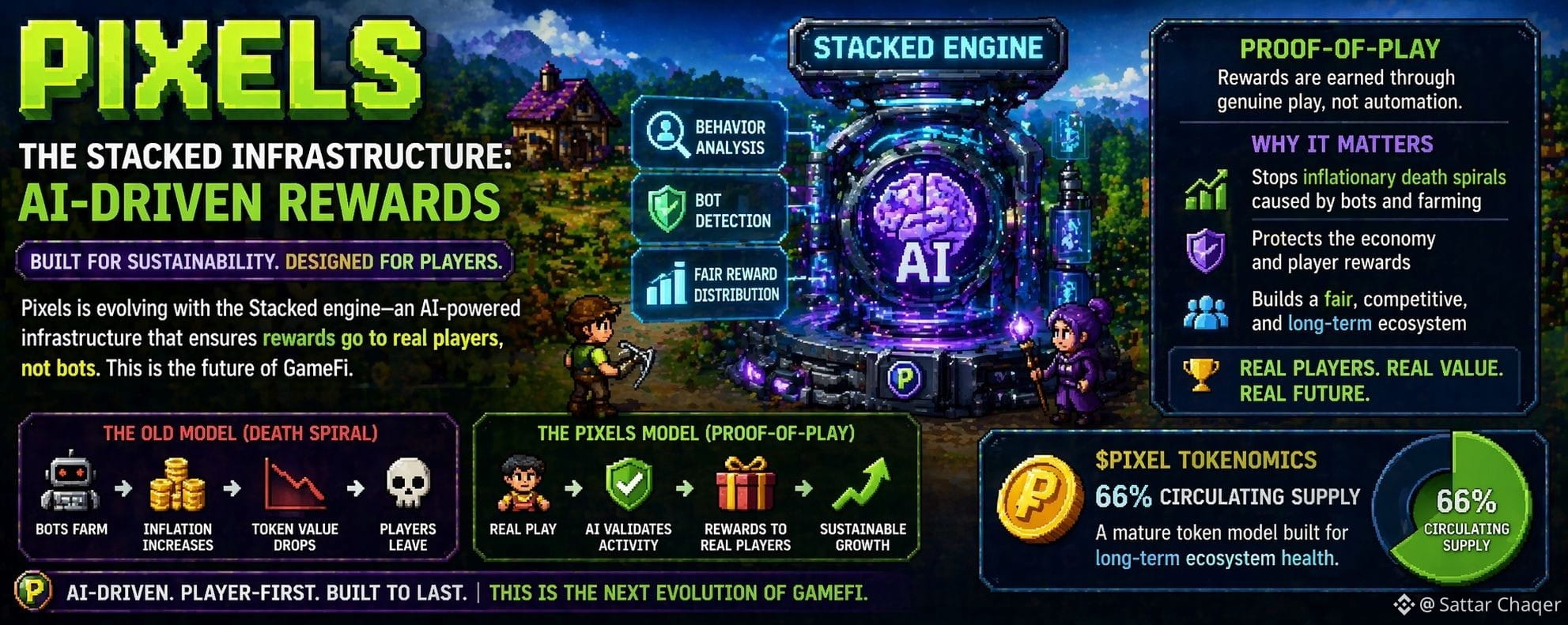


While looking into how Pixels is evolving the introduction of the Stacked infrastructure feels like a shift that goes beyond a simple feature update.
At first glance it’s framed around better reward distribution and bot resistance.
But the deeper idea seems to be something else.
Pixels is moving closer to a model where rewards are tied to actual behavior not just activity not just volume but the quality of participation itself.
That starts to look a lot like Proof of Play.
In earlier GameFi systems rewards were often distributed based on simple loops. Play more earn more. The problem is that these systems were easy to optimize not just by players but by bots.
And once that happens the balance breaks.
Rewards get extracted faster than value is created tokens flood the system and eventually everything starts to lose meaning. That’s the pattern most people refer to as the death spiral.
Pixels seems to be trying to avoid that.
With the Stacked engine rewards are no longer just emitted. They’re evaluated.
If AI is being used to analyze player behavior filtering bots identifying genuine interaction and adjusting distribution then rewards become conditional.
Not everyone gets the same output for the same input.
And that changes incentives.
Because now it’s not enough to simply participate.
You have to participate in a way the system recognizes as valuable.
That introduces a different kind of pressure.
Players start thinking less about maximizing actions and more about how those actions are interpreted by the system.
Which could make the overall economy more efficient.
Fewer wasted emissions. More targeted rewards. Less inflation over time.
And that ties into another important piece.
The current structure of PIXEL already shows signs of a more mature token model especially with a large portion of supply in circulation. That reduces some of the uncertainty that comes from heavy future unlocks.
But supply alone doesn’t solve sustainability.
Distribution does.
If rewards continue to flow without control even a well structured supply can face pressure. But if distribution becomes adaptive tied to real participation rather than raw output the system might hold its balance longer.
That’s where the Stacked layer becomes important.
It’s not just about stopping bots.
It’s about redefining what counts as meaningful activity.
And over time that could reshape how players approach the game itself.
Instead of optimizing purely for extraction players might need to align more closely with the system’s intended behavior.
Which sounds stable in theory.
But it also introduces a new question.
If rewards in Pixels become increasingly dependent on how AI interprets behavior does that create a more sustainable ecosystem.
or does it make the system harder for players to fully understand and adapt to?