
I didn’t enter Pixels thinking I would analyze anything. At first, it felt like a simple Web3 game, farming, crafting, upgrading, and repeating the same loops without much thought. I was playing casually, the way most games are played, just following actions without questioning what they meant underneath.
But over time, something subtle started to change in how I experienced it. I stopped seeing actions as isolated gameplay moments and started noticing something deeper connecting them, which was time. Not in an obvious or forced way, but in a quiet background structure where every decision began to feel slightly different depending on when I made it.
I didn’t consciously decide to think this way. It developed gradually. I would pause before certain actions without even knowing why, and I started comparing different activities not in terms of fun or reward, but in terms of how efficiently my time was being used inside the system. That shift was small at first, but once it appeared, it kept growing in the background of my thinking.
What made it even more interesting was how Pixels doesn’t explicitly tell you to optimize anything. Instead, it creates enough structure where you naturally begin to do it yourself. Delays, progression gaps, resource timing, and optional acceleration all exist in a way that encourages comparison without ever forcing it. Because of that, my mind started building its own internal logic for how time should be valued inside the game.
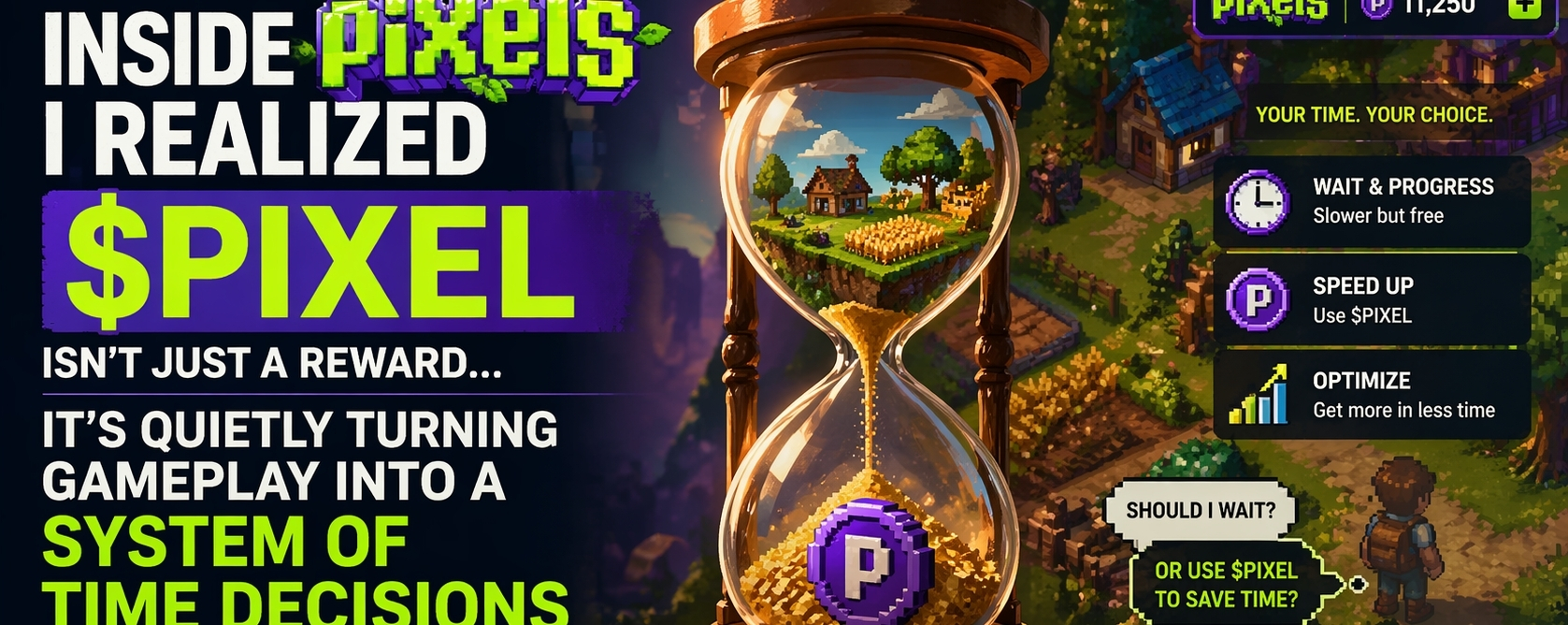
This is also where $PIXEL quietly became part of the experience. Not as a dominant feature, but as a layer that sits inside decision making. Sometimes it represents speed, sometimes efficiency, and sometimes just an option that changes how I think about waiting. But what matters most is not the mechanic itself, it is how it influences perception. It makes certain choices feel lighter, faster, or more efficient depending on how I choose to use it.
As I played more, I realized that I was no longer just deciding what to do next. I was constantly evaluating whether my time was being used in the best possible way at that moment. That question started appearing everywhere, in farming, in crafting, in progression, and even in simple waiting. Everything slowly began to feel connected through a single invisible layer of time value.
The most surprising part was that I didn’t learn this behavior from any instruction or guide. It emerged naturally just from interacting with the system long enough. Pixels doesn’t explicitly teach optimization, but it creates conditions where optimization becomes the natural response. Once that mindset forms, it changes how every action is interpreted.
Over time, I also noticed that different activities started feeling comparable even when they were not directly related. My mind began translating everything into a shared framework of time efficiency. That is when gameplay stops feeling like separate actions and starts feeling like continuous evaluation.
So now, when I log into Pixels, I don’t just think about progress or rewards. I think about timing, efficiency, and the silent value of every action I take. And $PIXEL sits inside that structure in a subtle way, not controlling it, but influencing how decisions feel within it.
I didn’t expect a simple game to change the way I think about time inside a system. But it did. And now, I am not just playing Pixels anymore. I am constantly navigating how my time is being shaped through every decision I make inside it