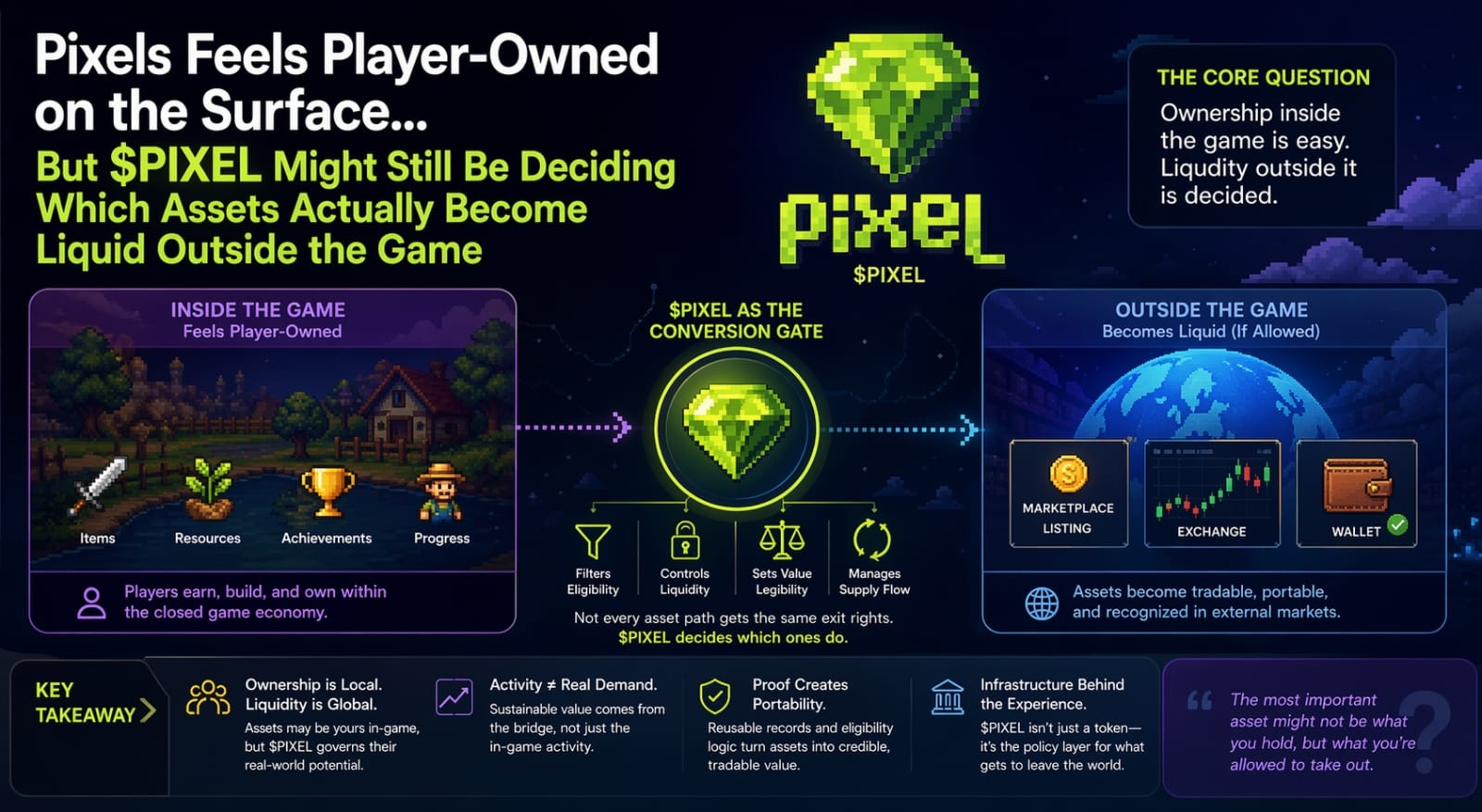
I keep thinking about how different things feel once you try to resell them. Almost everything looks valuable when it is sitting neatly inside its original environment. A skin inside a game menu, points inside an app, even store credit in a wallet. It all feels like ownership until you try to move it somewhere else. That is usually the moment the real rules show up. I think that hesitation is part of why Pixels has stayed interesting to me. On the surface it carries the language of player ownership, and maybe some of that is real, but I am not sure the deeper question is who owns the asset. I think it may be who controls the moment when that asset becomes liquid outside the game, and under what conditions.
That sounds like a small distinction at first, but it changes the whole frame. Ownership inside a closed system is one thing. Liquidity outside it is another. You can hold an item, earn a resource, build progress around it, and still remain dependent on a separate economic layer that decides whether any of that can travel. In practice, that layer matters more than the ownership language people usually focus on. A lot more, actually. Because markets do not price the feeling of possession. They price transferability, credibility, and repeated settlement.
I used to think game tokens mainly sat on top of the experience as a kind of reward rail. Play, earn, spend, repeat. Fairly standard. But with $PIXEL, the more interesting possibility is that it may function less like a reward and more like a conversion gate between internal game effort and external market value. Not every asset needs to become liquid. Not every action should. Still, if a token sits near the bridge between in-game accumulation and out-of-game realization, then it is doing something much more structural than just circulating through purchases or upgrades.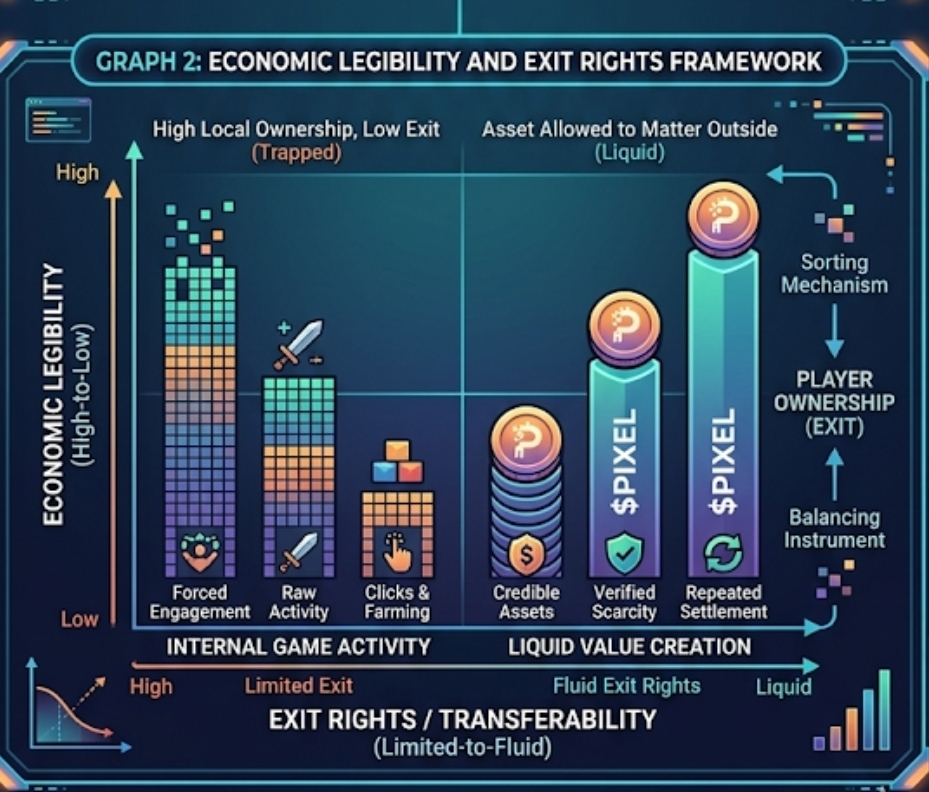
That is where the player-owned story starts to wobble a little. Because the question is not only whether players can accumulate things. It is whether the system lets those things become economically legible outside its own walls. Legible, in this case, just means understandable and acceptable to outside markets. An asset can exist, but if the market cannot verify how it was earned, how scarce it really is, how transferable it is, or whether the surrounding economy is stable, then ownership stays local. It looks strong from inside and weak from outside. I think that gap gets ignored too often.
There is also a difference between activity and liquid value creation. Games are very good at producing activity. Clicks, crafting, farming, upgrading, social coordination, daily routines. That part is easy to stimulate. The harder thing is deciding which of those activities deserve to produce assets that other people treat as credible beyond the game itself. And once you ask that, $PIXEL starts to look less like a general-purpose currency and more like a sorting mechanism. Not every asset path will carry the same exit rights. Not every player behavior will receive the same economic translation.
That translation layer matters because liquidity is not just a technical feature. It is a judgment. Somewhere in the system, rules are being set around what counts as valid effort, valid scarcity, valid progression. Even if those rules are not stated bluntly, they exist. They show up in token sinks, item gating, marketplace structure, access conditions, and the subtle ways one asset becomes tradable while another remains stuck as game-native status. So when people say a game feels player-owned, I now find myself asking a less comfortable question: player-owned in what sense? Owned enough to use? Owned enough to display? Or owned enough to exit?
And exit is where a lot of crypto-native systems quietly reveal themselves. If value can leave too easily, the system gets drained. If it cannot leave at all, the ownership promise starts sounding decorative. So the token often becomes the balancing instrument. It can slow release, filter eligibility, create conversion cost, or force players into repeat engagement before internal assets become economically meaningful outside the game. That is not automatically bad design. Honestly, it may be necessary. But it does mean the token is not neutral. It is deciding which forms of ownership become liquid and which remain trapped as participation memories.
I think this is also where demand gets misunderstood. People often see token usage and assume demand is healthy. But usage can be forced. It can come from dependency rather than preference. Real demand is different. Real demand persists even when incentives cool down, because the token is doing something users cannot easily replace. If $PIXEL is truly governing the conversion of in-game value into outside liquidity, then demand may depend less on how busy the game looks day to day and more on whether players believe that bridge remains worth paying for. That is a harder thing to sustain than raw activity.
There is another layer here. Reusable proof. I do not mean proof in a cryptographic sense only, though that matters too. I mean structured evidence that tells the system what kind of player, asset holder, or economic participant someone is without restarting from zero each time. If the game increasingly depends on persistent records of behavior, asset history, or eligibility logic, then liquidity decisions stop being one-off approvals and start becoming policy decisions encoded through repetition. The asset is not just liquid because you own it. It becomes liquid because the system recognizes a track record around it and allows that record to travel.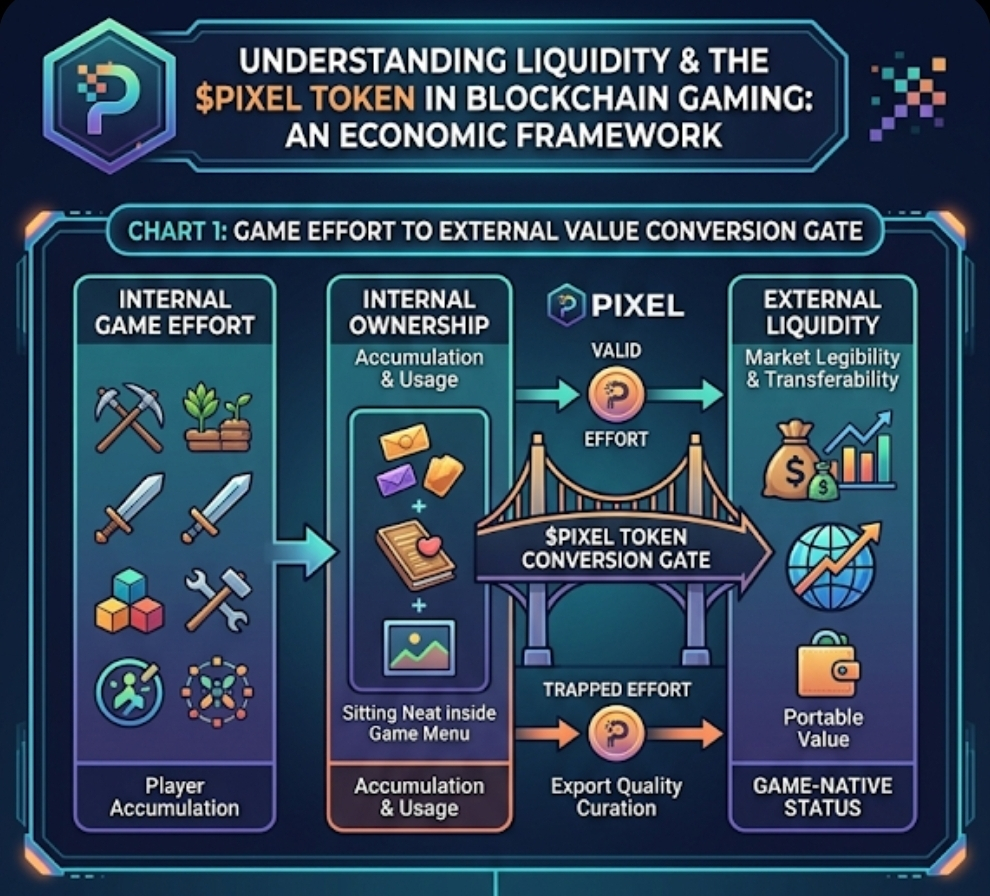
That is where the topic starts to feel bigger than a single game economy. Because once a token begins governing which internal objects are allowed to become external value, it is no longer just servicing play. It is curating export quality. It is saying something about which actions inside the world deserve recognition outside it. That feels a bit closer to infrastructure than entertainment, even if the interface still looks casual.
Maybe that is the real tension sitting underneath Pixels. It can feel player-owned on the surface because players are constantly accumulating, building, and interacting with assets that appear personal. But the deeper economic power may still sit with the layer that decides what becomes portable, credible, and liquid beyond the map itself. And if that is true, then the most important asset in the system may not be the item a player holds. It may be the permission structure wrapped around whether that item is allowed to matter somewhere else.