At some point, I stopped asking what I was doing in Pixels… and started asking why it felt so natural to keep doing it.
Nothing dramatic was happening. No big events, no explosive rewards, no loud signals telling me I was progressing. And yet, I stayed. I kept moving, gathering, crafting, circulating. The world didn’t push me forward it absorbed me.
That’s when it clicked: Pixels doesn’t run on moments. It runs on motion.
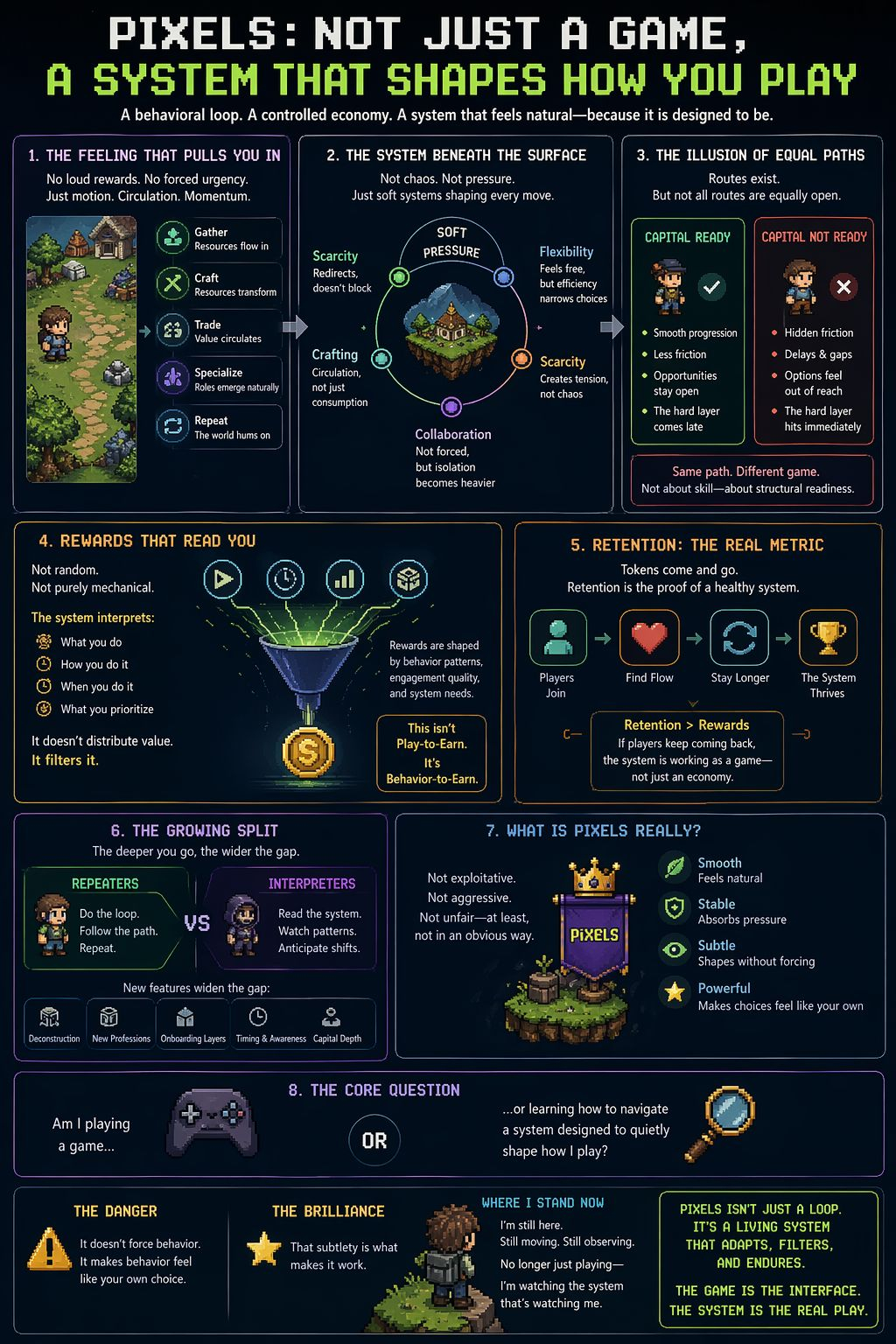
Everything in it feels quiet, almost passive. Players move, resources circulate, roles emerge, and the system hums in the background without ever announcing itself. It’s not trying to impress you with scale or spectacle. It’s trying to normalize participation. The world doesn’t expand when more players arrive it distributes them. It doesn’t break under pressure it absorbs it.
And that’s where things start to feel different.
Because when a system feels this smooth, this stable, this natural… you have to ask what kind of structure is holding it together.
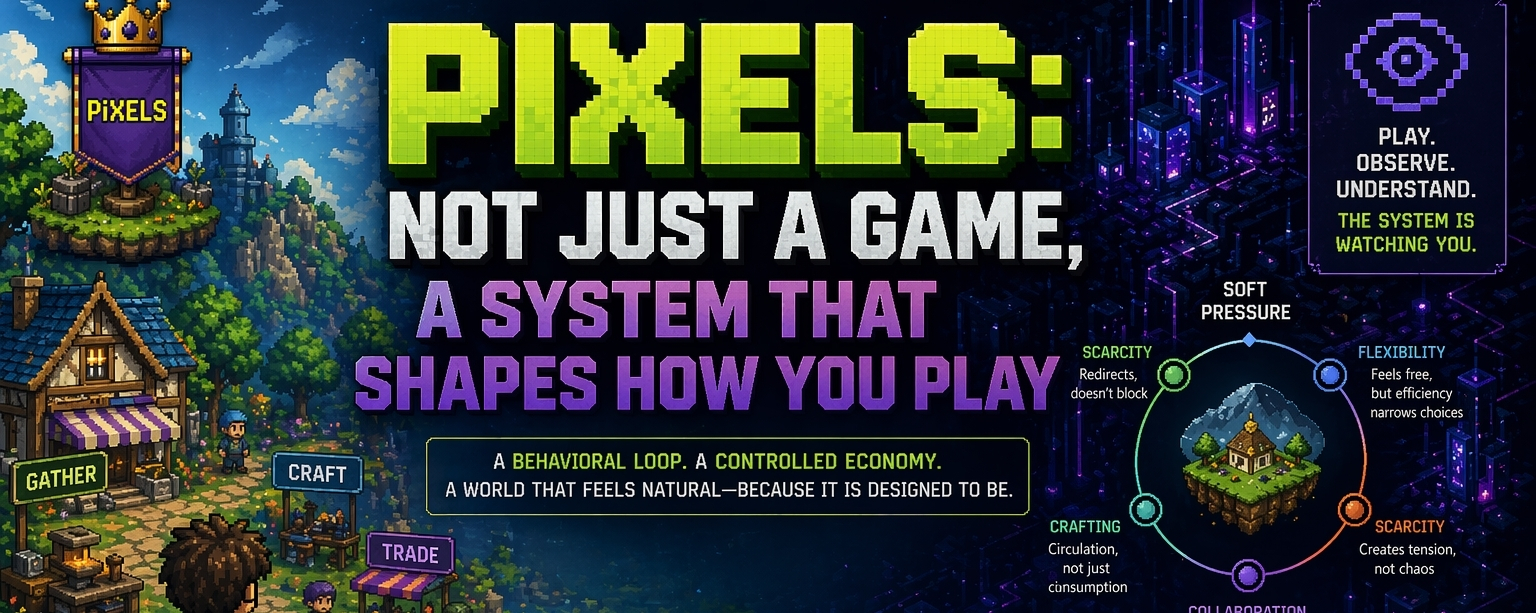
At first, it feels like freedom. You can gather, refine, trade, specialize. No one forces you into a role. But over time, you notice something subtle: flexibility starts to narrow. Not because the game tells you to optimize but because not optimizing begins to feel inefficient.
You’re not forced into collaboration either. But playing alone slowly becomes heavier, slower, less viable. The system never says “cooperate,” yet it quietly makes isolation the harder path.
That’s the pattern I kept running into: No hard rules. No loud restrictions. Just soft pressure shaping behavior.
Even scarcity works like this. It doesn’t stop you it redirects you. It changes where you go, what you value, what becomes worth your time. There’s no open conflict, no chaos. Just controlled tension.
And crafting? It’s not just a feature. It’s circulation. Resources don’t just get used they flow, transform, re-enter the system. It feels like gameplay, but it behaves like regulation.
The deeper I went, the more I realized: Pixels isn’t just a game loop. It’s a behavioral system.
And then came the moment that changed how I saw everything.
I followed a route that looked completely normal. Tasks were simple. Costs seemed manageable. It felt like pure gameplay until suddenly it wasn’t. I hit a wall, not of difficulty, but of liquidity.
That’s when I understood something uncomfortable: Some routes in Pixels aren’t blocked they’re selectively open.
They look playable inside the game, but depend on something outside it. Wallet readiness. Pre-positioned funds. Market access. Not obvious at first only visible after you’ve already leaned in.
That’s a very specific kind of friction. Not “pay to win.” Not even “expensive.” Just… conditional openness.
The route exists. You can see it. You can start it. But finishing it smoothly depends on whether capital is already close enough to support you.
And that changes everything.
Because now, two players can follow the same path but experience completely different games. One moves smoothly, barely noticing resistance. The other feels every gap, every delay, every missing piece.
The difference isn’t just outcome. It’s when the system becomes difficult.
For some, the hard layer comes late. For others, it’s immediate.
That’s not obvious inequality. It’s structural.
And then I started questioning rewards.
They didn’t feel random. But they didn’t feel purely mechanical either. It wasn’t just “do more, get more.” It felt like the system was… reading behavior. Interpreting how I played, not just how much.
If that’s true even partially then Pixels isn’t distributing value. It’s filtering it.
That’s a very different model from traditional play-to-earn. Instead of flooding rewards and letting extraction take over, it seems like Pixels might be trying something more controlled. More selective. More adaptive.
Not rewarding everything. Not rewarding everyone equally. But shaping what kind of participation gets rewarded.
If that’s the direction, then the real metric isn’t tokens or payouts.
It’s whether players keep coming back.
Because retention is the only proof that the system is still functioning as a game not just an economy.
But there’s tension here.
Because the more the system refines behavior, the more it risks turning play into interpretation.
After a certain point, grinding alone doesn’t feel enough. You start watching patterns. Prices. Scarcity shifts. Feature timing. You begin reading the system instead of just moving inside it.
And that creates a split: Players who repeat… and players who interpret.
New features don’t just add content they widen that gap. Deconstruction, new professions, onboarding layers they don’t affect everyone equally. They amplify differences in timing, awareness, and capital depth.
Which brings me back to the core question I can’t shake:
Am I playing a game…
or learning how to navigate a system designed to quietly shape how I play?
Because Pixels doesn’t feel exploitative. It doesn’t feel aggressive. It doesn’t even feel unfair in an obvious way.
It feels smooth. Stable. Natural.
And that might be the most powerful design choice of all.
The danger isn’t that it forces behavior.
It’s that it makes behavior feel like your own choice.
And the brilliance?
That same subtlety is what makes it work.
So I’m still here. Still moving, still observing. But I’m no longer just playing.
I’m watching the system that’s watching me.