
I used to follow the same route to the local shop every day. Same turns, same timing. It worked for a while. Then one day, construction blocked a small street I usually cut through. I kept walking the old way out of habit, even when it stopped making sense. It took me longer than I’d like to admit to adjust. Not because the path was hard to change, but because I wasn’t really paying attention anymore.
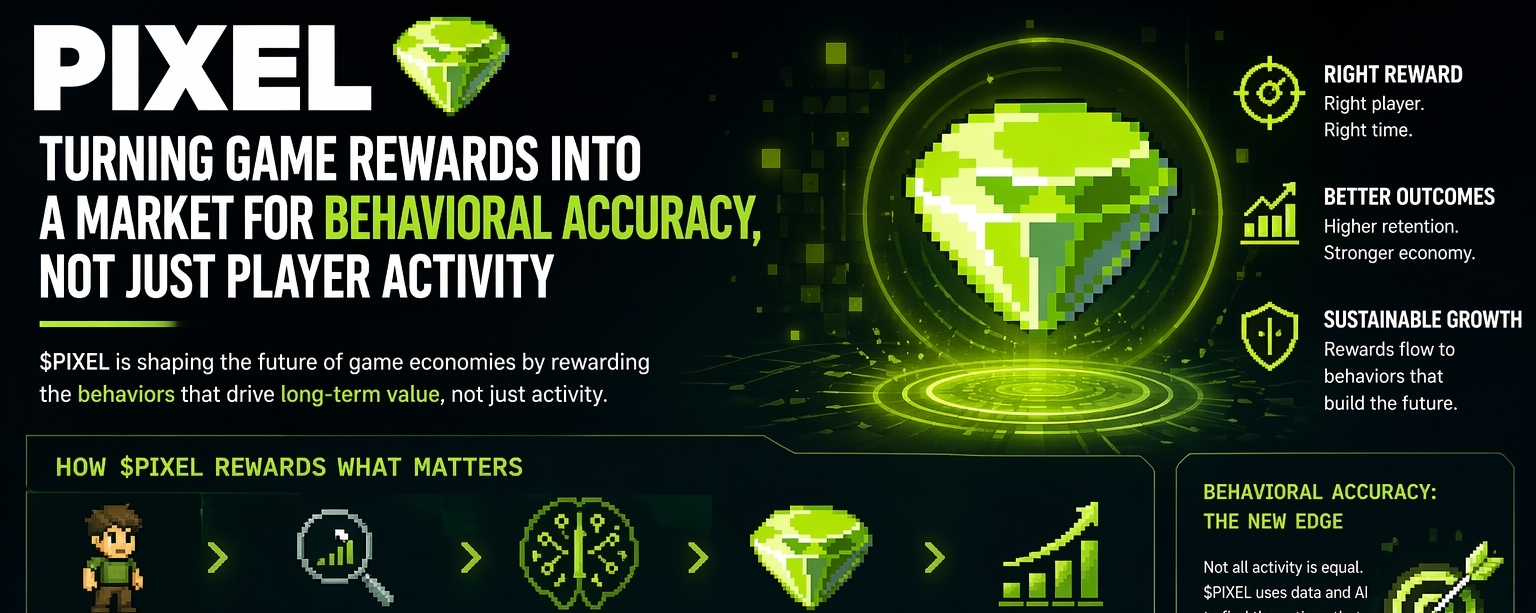
That feeling came back when I spent more time looking at Pixels.
At first, it looks like a simple loop. Do tasks, stay active, collect rewards. Nothing unusual. You could almost treat it like background activity. But then something starts to feel uneven. Not in a broken way. Just… slightly misaligned. You repeat the same actions you did yesterday, and the outcome doesn’t quite match. Not worse, not better, just different enough to notice.
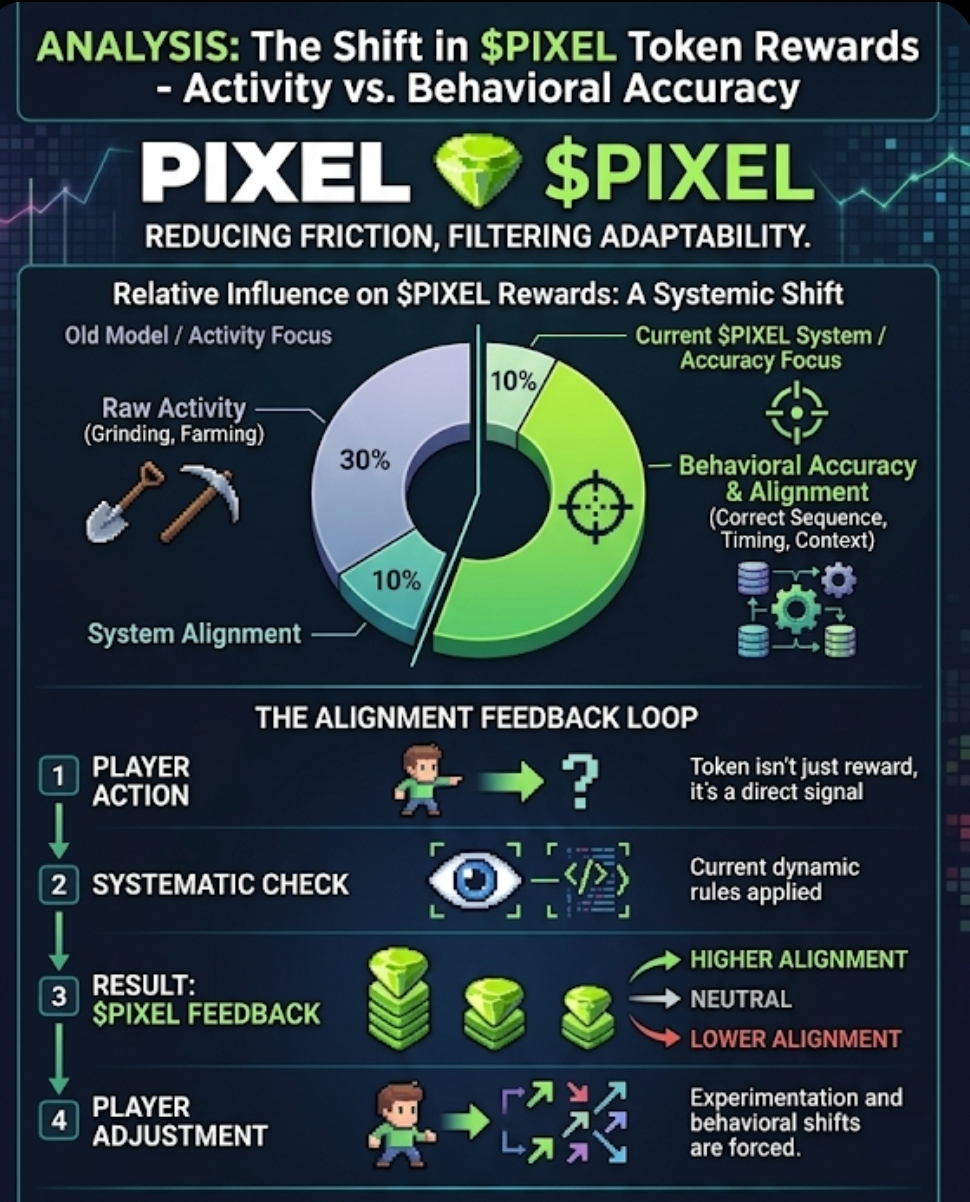
I think that’s where I started questioning my own assumption. I was treating activity as the main variable. As if the system only cared about how much you do. But it doesn’t really behave like that.
It feels more like it’s watching how you do things, not just how often.
There’s this quiet pressure to adjust. Not announced anywhere. No clear instructions. Just small signals. Some actions suddenly feel more efficient. Others lose their edge without explanation. If you’re paying attention, you shift. If you’re not, you keep grinding and wonder why things feel slower.
That’s where the idea of “behavioral accuracy” started making more sense to me, even if the term sounds a bit technical. It’s not about being active. It’s about being correct, in a way the system currently defines.
And the definition doesn’t sit still.
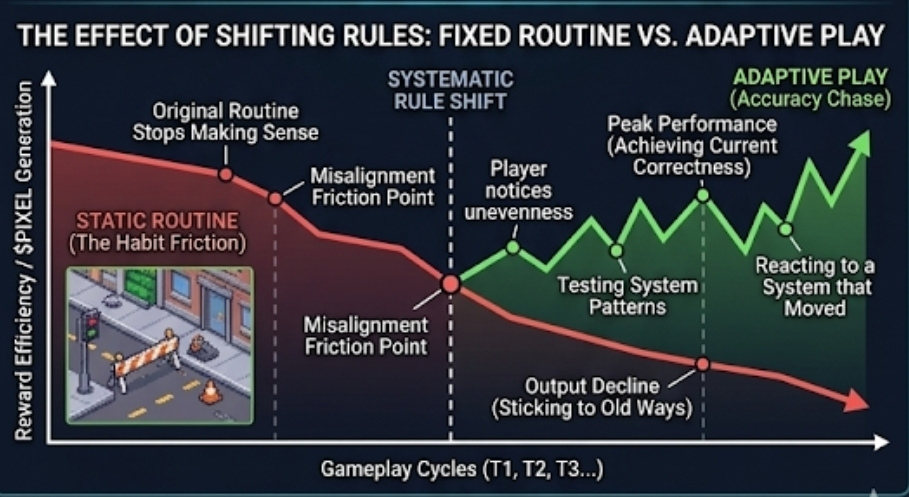
I’ve seen players stick to routines like they’re safe. Same farming loop, same crafting order. It looks consistent from the outside. But under the surface, the system seems to be moving around them. So the routine becomes less efficient over time, even if nothing obvious changes.
That’s a strange kind of friction. Not the usual “wait time” or resource scarcity. It’s more like misalignment friction. You’re still doing something useful, but not useful enough anymore.
The token, $PIXEL, sits right in the middle of this.
It doesn’t just feel like a reward. It feels like feedback. Almost like the system is quietly saying, “this behavior works… for now.” When you earn more, it’s not just because you did more. It’s because you matched something correctly. When you earn less, it’s harder to point to one clear reason.
That uncertainty does something to people. I’ve noticed it in myself too. You start experimenting more. Small changes. Different sequences. You’re not just playing, you’re testing the system.
It reminds me a bit of how content works on Binance Square. You can post every day, consistently, and still not get much reach. Then one post, slightly different in tone or timing, suddenly performs better. And you don’t always know why. The dashboard shows engagement numbers, but the real logic sits somewhere deeper.
So you adjust. You write differently. You post at different times. You try to “fit” what the system wants, even if it’s never fully explained.
Pixels feels similar, just translated into gameplay.
There’s something clever about this. It keeps things from going stale. If rewards were purely tied to activity, people would eventually optimize one loop and never leave it. That’s how most systems get drained over time. Here, the system keeps shifting just enough to prevent that.
But it also creates a different kind of tension.
Because if accuracy matters more than activity, then players are always slightly behind. You’re reacting to a system that already moved. And if you move too slowly, you feel it in your output.
Some players enjoy that. It turns the game into a kind of puzzle. Others might not even notice it clearly, but they feel the difference. Something about their routine stops working, and they can’t fully explain why.
That’s where it gets tricky.
If the system becomes too dependent on this kind of shifting accuracy, it risks becoming hard to trust. Not in a dramatic sense. Just in a quiet way where players stop feeling confident in their actions. They’re still playing, but with a bit more hesitation.
And hesitation changes behavior.
It can lead to over-adjustment. People chasing patterns that may not even be stable. Spending more time trying to decode the system than actually engaging with it. I’ve caught myself doing that in other environments too, especially where rewards depend on hidden logic.
Still, I don’t think this direction is accidental. It feels intentional. Almost like Pixels is trying to filter not just active players, but adaptive ones. The ones who notice shifts early. The ones who don’t rely on routine too much.
That creates a different kind of player base over time.
But it also raises a question I can’t fully settle.
If value comes from matching the system correctly, then how long before players start focusing more on predicting the system than actually enjoying the game itself?