
There’s a moment in Pixels that doesn’t feel important at first.
You pick something up—a resource, a crop, an item—and you don’t really know what to do with it.
You could use it.
You could save it.
You could sell it.
But you don’t actually know what it’s worth.
Not exactly.
Pixels doesn’t give you fixed value—it forces you to feel uncertainty.
And that’s where things get interesting.
In most games, value is clear. Items have defined uses. Progression is structured. You don’t question whether something is worth keeping—you already know. The system tells you.
Pixels doesn’t.
It gives you options without clarity.
And that creates hesitation.
You start second-guessing decisions. Should you sell now or wait? Is this resource more useful later? Are you making a mistake by using something too early? The game doesn’t answer these questions for you.
So you start paying attention.
To patterns.
To timing.
To what other players seem to be doing.
That’s when the experience shifts.
You’re no longer just collecting—you’re evaluating.
And that evaluation is where the system quietly builds depth.
Because uncertainty forces engagement in a different way. You’re not following instructions anymore. You’re forming judgment. Every small decision carries a bit of risk—not a dramatic one, but enough to make you think twice.
That thinking changes how the game feels.
Simple actions start to carry weight.
Selling isn’t just selling—it’s a decision. Using resources isn’t just crafting—it’s a commitment. Even holding onto something becomes a choice, not a default.
And over time, those choices shape how you play.
Some players become cautious. They hold, observe, wait for clarity. Others act quickly, accept mistakes, and learn through movement. Neither approach is wrong—but they lead to very different experiences inside the same system.
That’s the part most people overlook.
Pixels doesn’t separate players by mechanics.
It separates them by how they handle uncertainty.
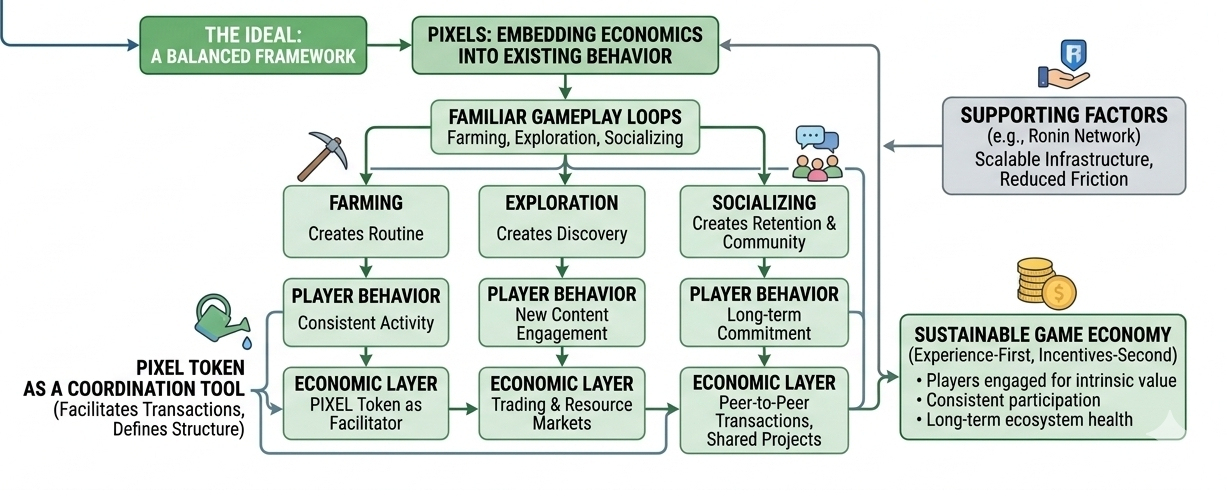
$PIXEL sits right in the middle of that.
It doesn’t define value—it reflects it. Prices move. Demand shifts. What felt insignificant earlier might suddenly matter later. And when that happens, players who paid attention react differently from those who didn’t.
The system rewards awareness.
But it doesn’t guarantee it.
That’s what makes it feel less like a traditional game and more like something alive. Not because it’s complex—but because it’s not fully predictable. You can’t memorize everything. You can’t optimize perfectly from the start.
You have to engage with it.
And that engagement creates tension.
Because uncertainty isn’t always comfortable.
It slows you down. It makes decisions harder. It introduces the possibility of being wrong. But at the same time, it makes outcomes feel earned in a different way. When something works, it feels like your decision—not just the game’s design.
That’s a subtle but powerful shift.
Pixels isn’t just asking you to act.
It’s asking you to decide without full information.
And in a system where value isn’t fixed…
that becomes the real game.