
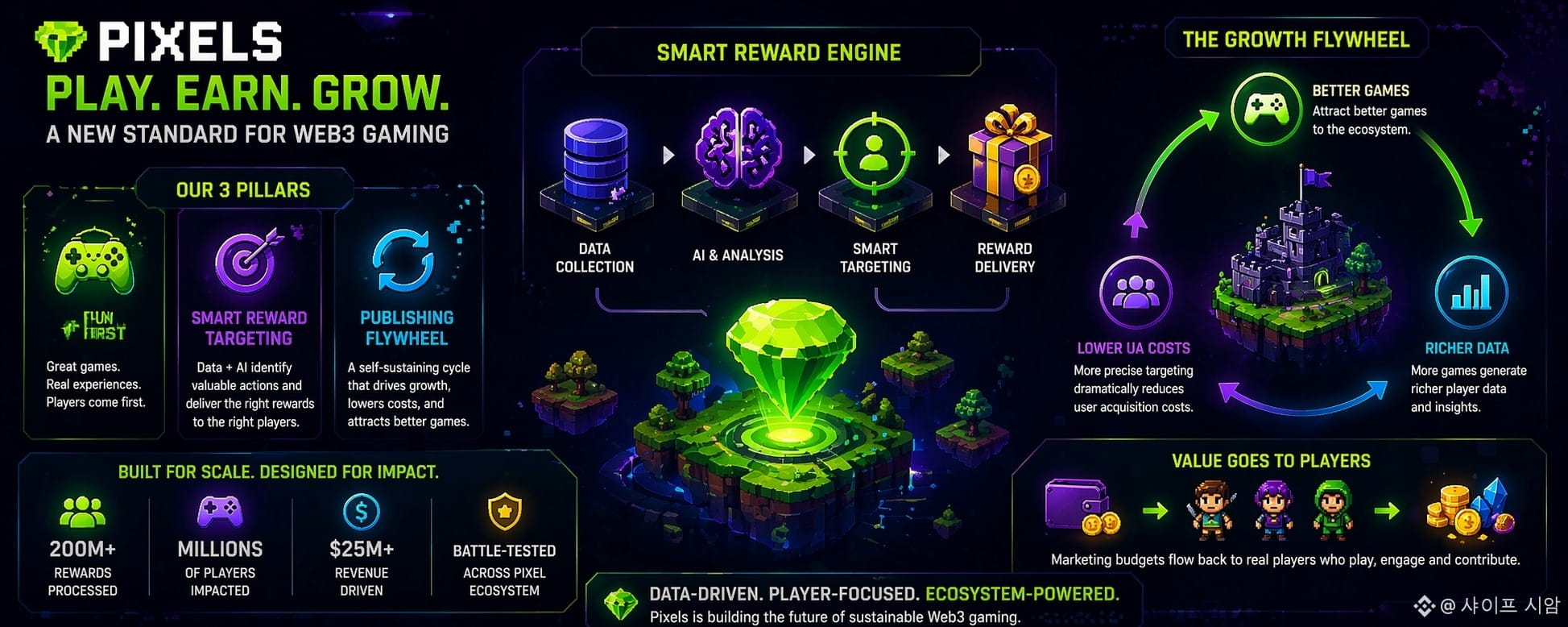
The evolution of Web3 gaming has exposed a fundamental limitation in traditional play-to-earn systems. Early models focused heavily on reward distribution but lacked the structural depth required to sustain long-term engagement. Pixels approaches this challenge by redesigning the relationship between gameplay, incentives, and economic flow through a system that is both data-driven and experience-focused.
At the foundation of the $PIXEL ecosystem lies a principle that is often overlooked in blockchain gaming: gameplay must stand on its own. A system built purely around earning quickly loses its appeal once incentives decline. Pixels avoids this trap by prioritizing engagement quality, ensuring that players remain active because the environment is interactive, enjoyable, and continuously evolving. This creates a stable base layer where retention is not artificially inflated but organically maintained.
Building on this foundation, Pixels introduces a reward allocation system that functions with precision rather than volume. Instead of distributing rewards evenly or randomly, the system identifies behavioral signals that indicate meaningful contribution. These signals may include progression milestones, consistent participation, or interaction patterns that correlate with long-term retention. By aligning rewards with these signals, Pixels ensures that incentives reinforce valuable actions rather than temporary activity spikes.
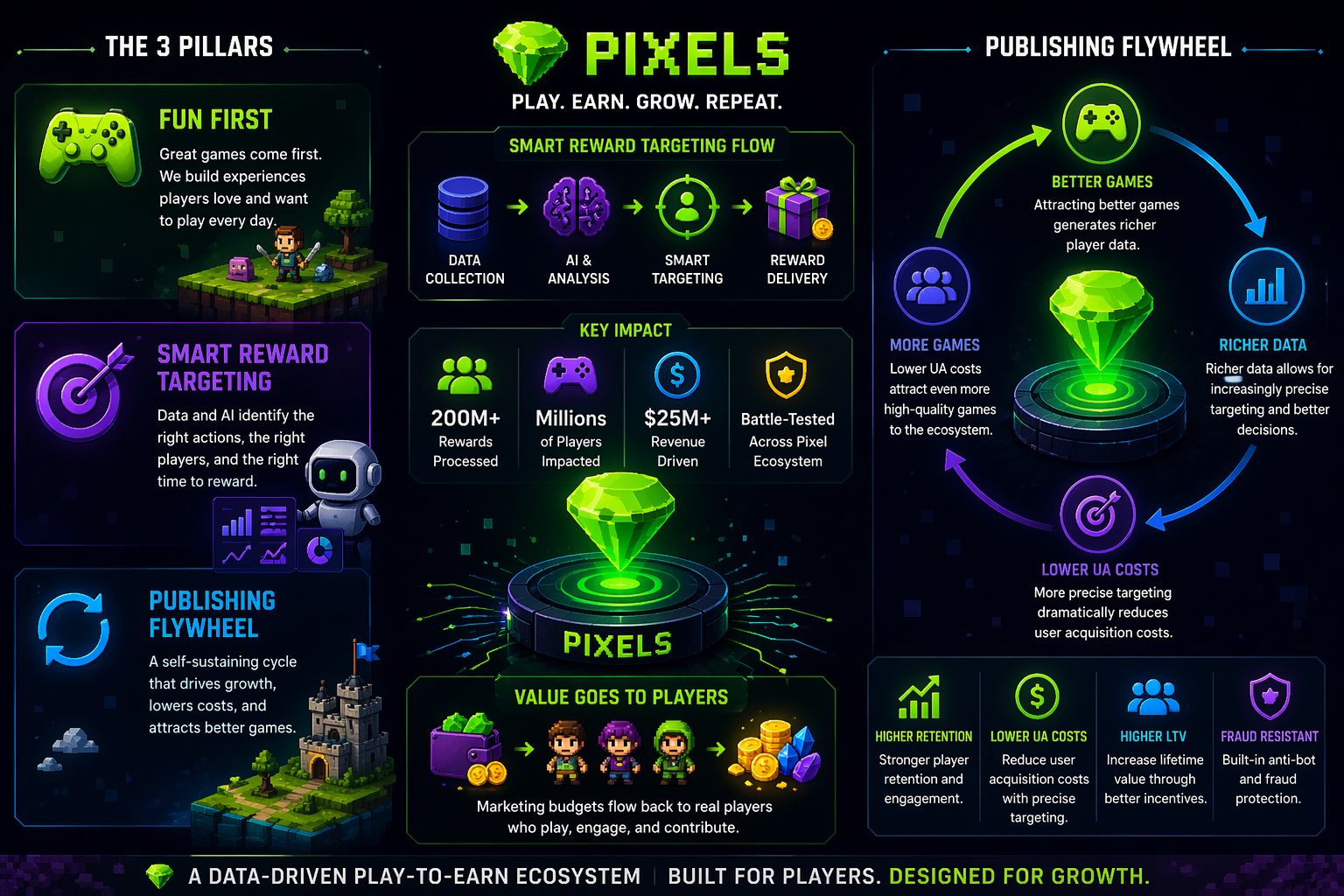
A key component enabling this level of optimization is the integration of large-scale data analysis. Every interaction within the ecosystem contributes to a growing dataset that reflects how players engage across different environments. This data is processed to detect trends, predict outcomes, and refine reward strategies in real time. As a result, studios are able to shift from broad, inefficient user acquisition methods to targeted engagement strategies that produce measurable improvements in metrics such as retention rates and lifetime value.
The structural advantage of this approach becomes more apparent when examining the growth mechanism embedded within the ecosystem. Pixels operates through a continuous feedback loop often described as a flywheel. As higher-quality games join the platform, they generate richer datasets. These datasets enhance targeting accuracy, allowing for more efficient reward distribution. Improved efficiency reduces acquisition costs, making the platform more attractive to additional developers. Each cycle strengthens the next, creating a compounding effect that accelerates ecosystem expansion without relying on unsustainable spending.
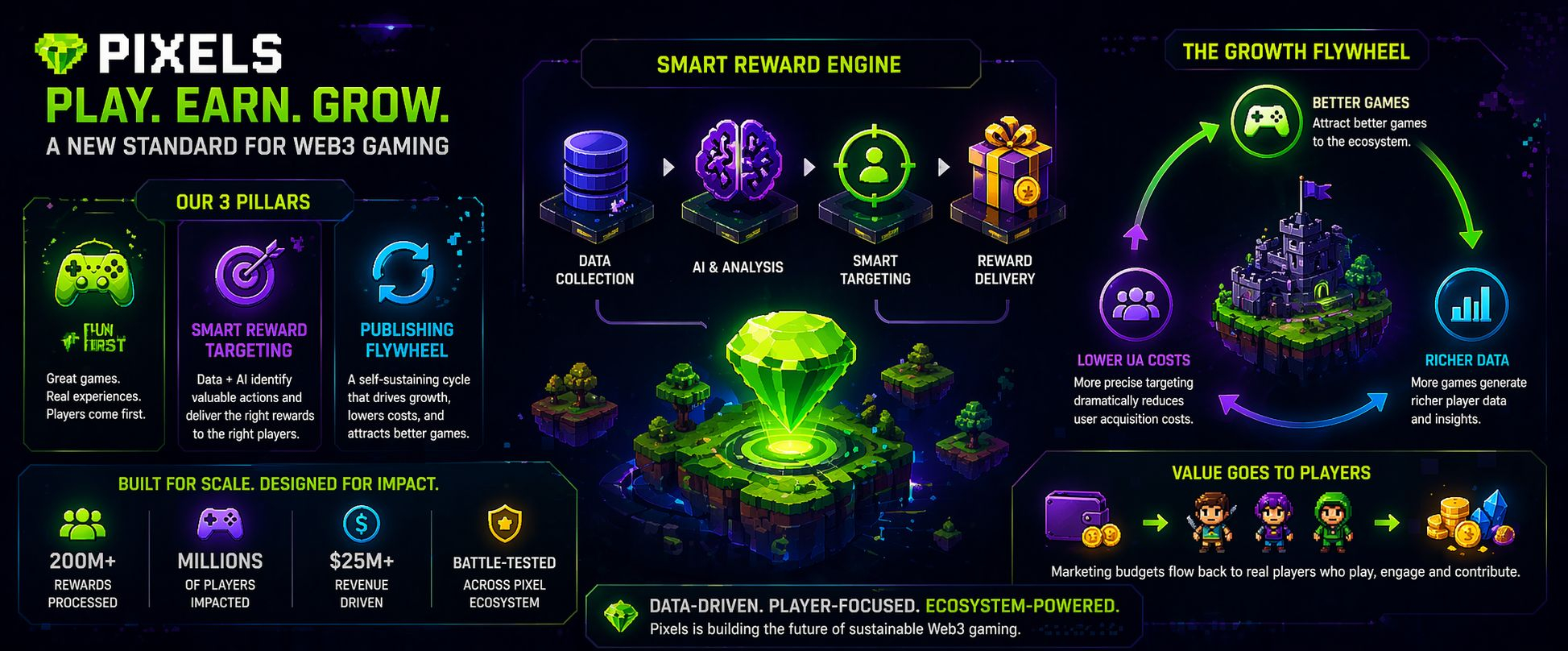
Another critical shift introduced by #pixel is the redirection of economic value. In traditional gaming ecosystems, a significant portion of revenue is allocated to external advertising platforms. Pixels restructures this flow by channeling value directly back into the ecosystem. Players who actively contribute receive a greater share of the generated value, transforming engagement into a form of participation rather than passive consumption. This redistribution not only improves user satisfaction but also strengthens the internal economy.
Scalability remains a defining factor in the long-term viability of any Web3 system, and Pixels demonstrates this through its operational performance. With millions of interactions processed and a continuously expanding user base, the system has already validated its ability to function at scale. More importantly, it maintains efficiency as complexity increases, ensuring that growth does not compromise performance.
In essence, @Pixels represents a shift from experimental reward systems to a structured economic framework. By combining engaging gameplay, intelligent reward targeting, and a self-reinforcing growth loop, the platform establishes a model where incentives are aligned with sustainability. Rather than relying on short-term attraction, it builds a system designed for continuous participation, measurable impact, and long-term ecosystem stability.