
I had completely given up on gaming for a while. Not in a dramatic way, just slowly stopped caring. Every game felt the same, you grind, you spend time, you close the app with nothing to show for it. Then someone mentioned Pixels to me. I honestly expected nothing. A farming game built on blockchain sounded either too nerdy or too boring or both. But I tried it anyway, and a few hours in I realized this was not just a game. This was a whole living economy that I was actually participating in, and the more I explored it the more I understood why people are talking about it so seriously right now in April 2026.
So let me tell you what I found, because I think a lot of people are still sleeping on this project.
What Pixels Actually Is Before Anything Else
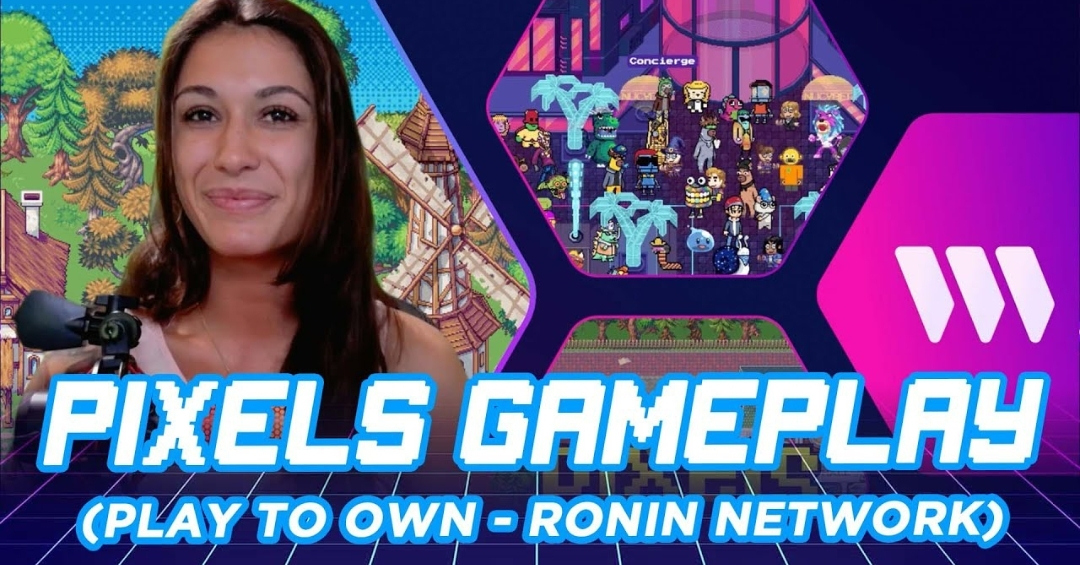
Pixels is an open world farming and exploration game running on the Ronin Network, the same blockchain that Sky Mavis built for Axie Infinity. But the vibe here is completely different from anything that came before it in Web3 gaming. You do not need to spend hundreds of dollars on NFTs just to get started. You create an account, you jump into the world, you start farming crops, collecting resources, doing quests, building skills, and interacting with other players. The entry barrier is low but the depth is surprisingly high.
The visual style is pixel art, think old school games like Stardew Valley or Harvest Moon but built inside a blockchain ecosystem with real ownership attached to everything you do. Your progress matters. Your land matters. Your items have actual value. And every action you take feeds into a larger economy that has real token mechanics behind it.
Since Pixels moved from Polygon to the Ronin Network back in 2023, the game exploded. At its peak it was pulling over a million daily active players, which made it the number one blockchain game by player count. That is not a small number. That is a massive living community all farming, trading, building, and competing inside the same world.
The Story Of How This Economy Evolved
Here is where it gets really interesting. When Pixels first got popular it had two currencies inside the game. One was called BERRY, which was an inflationary in-game token. The problem with inflationary tokens in games is always the same. The game gives out too much of it, players dump it, value drops, and eventually nobody cares about earning it anymore. It is a trap that killed dozens of Web3 games before they ever got a real chance.
Pixels saw this problem coming and made a bold decision. They started phasing out BERRY and consolidating the entire economy around a single token called $PIXEL . This is not just a cosmetic change. This is a fundamental shift in how the game economy works. When there is only one token that matters, players treat it differently. They hold it more carefully. They think before spending it. The economy becomes healthier because the supply and demand dynamics are actually working together instead of fighting each other.
And this transition started producing real results. In May 2025 the Pixels ecosystem hit a milestone that almost no Web3 game has ever hit before. For the first time, more tokens were being deposited into the game than were being withdrawn from it. Think about what that means. Players were putting value in rather than taking it out. That is the sign of a genuinely healthy game economy. That is the moment where you stop calling something a game and start calling it an ecosystem.
What PIXEL Actually Does Inside The Game
Let me be very direct here because I think people underestimate how deep the utility of PIXEL goes inside this project. It is not just a speculative token you buy and hope it goes up. It has real use cases baked into the game itself and that is what separates Pixels from a lot of other GameFi projects that are just riding hype.
First, PIXEL is the currency for minting NFTs inside the game. Every future NFT that comes out of Pixels will require PIXEL to mint. This creates consistent demand that is directly tied to how active the game is. More players, more NFTs, more PIXEL needed.
Second, there is the VIP Battle Pass system. Players can buy VIP membership using PIXEL and in return they get access to exclusive content, extra earning opportunities, reduced fees on the in-game marketplace, and perks that make the daily grind a lot more rewarding. It costs around ten dollars worth of PIXEL per month, which is honestly not that different from paying for a Netflix subscription, except here you are paying into an ecosystem you actually own a piece of.
Third, there are Guilds. Guilds are a social-fi feature where players come together, use PIXEL to create or join groups, and work collaboratively toward shared goals and rewards. This is not just a game mechanic. This is community building with economic incentives attached to it. When people have a financial reason to collaborate and a shared identity inside a game, the engagement levels go through the roof.
Fourth, there are quality of life upgrades. Want to speed up your build times, unlock new crafting recipes, get better skins, or boost your energy? All of that goes through PIXEL. Every premium experience in the game runs through this one token.
And fifth, governance. Eventually PIXEL holders will be able to vote on decisions related to the community treasury. This is the part where the game stops being just entertainment and starts being an actual decentralized organization that players collectively own and direct.
Chapter 2 Changed Everything And Chapter 3 Is Coming
Pixels released Chapter 2 in June 2024 and it was a significant overhaul. New skills were added to the game. The marketplace was completely redesigned. A new avatar system came in with visual updates across the board. The overall feel of the game became more polished and the earning structure became more strategic. Players could no longer just mindlessly grind and expect big returns. You had to think, plan, and build your approach based on your goals.
Now in 2026 the ecosystem is pushing into Chapter 3 development and the direction is even more ambitious. Combat mechanics are being introduced. Procedurally generated Exploration Realms are being added, which means every player's exploration experience can be unique and different. The game is no longer just a farming simulator. It is growing into a full adventure experience with progression depth that can keep players engaged for years.
And Pixels is not stopping at just one game. The team is developing five to six games that will all exist within the same ecosystem, with PIXEL functioning as the connective tissue across all of them. Players will be able to stake PIXEL into specific Game Validators, which is a community-driven way of deciding which games get resources and development attention. This is decentralized publishing, run by the players themselves.
Multi-Game Staking And Why It Is A Big Deal
The staking model that Pixels has built is genuinely different from what most projects are doing. You are not just locking your tokens for some percentage yield and waiting. When you stake PIXEL into a Game Validator you are literally casting a vote for which games in the ecosystem deserve to grow. You are becoming a publisher, in a small way, with actual economic skin in the game.
Two coins worth looking at as reference points for how token utility works in gaming ecosystems are $CHIP and $MET . Both of these tokens show different approaches to in-game economies and community engagement. PIXEL's model learns from the broader space and takes a more integrated approach where the token is woven into gameplay, governance, and the entire multi-game publishing structure rather than sitting on the outside as a detached financial instrument.
The Numbers Behind The Token
The total supply of PIXEL is capped at five billion tokens, and the unlock schedule runs across sixty months on-chain. The biggest allocation, thirty four percent, goes toward ecosystem rewards, which means gameplay, staking, and the decentralized publishing system. Seventeen percent sits in a community-owned treasury governed by a DAO. The team holds twelve and a half percent under long-term vesting, which is important because it means the developers cannot just dump and disappear. Their incentives are locked to the long-term health of the project.
The Binance Launchpool allocation was seven percent and Binance actually distributed three hundred fifty million PIXEL tokens to its community during the initial launch period. That kind of exchange support at launch is rare and it shows the level of institutional confidence that was behind this project from day one.
Why This Project Feels Different From The Usual Web3 Gaming Hype
I have watched a lot of Web3 gaming projects come and go. Most of them follow the same pattern. Big promises, flashy tokenomics, early players make money, late players lose, and the game quietly dies. Pixels breaks this pattern in a few important ways.
The team has been building since 2021. They did not rush to market. They built the game first, let players experience it, listened to what was working and what was not, and only then launched the token. The move from Polygon to Ronin was not a panic move. It was a strategic decision to find a blockchain environment that could actually handle the player load and give the game room to grow.
The economic reform of phasing out BERRY and centralizing around PIXEL showed that the team is willing to make hard decisions for the long-term health of the project even if it creates short-term friction. That kind of discipline is rare in crypto. The milestone of net-positive token deposits in May 2025 was not just a statistic. It was proof that the discipline worked.
The connections to over ninety Web3 projects including major names like Mocaverse and YGG show that Pixels has built real relationships in the broader ecosystem. It is not an island. It is a hub.
Conclusion
If you are someone who loves gaming and you have been curious about Web3 but never found the right entry point, Pixels is genuinely worth your time right now. The game is free to start, the community is massive, and the economy is at a stage where it is mature enough to be trustworthy but still early enough for new players to build meaningful positions.
PIXEL is not just a meme or a hype coin. It is the economic engine of a living, growing, multi-game ecosystem that is building toward something genuinely big. With Chapter 3 on the horizon, the multi-game publishing expansion underway, and a community that is growing every single day, this is one of those moments where paying attention to a project early actually makes a real difference.
@Pixels is building the future of gaming, one pixel at a time, and the token powering all of it is PIXEL.