
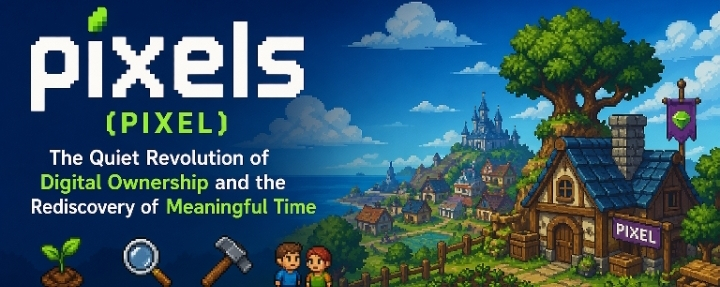
There’s a quiet kind of game that doesn’t announce itself.
No explosions. No urgency. No loud promise that it’s about to change your life. You just log in, move around a bit, plant something, maybe talk to someone you don’t know—and for a while, nothing feels remarkable. Then you notice you’ve been there longer than you planned. Then you come back the next day without really deciding to. That’s usually when it hits you: something about this is working on you, slowly, almost politely.
Pixels sits in that space. It doesn’t try to impress you in the first five minutes, which is already unusual. Most games treat your attention like something fragile that needs to be grabbed and locked down immediately. Pixels doesn’t seem particularly concerned with that. It assumes you’ll either stay or you won’t. And strangely, that confidence—or maybe indifference—is part of its pull.
On paper, it’s easy to describe. A social, casual Web3 game on the Ronin Network. Farming, exploration, crafting. The kind of summary that sounds like it could apply to a dozen other projects. But the experience doesn’t really match the description. There’s something softer happening under the surface, something less mechanical than it first appears.
You plant crops in Pixels, but it doesn’t feel like a task designed to optimize your time. It feels closer to a routine. There’s a difference. In most games, repetition is something you tolerate because it leads to rewards. Here, repetition becomes the reward—or at least part of it. You return to the same patch of land, go through the same motions, and instead of feeling trapped in a loop, you feel anchored by it. It’s subtle. Easy to miss if you’re expecting constant stimulation.
I found myself thinking about older games while playing—titles where nothing particularly dramatic happened, but you stayed anyway. There was a kind of trust back then, between player and game. You gave your time, and the game didn’t rush you or manipulate you too aggressively in return. Somewhere along the way, that relationship changed. Everything became louder, faster, more insistent. Pixels feels like a small rebellion against that shift, though I’m not entirely convinced it’s intentional. Sometimes it just feels like the byproduct of a different set of priorities.
The Web3 layer complicates things, of course. It’s impossible to talk about Pixels without addressing ownership, because that’s one of its defining features. You can own land, items, resources—things that, in theory, extend beyond the boundaries of the game itself. That idea has been floating around for years now, often packaged with a lot of noise and unrealistic expectations. Most attempts at combining gaming with blockchain ended up feeling like financial experiments first and games second. Players could sense it. They always can.
Pixels seems more restrained. Not pure, not untouched by speculation—but restrained. The economy exists, but it doesn’t dominate every interaction. You’re not constantly reminded of the monetary value of what you’re doing, which is probably why the experience feels more intact than many of its predecessors. Still, I can’t help but wonder how long that balance can hold. Once real value is attached to digital actions, behavior changes. It always does. People optimize. They extract. They turn routines into strategies.
And yet, even with that tension, the game manages to create moments that feel oddly personal. I remember walking through a player’s land—someone I didn’t know, will probably never know—and just observing how they arranged things. Crops placed in a certain pattern, pathways that didn’t quite follow efficiency, small decisions that suggested a person rather than a system. It reminded me that even in structured environments, people leave traces of themselves. Pixels gives enough freedom for those traces to exist.
There’s also something to be said about the pace. Or maybe the lack of pressure. You’re not being pushed toward an endgame. There isn’t a clear sense that you’re supposed to “win” anything. That absence can feel disorienting at first, especially if you’re used to games that constantly validate your progress. But after a while, it becomes relieving. You start to define your own objectives, even if they’re small and slightly irrational. Checking your crops. Expanding your land. Trading with someone because it feels fair, not because it’s optimal.
I’m aware that this kind of design isn’t for everyone. Some people will find it boring. Others will dismiss it as shallow because it doesn’t immediately reveal complexity. That’s a reasonable reaction. Pixels doesn’t confront you with its depth; it lets you discover—or ignore—it at your own pace. There’s a risk in that approach. A lot of players won’t stay long enough to see what’s underneath.
What interests me more is what Pixels suggests about the direction of digital spaces. Not in a grand, overhyped way, but in small, practical terms. What happens when players actually own parts of the environments they spend time in? What changes when your effort isn’t just consumed by a closed system but persists in some form? These questions aren’t new, but they’re starting to feel less theoretical.
At the same time, I’m cautious about framing Pixels as some kind of turning point. The industry has a habit of declaring revolutions too early. There are still unresolved issues—accessibility, sustainability of the economy, the balance between engagement and extraction. And then there’s the broader question of whether players even want this level of ownership, or if it introduces a kind of responsibility that makes games feel less like escape and more like work.
Because that’s the other side of it, isn’t it? When your time has value, it stops being purely recreational. Even if the game doesn’t push you in that direction, the possibility is always there. You start thinking about efficiency, about missed opportunities, about whether you’re playing “correctly.” It’s a subtle shift, but it can change the texture of the experience.
And still, despite all that, I keep coming back to the feeling Pixels creates in its quieter moments. Standing in a field you’ve been tending for days. Watching small changes accumulate. Recognizing patterns in your own behavior. It’s not dramatic. It doesn’t make for a compelling trailer or a viral clip. But it lingers.
Maybe that’s what makes it worth paying attention to.
Not because it’s perfect, or because it’s the future of gaming, but because it experiments with something that feels slightly forgotten. The idea that a game can be a place you inhabit rather than a system you conquer. The idea that time spent doesn’t need to be justified immediately. The idea that ownership—real or perceived—can deepen your connection to a digital space without completely distorting it.
I don’t know if Pixels will maintain that balance. I’m not sure any game can, especially once scale and money enter the picture in a serious way. But for now, it occupies an interesting middle ground. Not entirely a game in the traditional sense, not fully an economic platform, but something in between. Something still figuring itself out.
And maybe that’s why it feels human.
A little uncertain. Slightly uneven. Not always efficient. But quietly persistent.
The kind of experience that doesn’t demand your attention, yet somehow keeps it anyway.