
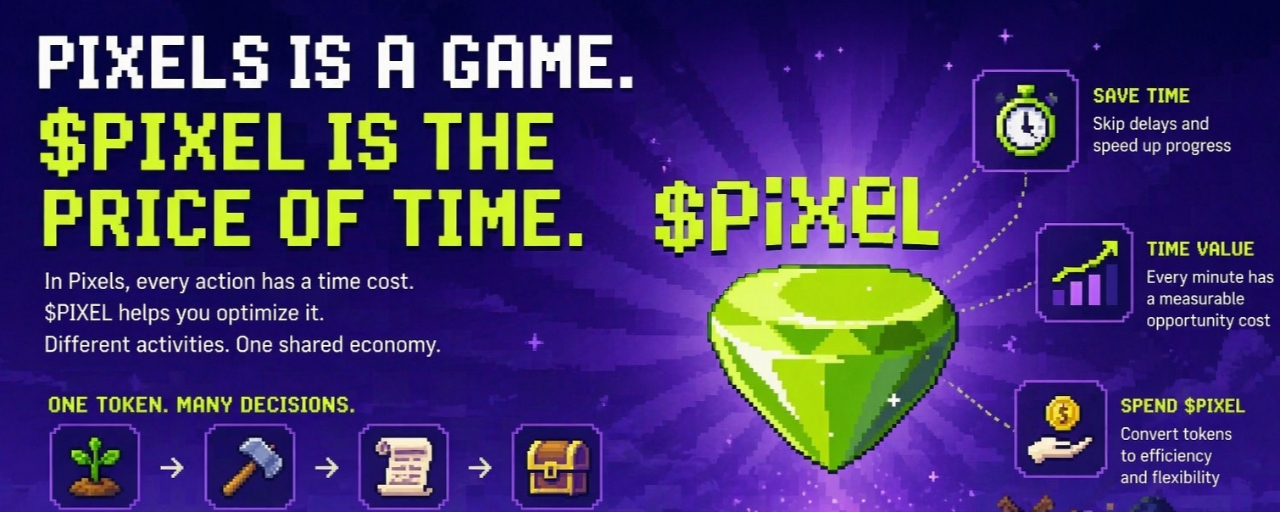
For a long time, I viewed in-game time as something unimportant. You log in, do a few things, then log out. Nothing really sticks. It’s not like work, where hours have value, or infrastructure, where delays cost you. In-game, time seemed disposable… until it wasn’t anymore.
The pixels don't immediately change that impression. At first glance, it just looks like a regular farming loop. Planting, waiting, harvesting. I didn't think much about it. But after a while, I noticed something slightly unsettling. Not clear-cut. Just a silent pattern, where different activities started to feel… comparable. Almost as if they were being measured against each other, even when they shouldn't be.
That's when everything started to change for me.
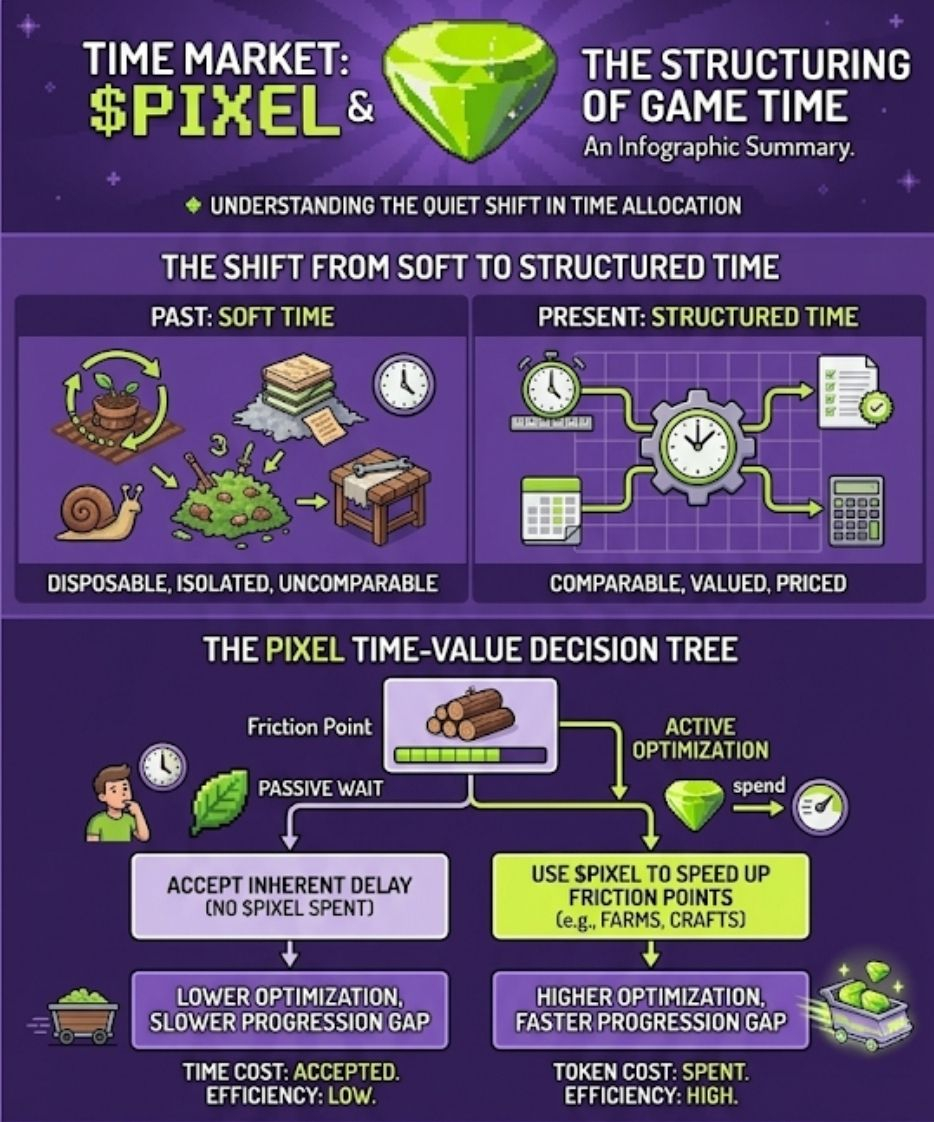
Most games don’t tackle this issue properly. Farming time is separate from crafting time. Quests are in a completely different aspect. You can't meaningfully compare them. The system doesn't attempt to do that. It simply rewards each different loop and hopes players don’t notice the inconsistencies.
Pixels seems to be trying to address that issue, but not directly. It doesn't say, 'This is a time market.' It just builds enough structure for time to start functioning like a real-time marketplace.
And once that happens, $PIXEL is no longer just a reward. It starts to resemble a pricing tool.
I didn’t realize this until I started doing small calculations mindlessly myself. Is it worth waiting here? Should I spend time? $PIXEL How do I speed things up? Not just in one activity, but across various aspects of the game. Farming, crafting, pacing… all starting to feel like variations of the same decision.
That’s quite unusual.
Because now the question is no longer 'What should I do next?' but silently becomes 'Where is my time currently most valuable?'
It's a different system. Less focused on diversity in gameplay, and more on time allocation.
And the coin is right in the middle of it.
Interestingly, this friction is very subtle. It’s not harsh. You’re not forced to spend money. But there are enough delays, enough little slowdowns, that you start to notice them piling up. Individually, they’re not bothersome. But combined, they create a continuous underlying pressure.
You can wait… or you can adjust the speed.
That's the crux that helps Pixel shine.
In a way, it reminds me of cloud services more than a game economy. You pay to reduce latency, which basically means you're paying to save time. Faster processing, quicker distribution, faster execution. This system doesn't directly sell results. It sells efficiency in time.
Pixels seems to be doing a simpler version of that idea. The same concept, but in different environments.
The difference here is that it’s tied to player behavior. Not machines. Not infrastructure in the traditional sense. But humans.
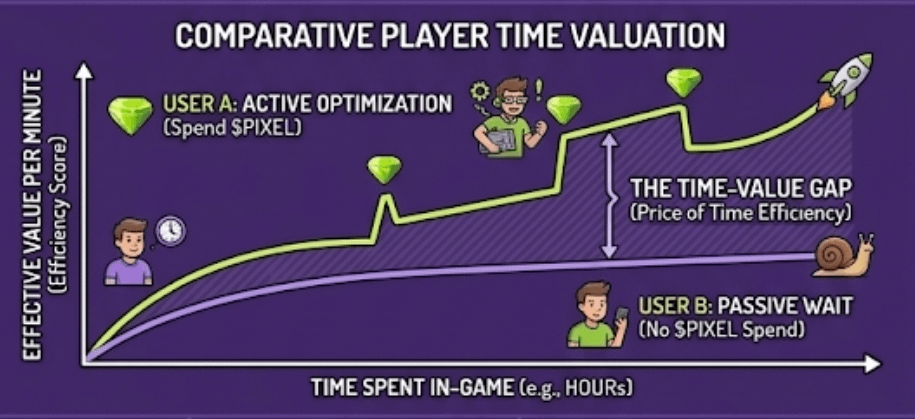
And that creates a strange effect. Two players can spend the same amount of time in the game, but end up in very different positions depending on how that time is 'valued' through their decisions.
So, time is no longer neutral. It becomes structured.
That structure is where things get interesting… and also quite fragile.
Because once players start to optimize, they won't stop. They'll figure out the most efficient loops. The highest profit per minute. The least friction to achieve maximum output. That's just natural. Every system ultimately aims for that.
If too many players go down one path, the whole balance can be disrupted. The world that seemed natural now resembles a set of optimized routes. You can see this in almost every economy, not just in games.
And then there's the issue of perception.
Even if the system is technically fair, it can still feel rigged. That's the risk. When players notice that time itself is being shaped, they start to question. Is this friction natural, or is it intentionally created? Is this a choice, or a covert manipulation?
Those questions don’t immediately collapse the system. But they’re still there.
I'm not sure Pixels has completely shaken off that stress. Maybe it's not even trying to.
Whether intentional or not, it seems to be turning time into something more consistent across the entire experience. Not equal, but comparable. Just that alone has changed how the economy operates.
And if that consistency is maintained, it will open up a different direction. Not just for one game, but potentially for many different systems that could share similar logic. Where effort, not just resources, becomes easily transferable in some form.
It's still too early. Maybe it's too early to say for sure.
But I keep noticing a small detail. I don’t think Pixel is mainly about your income. It feels more like a way to adjust how the system interprets your time.
It's a quiet shift. Very easy to overlook.
Until you realize that you’re no longer just playing. You’re constantly having to decide how much your time is worth. @Pixels $PIXEL #pixel
