
Let me say one thing first, because it really needs to be said
The more I go through official updates from Pixels, the more it feels like this is no longer just a single game. Instead, it’s slowly turning into a network of small systems growing inside one larger ecosystem.
As we move closer to 2026 what becomes clear is that Pixels is no longer a standalone gaming experience. It has evolved into a multi layered ecosystem. But the interesting part is this: while everything looks polished from the outside the internal structure is not as clean or simple as it seems.
And that contrast is what makes it worth looking at.
Starting with the core game
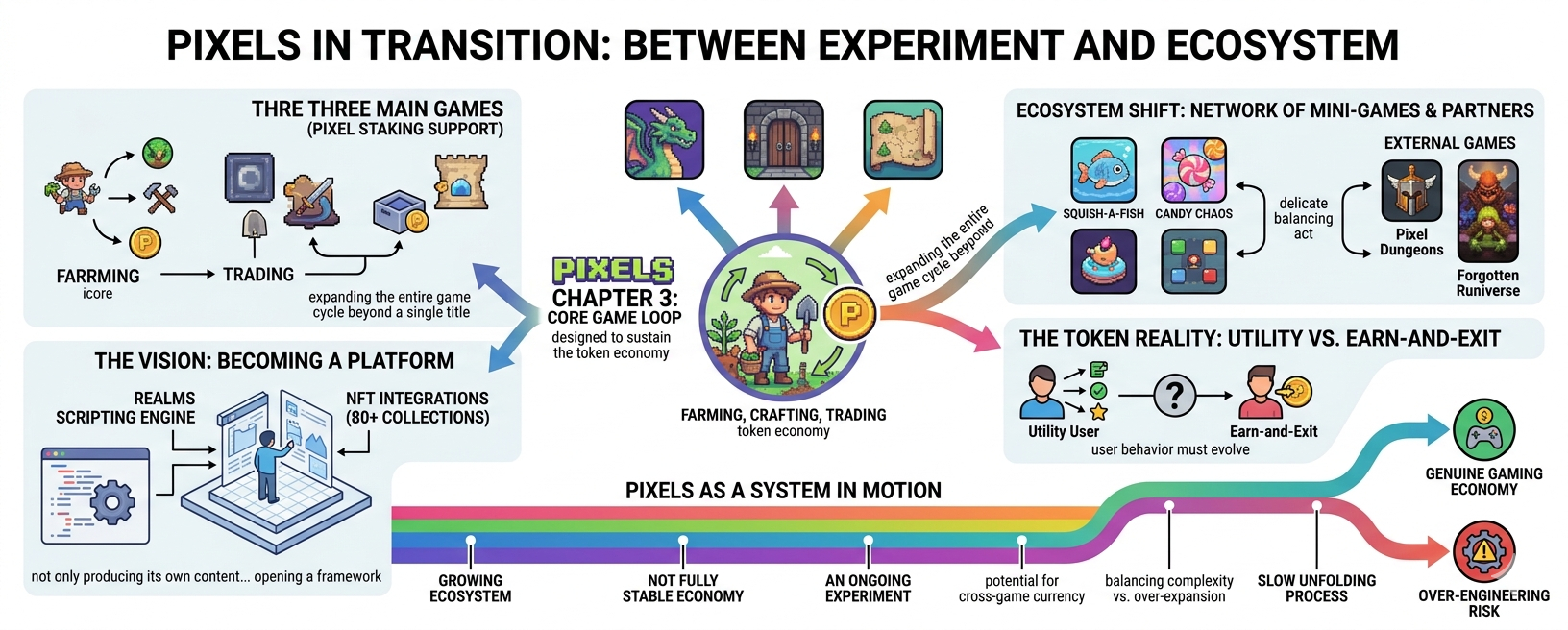
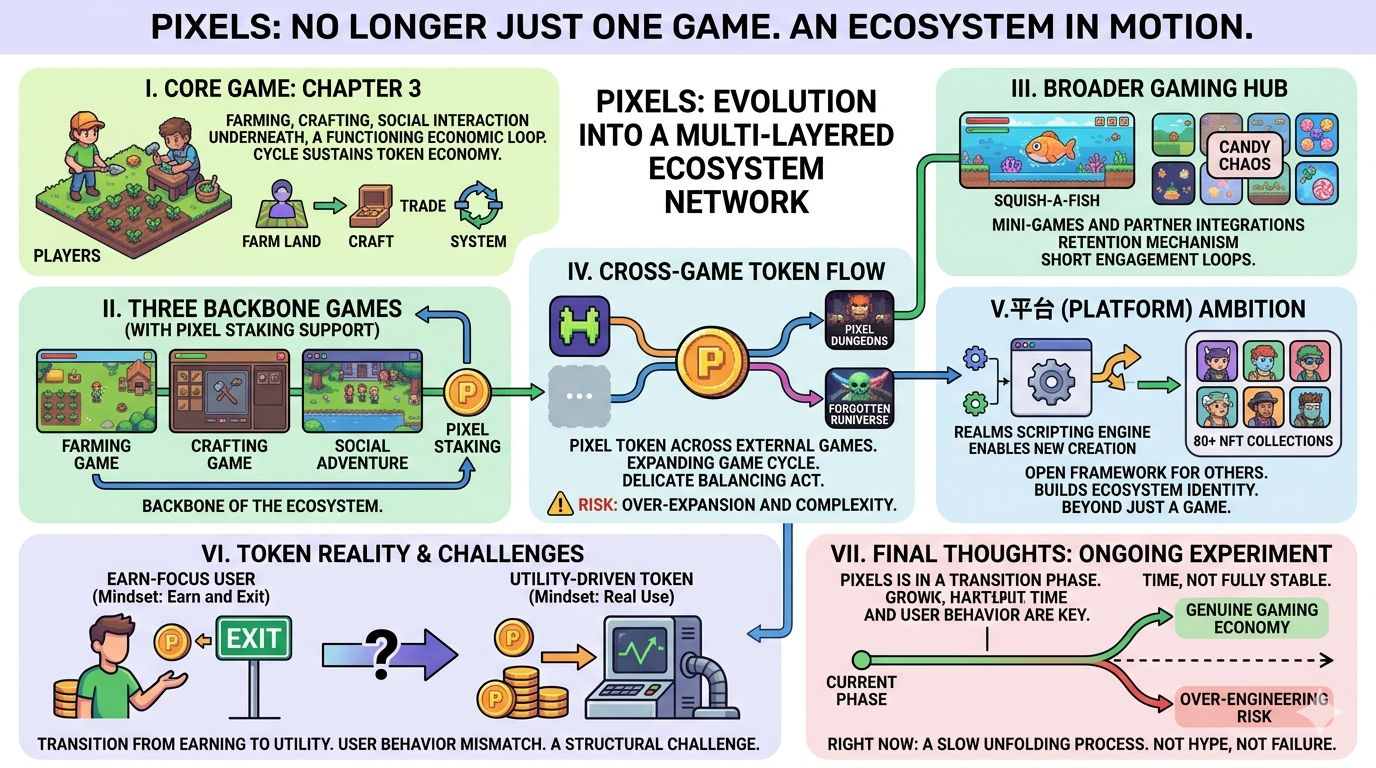
Pixels Chapter 3 still sits at the center of the entire system. Farming, crafting, and social interaction are all part of an attempt to build a living virtual world.
At first glance it looks like a soft casual game. But underneath that surface, there is a functioning economic loop. Players farm land, craft items, and trade them back into the system. This cycle is not just gameplay—it is also designed to sustain the token economy.
If you look at it structurally, three main games (with PIXEL staking support) currently act as the backbone of the ecosystem. On top of that, Pixels has expanded into a broader gaming hub with mini-games and partner integrations.
The real question: how stable is it?
There is no simple answer.
These kinds of economies only become strong when they are driven not just by speculation, but by consistent and meaningful utility. Pixels is clearly moving in that direction, but it is not fully there yet.
Being ranked among the top Web3 games is a positive signal, but rankings alone don’t guarantee long-term stability. In crypto gaming, positions change quickly.
The ecosystem shift is the real story
This is where things get more interesting.
Pixels is no longer limited to its own internal world. The PIXEL token is now starting to appear across external games as well.
And maybe this is the real shift—not just improving gameplay, but expanding the entire game cycle beyond a single title.
Games like Pixel Dungeons and Forgotten Runiverse, despite being different genres, are now tied into the same token flow.
This is where the idea of a cross-game currency starts to form.
But it is not an easy direction. Different game economies create different player behaviors. Demand in one place can easily affect balance somewhere else. So the entire system becomes a delicate balancing act.
The risk: over-expansion
The more integration you add, the more complexity increases.
And complexity almost always creates friction.
Mini-games: small systems, big purpose
At first, mini-games like Squish-a-Fish or Candy Chaos may sound almost playful or even trivial.
But in reality, they serve a deeper purpose—retention.
They keep users inside short engagement loops and encourage daily interaction.
Honestly, it’s the kind of system where you think, “just one round,” and suddenly 30–45 minutes are gone.
And in Web3 gaming, without strong retention, no token economy can survive for long.
The bigger vision: becoming a platform
The Realms scripting engine and NFT integrations suggest a long-term ambition that goes beyond being just a game.
Having 80+ NFT collections is not just cosmetic—it is part of building an ecosystem identity.
In other words, Pixels is not only producing its own content anymore. It is opening a framework for others to build inside it. That is the key difference between a game and a platform.
But becoming a platform is not easy. It requires handling not just game design but also governance economic balance and developer incentives. Many projects struggle at this stage.
The reality of the token
The biggest challenge for PIXEL is this transition from an earning-focused token to a utility-driven one.
However, many users are still operating with a simple “earn and exit” mindset.
This mismatch is one of the biggest structural challenges. Because for a long-term ecosystem to work, user behavior must evolve—but that cannot be forced.
Final honest thought
Right now, Pixels feels like it is in a transition phase.
On one hand, it is a growing ecosystem with multiple games, integrations, and NFT layers coming together. On the other hand, it is still not a fully stable economy—it is more like an ongoing experiment.
And the interesting part is that both of these realities exist at the same time.
Sometimes it feels like it could genuinely become a new kind of gaming economy. Other times, it feels like it might be leaning into over-engineering.
In the end, it comes down to this:
Pixels is no longer a finished product—it is a system still in motion.
And in systems like this, the two most important factors are time and user behavior.
If everything aligns properly it could become something much bigger. If not it may remain just another interesting experiment in Web3 gaming.
Right now, it sits somewhere in between not hype, not failure… just a slow unfolding process.
