There’s a pattern you start noticing after watching enough Web3 games try and fail, to scale beyond their own sandbox. They build tight loops. Sometimes even fun ones. But the moment they try to stitch multiple experiences together, everything breaks. Economies clash. Progression systems bleed into each other. Players min-max the fun out of it.
What Pixels is attempting with $PIXEL is… more ambitious than it looks at first glance. Not because cross-project gameplay is new, it isn’t but because they’re deliberately choosing what not to unify.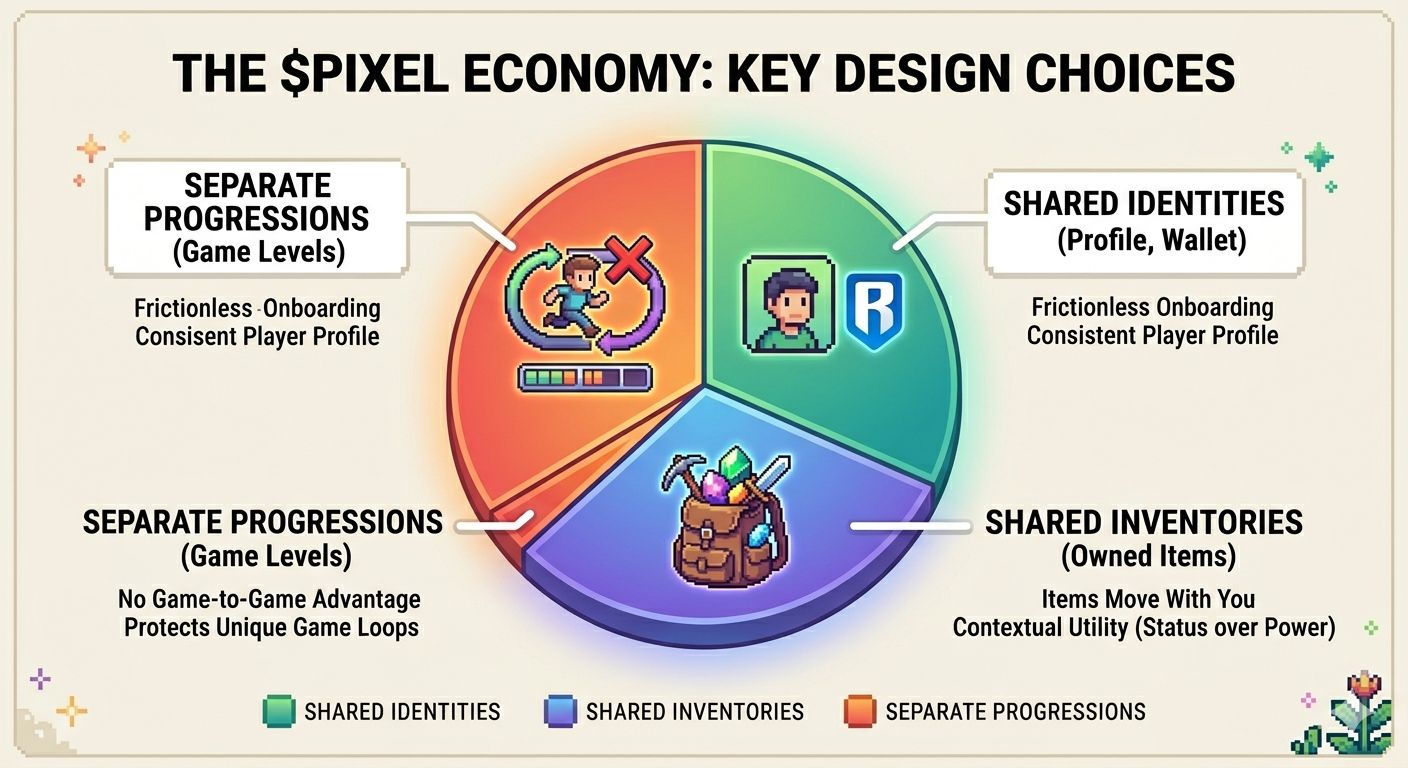
That restraint is the whole design.
The Problem With “Shared Universes”
Most so-called metaverse ecosystems lean too hard into interoperability as a selling point. Everything connects. Everything transfers. Everything compounds.
Sounds good. It usually isn’t.
Different games attract different player psychologies. A casual farming loop doesn’t coexist cleanly with a high-intensity combat economy. One inflates slowly. The other burns fast. Merge them carelessly and you don’t get synergy, you get imbalance.
Pixels seems to understand that.
They’re not trying to force a universal game loop. They’re building parallel ones.
Separate Loops, Separate Identities
At its core, PIXEL exists inside a relatively calm system, farming, land upgrades, item collection. Low pressure. Repeatable. Sticky in a quiet way.
Now imagine plugging in external projects with entirely different mechanics. Combat-heavy systems. Strategy layers. Maybe even social economies that don’t rely on resource grinding at all.
Pixels doesn’t try to normalize these.
Each project keeps its own loop. Its own pacing. Its own audience.
That decision matters more than any token mechanic.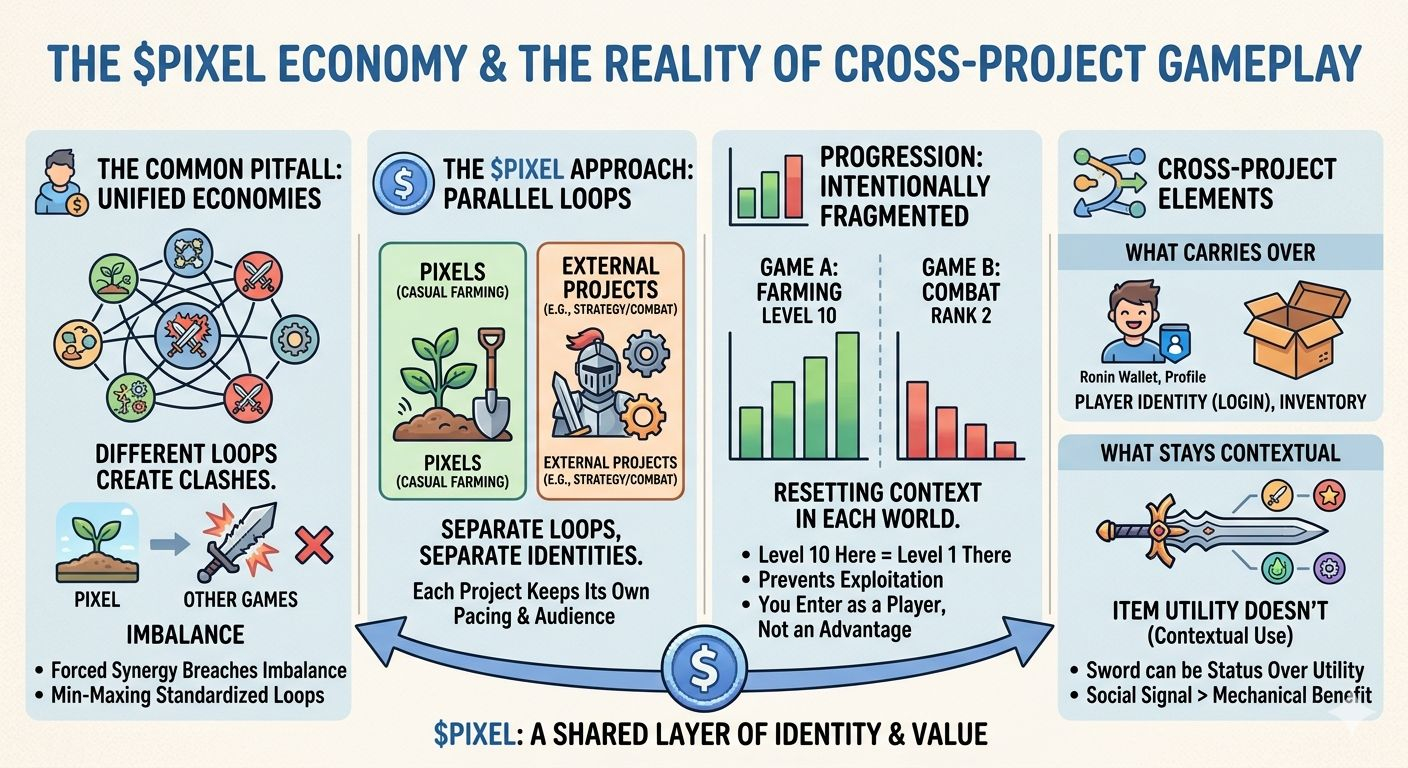
Because the moment you standardize loops across projects, you’re no longer building a platform, you’re flattening creativity.
Progression: Intentionally Fragmented
Here’s where things get interesting.
Progression doesn’t carry over.
Not really.
Your level in one world? Useless in another. Your grind in one loop? Doesn’t shortcut a different experience.
That sounds counterintuitive in Web3, where “own once, use everywhere” is practically a mantra.
But think about the alternative.
If progression did carry across worlds, the most efficient loop would dominate everything. Players wouldn’t explore, they’d optimize. Every new game would just become another surface to exploit with existing progress.
Pixels cuts that off early.
Each world resets the context. You enter as a player, not as a walking advantage.
That’s not a limitation. It’s protection.
What Actually Carries Over
Not everything is isolated.
Some layers are shared and carefully so.
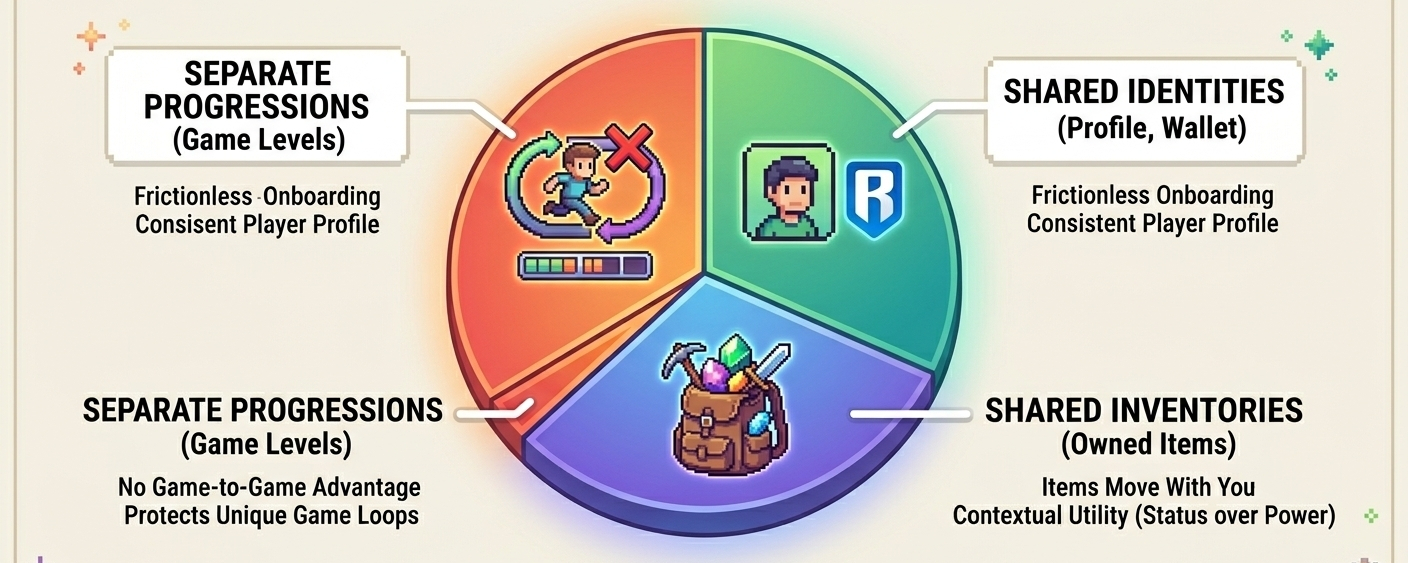
Player identity, for one. Your profile, your onboarding, your account tied to Ronin Network, that moves with you. No friction. No re-entry tax.
Then there’s inventory. Your items follow you between worlds.
But here’s the catch: utility doesn’t.
That sword you earned? Might be useless elsewhere. That soil? Doesn’t transplant. That rare drop? Maybe just a decorative flex in another world.
This is where Pixels threads the needle.
Ownership is portable. Function is contextual.
Items: Status Over Utility
Most cross-game systems fail because they try to preserve functionality across environments.
Pixels leans into something simpler: perception.
Items from one world can exist in another but often as artifacts, not tools. Their value becomes social, not mechanical.
A rare item placed in your house in another project isn’t there to give you an advantage. It’s there to signal history.
The tricky part and Pixels acknowledges this is visibility. Rarity doesn’t mean much if nobody understands it. So they’re building systems to surface that context. To explain why something matters.
Because in a fragmented ecosystem, meaning doesn’t transfer automatically.
It has to be translated.
Controlled Interoperability
There will be exceptions.
Some projects might allow item functionality across worlds. Weapons, tools, maybe even mechanics bleeding through.
But notice the framing: it’s optional.
Interoperability isn’t the default. It’s a design choice made per project.
That’s a subtle but important shift. It moves control away from the platform and back to the creators.
Which is probably the only way this works long-term.
pixel isn’t trying to be the glue that forces everything together. It’s more like a shared layer of identity and value that sits above wildly different experiences.
That’s harder to design for.
Because now you’re not optimizing for one economy, you’re balancing multiple, disconnected ones that still share a surface layer.
Inflation behaves differently in each world. Rarity means different things. Player intent shifts depending on the loop.
And yet, the token has to feel coherent across all of it.
Most projects wouldn’t even attempt this.
Pixels isn’t building a single game.
It’s building a space where multiple games can coexist without stepping on each other’s design.
That sounds obvious. It isn’t.
Most ecosystems collapse into sameness the moment they scale. Pixels is trying to avoid that by embracing separation.
Whether that holds under real player pressure, that’s the real test.
But for once, the architecture doesn’t look naïve.