
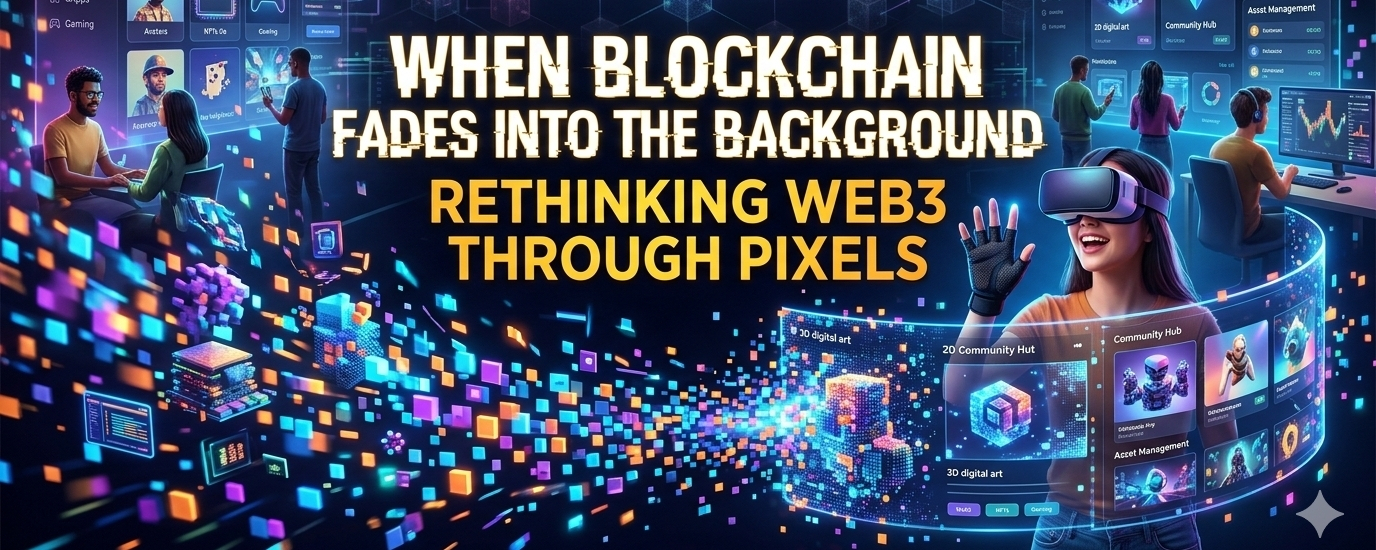

I didn’t expect a farming game to make me think about infrastructure but that’s where I ended up after spending time with Pixels. There’s something slightly disorienting about tending virtual crops and realizing that somewhere beneath that simple loop there’s a blockchain quietly recording parts of the experience. It’s not obvious while you’re playing and maybe that’s the point. Still the awareness lingers in the background like a system you don’t fully see but can’t quite ignore either.
What Pixels seems to be testing whether intentionally or not is how much of Web3 actually needs to surface to the player. For years the conversation around blockchain gaming has been loud ownership tokens open economies all framed as transformative ideas. But when you’re walking around a pixelated field planting seeds and waiting for them to grow those ideas don’t announce themselves. They sit quietly underneath only becoming visible when you step outside the moment and start asking questions about what’s really happening.
The choice to build on a network like Ronin adds another layer to this. Ronin has its own history, shaped by earlier experiments in blockchain gaming that were far more visible, sometimes to their own detriment. With Pixels, the approach feels softer almost cautious. Instead of putting the economic layer front and center it leans into familiarity. Farming exploration light social interaction these are mechanics that don’t require explanation. They work because people already understand them. The blockchain element by contrast feels like infrastructure in the literal sense: something that supports the experience without demanding attention.
But that raises an uncomfortable question. If players don’t really notice the blockchain does it change anything meaningful? It’s easy to argue that it does that ownership and transparency matter even if they’re invisible most of the time. Yet in practice, most players seem more concerned with immediate goals harvesting crops completing tasks maybe chatting with others than with the deeper structure of the system. The technology promises a kind of long-term significance but the gameplay lives in the short term.
There’s also the issue of friction which never fully disappears. Even in a game designed to feel casual the presence of wallets assets and transactions introduces a subtle layer of complexity. It’s not overwhelming, but it’s there. You notice it when something takes a bit longer than expected or when you’re reminded that what you’re interacting with has a value beyond the game itself. That awareness can be intriguing, but it can also pull you out of the experience in small ways.
At the same time Pixels hints at a different way of thinking about blockchain in games. Instead of treating it as a feature to be showcased it treats it more like a foundation to be built upon quietly. The open world becomes a kind of shared space where actions might carry a bit more permanence than usual even if that permanence isn’t constantly emphasized. It’s less about dramatic shifts and more about subtle changes in how the system behaves over time.
I find myself comparing it to something like an online game server that never quite resets, where progress accumulates in a way that feels slightly more durable. Not dramatically so but enough to create a different texture. Whether that difference matters in the long run is still unclear. It might depend on whether players start to engage with those deeper layers or whether they remain mostly invisible supporting an experience that could just as easily exist without them.
What makes Pixels interesting isn’t that it solves the challenges of Web3 gaming. It doesn’t. If anything it exposes them in a quieter way. It shows how difficult it is to balance immersion with infrastructure, simplicity with complexity play with value. And it does so without making a big deal out of it which might be why it feels more honest than some of the louder experiments in the space.
I’m left wondering if this is what the next phase of blockchain applications looks like not bold declarations but small almost hesitant integrations into familiar experiences. A farming game that doesn’t insist on being more than it is even while it carries a layer of technology that suggests it could be.
Maybe the real question isn’t whether Pixels succeeds or fails as a Web3 project. It’s whether players eventually start to care about the things it quietly enables, or whether those things remain background details interesting mostly to people who are already paying close attention.
