
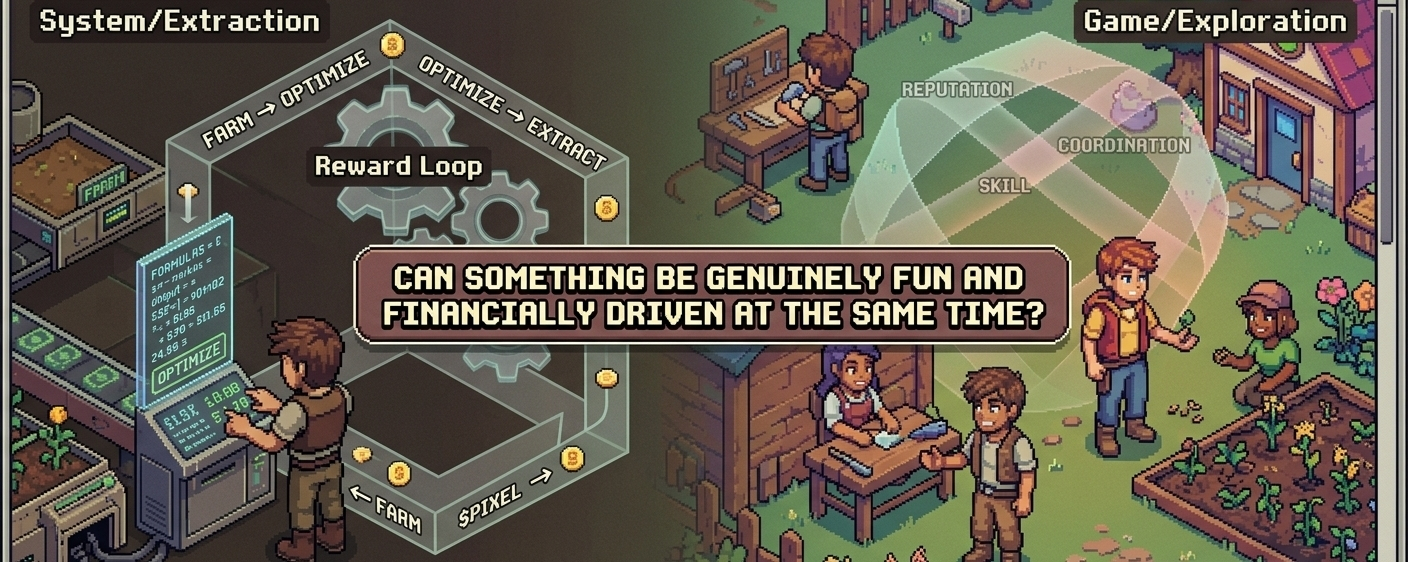

That’s the thing with most Web3 games… they don’t really lose you overnight. You just reach a point where everything clicks a little too well. The loop becomes obvious. You stop exploring and start optimizing. And once that switch flips, it’s hard to unsee it.
It stops feeling like a game. It starts feeling like a system you’re trying to beat.
I went into $PIXEL expecting exactly that. Farm, optimize, extract — same cycle, different skin. I’ve been around long enough to know how that story usually ends.
But this one didn’t fully behave the way I expected.
There were times where putting in more effort didn’t actually give better results. At first that feels wrong… but the more I paid attention, the more it felt intentional. Like the game wasn’t just tracking output — it was reacting to behavior.
That’s when it started to feel like something deeper was happening.
Rewards didn’t feel fixed. They felt… interpreted.
Almost like the system is watching how people play and adjusting quietly in the background. Not perfectly, not dramatically — just enough to notice if you’re paying attention.
And honestly, that changes the whole dynamic.
Because the real problem with play-to-earn was never just inflation. It was the mindset it created. People weren’t playing — they were extracting. And once that becomes the goal, everything else falls apart sooner or later.
Fast players win early, value drains, and the rest follow the same path.
Cycle repeats.
What @Pixels seems to be trying is different:
not more rewards — but smarter ones.
Not everyone gets the same outcome. And that’s not a flaw, it feels designed that way. Over time, players naturally drift into different paths without the game ever forcing it.
Same world, completely different experiences.
And weirdly… it actually feels more like a game because of that.
There’s crafting, small decisions, coordination with others — things that don’t always translate into instant rewards. And slowly, you stop thinking only about your own output.
You start thinking about where you fit in the system.
The token is still there, of course. PIXEL still brings that familiar tension — play vs sell. That never really goes away.
But instead of throwing more tokens at the problem, it feels like the system is trying to be more selective. More precise.
Who gets rewarded.
When they get rewarded.
Why they get rewarded.
That’s a much harder balance to get right.
And it brings up a bigger question I keep coming back to:
Can something be genuinely fun and financially driven at the same time?
Because money always changes behavior. Even in small ways. People will always look for the edge.
The real challenge isn’t stopping optimization — that’s impossible.
It’s making sure it doesn’t take over everything.
If you zoom out, PIXEL doesn’t really feel like a normal game.
It feels like an attempt to fix a loop that’s been broken for a long time.
The old pattern was simple:
play → farm → sell → leave
This feels more like:
play → return → adapt → stay
And in the end, the only thing that really matters is whether people come back.
Not rewards.
Not price.
Just that.
Because if players don’t return, nothing else holds up.
If RORS actually works the way it seems to, then that’s what it’s trying to reinforce — behavior that keeps the system alive over time.
But yeah… none of this guarantees success.
Systems like this need scale. They need real player behavior to learn from. Early on, there just isn’t enough signal.
Sometimes good design isn’t enough without enough people.
Still… I don’t think #Pixels is trying to be just another Web3 game.
It feels like it’s trying to fix the relationship between playing and earning — not separate them.
The idea makes sense.
Now it’s all about whether they can actually pull it off.
