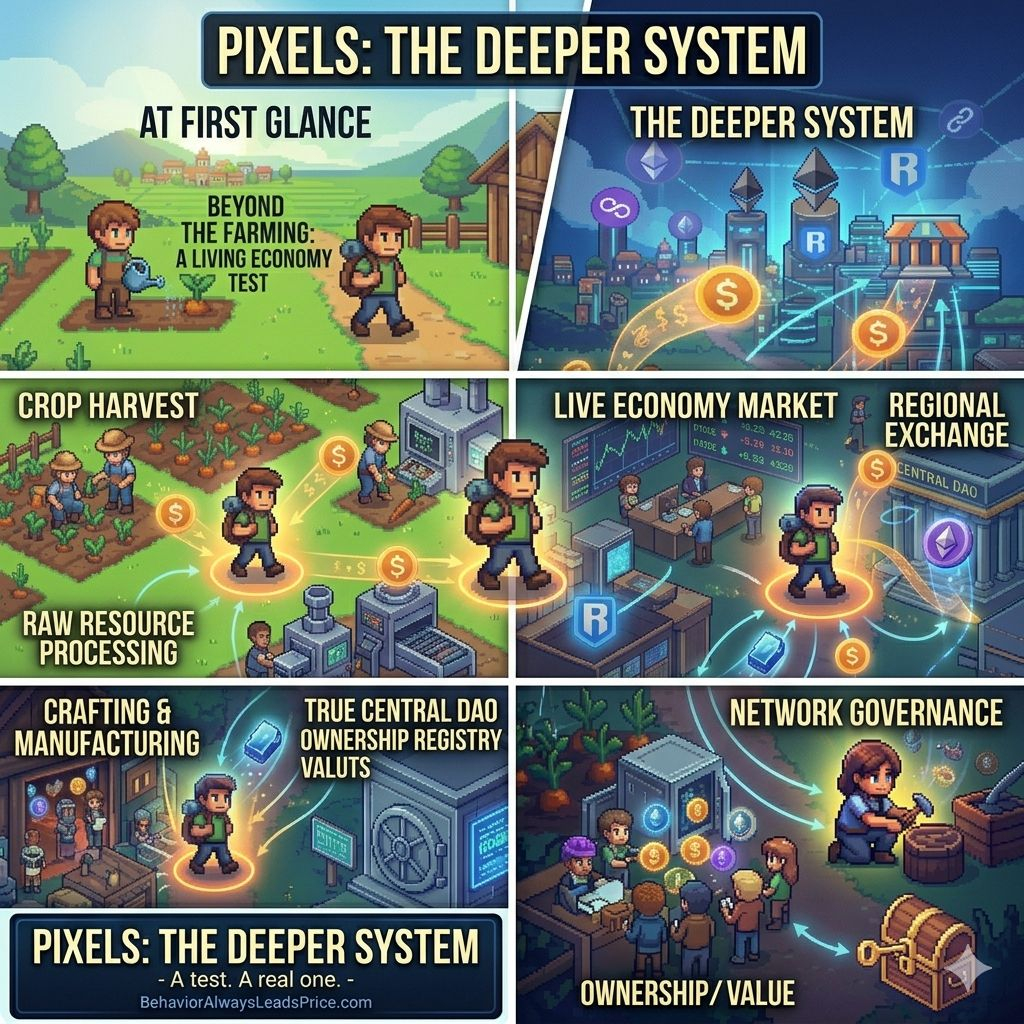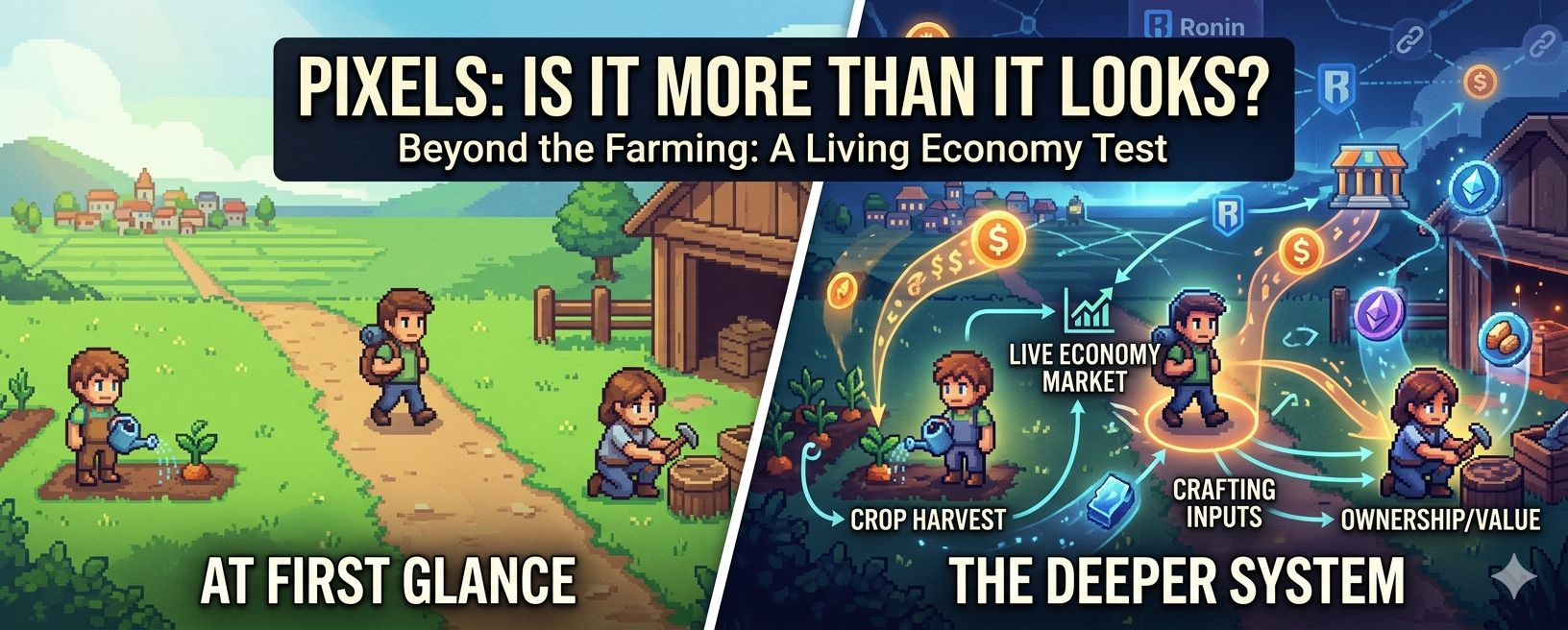

Something about this feels more important than it looks at first glance.
I keep coming back to Pixels, not because it’s loud, but because it’s quietly building a system that actually behaves like a living economy. Most people glance at it and see a simple farming game. I don’t. I see a test. A real one. Can a player-owned world sustain attention when the hype fades and only the loop remains?
That’s where my focus is.
I’m watching how players interact with the system, not just how many show up. There’s a big difference. Anyone can attract traffic for a short period. But retention… that’s where truth lives. And Pixels is trying to anchor that through something deceptively simple: farming, exploration, crafting — all tied into a live economy where actions carry weight.
And that changes the way I look at it.
When an in-game economy is real, behavior shifts. People stop playing casually. They start thinking. Planning. Optimizing. Every crop, every movement, every decision feeds into something bigger. That’s when a game stops being just entertainment and starts becoming a system people plug into.
I pay attention to that shift more than anything else.
What stands out to me is how Pixels leans into familiarity. It doesn’t try to reinvent gaming. It refines it. That’s smart. Because the market doesn’t reward complexity for the sake of it. It rewards systems that people understand quickly… and then choose to stay in.
But here’s where I slow down and look deeper.
A live economy is powerful, yes. But it’s also dangerous if not balanced properly. I’ve seen this too many times. If rewards flow too easily, value collapses. If progression feels like a grind with no satisfaction, users disappear. It’s a delicate line, and most projects fail right there.
So I watch the balance.
Are players coming back because they enjoy the loop… or because they’re chasing short-term gains? That question matters more than price ever will in the early stages. Because behavior always leads price, not the other way around.
Pixels sits on Ronin, and that’s another layer I don’t ignore. That ecosystem already understands gaming users. That alone gives it a better starting position than most Web3 games trying to force adoption from the outside. Here, the audience is already somewhat aligned.
Still, that doesn’t guarantee anything.
The crowd, as usual, is distracted. They look for spikes. They look for quick narratives. They don’t sit long enough to observe structure. But I do. Because I know that the real opportunity usually hides in systems that are building quietly while everyone else is chasing noise.
The bullish side is clear in my mind.
If this loop keeps players engaged… if the economy keeps circulating instead of stalling… if ownership actually feels meaningful and not just theoretical… then this can evolve into something much stronger than just another crypto game. It becomes a habit. A place. And markets love habits.
But I don’t ignore the other side.
If the loop becomes repetitive, if the economy starts feeling extractive instead of rewarding, or if users only show up when incentives spike, then the whole structure weakens. And when structure weakens, price eventually follows. Always.
That’s why I stay grounded here.
I’m not blindly bullish, and I’m definitely not dismissing it. I’m observing. Watching how the pieces move together. Watching whether momentum is organic or forced. Watching whether this world actually holds people… or just attracts them temporarily.
Because in the end, that’s the real game.
Not farming. Not tokens. Not even exploration.
It’s attention.
And right now, Pixels is doing just enough to make me pay attention.