
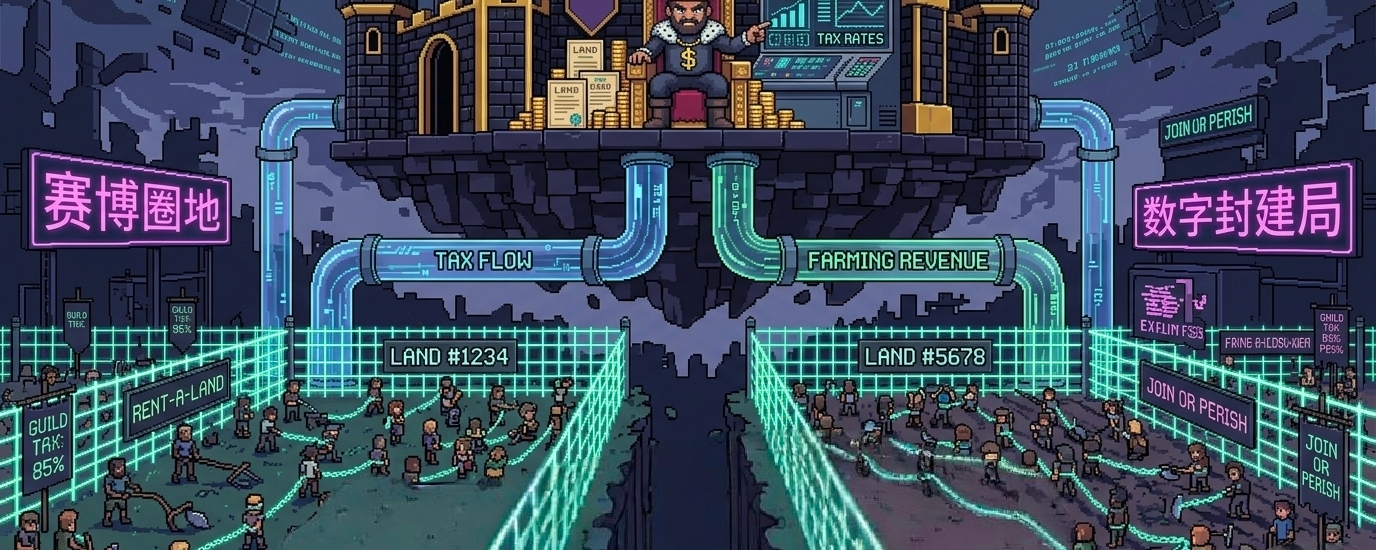

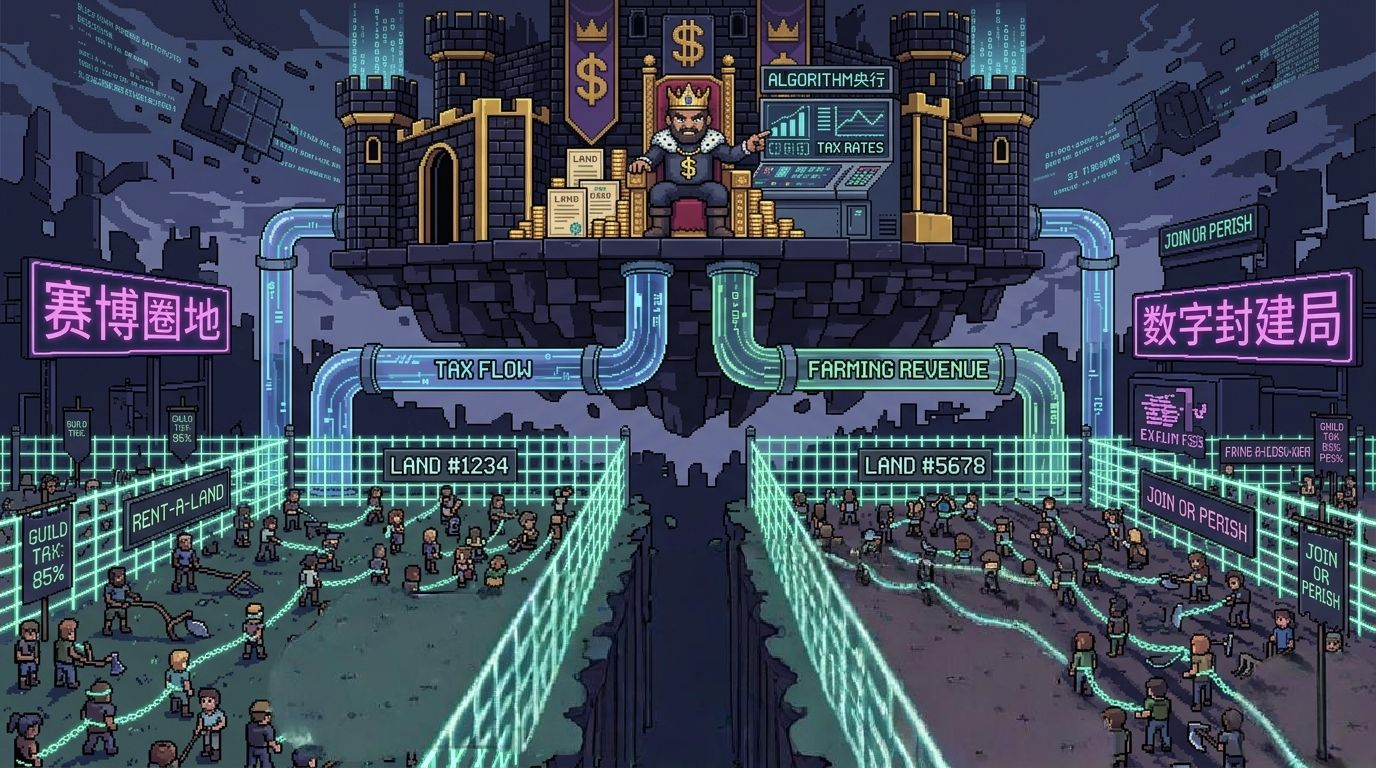
 Watching the community chat these past few days, it's a total brawl over the so-called "low tax quality land (Land)" mining rights. Even major guilds are forming alliances and backstabbing each other, going wild with the buying frenzy. As an old-timer who usually looks at projects from a fundamental logic and asset separation perspective, I can only chuckle and shake my head. Everyone's lost in the fantasy of "guilds as one big happy family" and "building pixel farms together," but hardly anyone wants to peel back that warm, fuzzy veil to see the real production relationships behind it. In this jungle of scythes known as Web3, there's no such thing as a "mutual win utopia." The core game has long shifted from "how to efficiently mint coins" to "a brutal cyber land grab and digital feudalism."
I’ll stick to the framework of 'pain points, breaking points, and dimensional analysis' to break down the land and guild situation in @Pixels .
First, let’s talk about the pain points. Currently, the biggest pain point for players in this system is mistaking 'blatant class solidification' for 'social gaming experience.' Look at the Land NFT mechanism and guild revenue-sharing setup in Pixels; on the surface, they aim to enhance social stickiness in the game, allowing big players and retail traders to huddle together for warmth. But fundamentally, what is it? It’s a Web3 version of the 'landlord and tenant' agreement. Many landless retail traders naively think that joining a good guild and finding a prime piece of land will allow them to 'Play to Earn' comfortably, but in a system where the means of production (land resources) are monopolized by a few, every bit of labor you contribute adds value to the landlord’s assets. While you’re sprinting up the guild leaderboard and grateful for slight tax breaks, the Land Holders have already calculated the 'surplus value of human capital,' locking your labor earnings right at the 'subsistence line' that barely keeps you online. The pain of ordinary players lies in their attempt to cross the gap of the bourgeoisie with high-intensity online hours while still hoping to sit on equal footing with those holding the core means of production.
So where’s the breaking point? The real breaking point isn’t about figuring out how to recruit members for the guild or seize high-resource-density plots; it’s about viewing Pixels’ land guild system as a 'Digital Real Estate Investment Trust (REITs).' Look at those top guild operators who are really profiting in this system; their operation logic mirrors traditional commercial real estate’s investment attraction and rental income extraction. When project parties empower land, they’re essentially issuing 'tax collection licenses.' When landlords need to attract liquidity (player labor), they lower tax rates or even provide guild benefits, which we call 'subsidies for growth'; when a guild forms a scale barrier and player migration costs rise, they secretly increase the revenue share, which we refer to as 'harvesting monopoly profits.' Here, those who truly benefit are the ones who understand 'land rent economics' and leverage the herd effect of retail traders to elevate themselves, not those sweats pouring out their effort on someone else's turf while developing Stockholm Syndrome towards their guild.
If we conduct a dimensional analysis and strip Pixels from its 'multiplayer online social game' shell, you’ll find that its land guild system is actually a highly sophisticated 'labor arbitrage and transfer payment engine.' In this dimension, guilds are not brotherly havens but publicly listed micro-labor dispatch companies. When you stake tokens to buy guild shares (fragmented or membership cards), you’re essentially buying a risky subordinate bond, betting that this guild can keep leeching off other bottom players to pay you dividends. The flashy guild buildings and exclusive resource points are merely traps set by landlords to build a moat and prevent labor loss as 'sunk cost traps.' The real top hunters are watching the overall active retention data from behind the scenes, skillfully balancing tax rates and benefits. They don’t need to go out and chop trees or mine; just by adjusting a few profit-sharing ratios in the guild announcements, they can manipulate the biological time of thousands of players across the server, continuously converting it into $PIXEL in their wallets.
Many players still caught up in 'guild development' have no idea they’re at the bottom of a never-ending game of hot potato. I glanced at the Land NFT turnover rates and the funding addresses of top guilds recently; those disguised 'strategic investments' are just high-level buy-ins, and the logic behind chip distribution is brutally cold. If the top landlords in a virtual economy derive their profits not from real external consumption but purely from the daily tax exploitation of bottom-tier gold farmers, the stagnation of this exploitative model is just a matter of time. Especially in the current market of stagnant competition, with new retail traders drying up, once the bottom players can’t even cover their electricity bills and server costs, a massive labor strike and exodus will directly lead to the liquidity crisis and valuation collapse of land assets.
So, let’s cut to the chase. Facing this Ponzi structure deeply tied to human nature and class characteristics, my operations are always emotionless: in the current ecosystem, am I the rent-collecting bourgeoisie or just cheap fuel that can be replaced at any moment? If you’re a retail trader, don’t get any sense of 'belonging' to a guild; don’t let the guild leader’s 'Brothers, let’s go!' brainwash you. Treat every effort like a cold, hard gig job with daily pay, no grand ambitions; if you’re a landholding landlord, don’t clash with some century-old guild’s grand vision, but rather focus on the new daily active trends on the Ronin chain and the strength of the secondary market’s absorption.
Ultimately, the so-called social ecology of GameFi is forever built on the ruthless exploitation of time and funds from newcomers. Listen less to those guild leaders painting rosy pictures to recruit members and reflect more on those cyber landlords clinging to sinking land at the end of the Axie era. In this battlefield filled with capital calculations and human struggles, rather than getting lost in being a model worker on a virtual farm, knowing when to see through the landlord's bottom line and ruthlessly sell off your chips is the only iron rule that keeps us veterans alive in this circle. After all, when the tide goes out and the buyers disappear, no matter how luxurious the pixel estate, it won’t hide the bloody scent of chives all over the ground.#pixel