
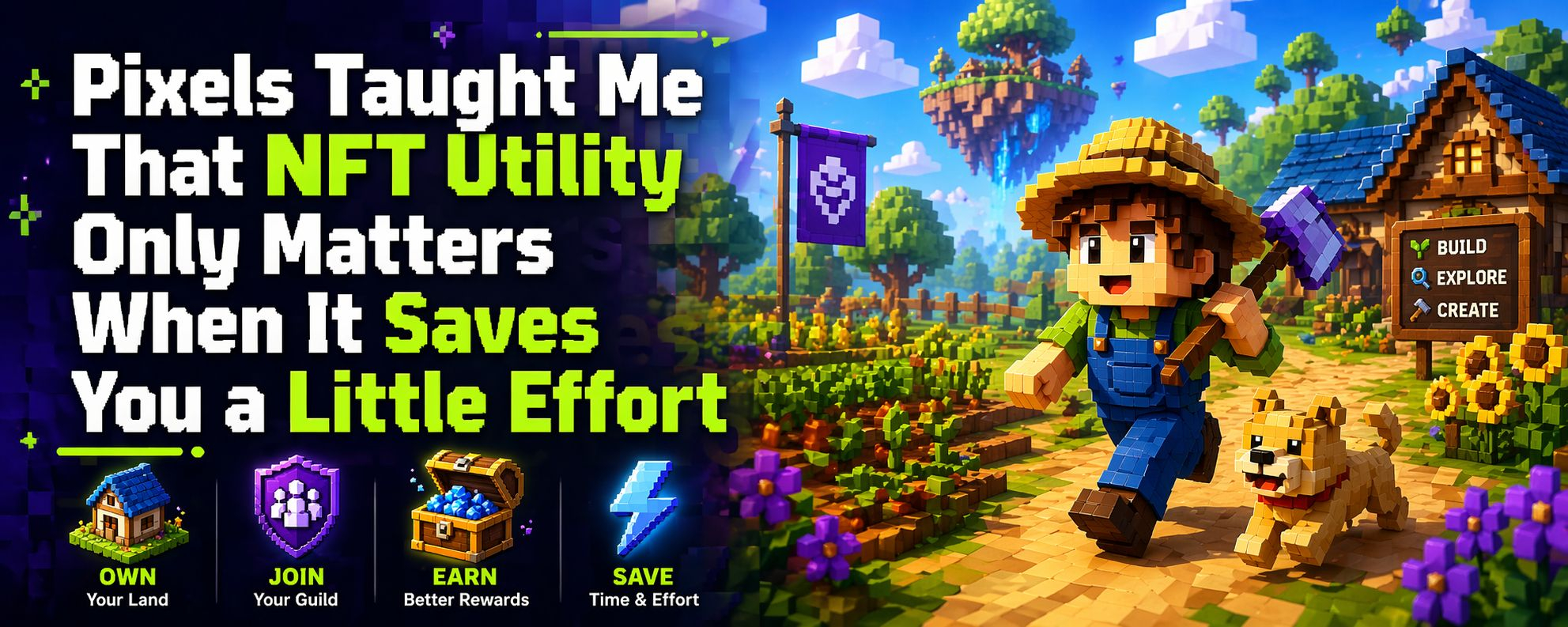
What keeps me interested in Pixels is not the NFT part in the way these projects usually sell it. I do not think the real value is in owning something flashy or being early to a narrative. What feels more meaningful is much smaller than that. Pixels seems to understand that utility works best when it quietly changes the way the game feels for the player.
That is the part I keep coming back to. The strongest NFT feature is often not the one that sounds revolutionary in a pitch deck. It is the one that makes your next session a little smoother, your progress a little easier, or your access a little more useful. In Pixels, that can look like land, guild access, roles, boosts, or other small advantages that do not demand attention but still shape the experience. They do not try to become the whole story. They just make the story easier to live inside.
From my perspective, that is why Pixels feels more credible than a lot of Web3 games. It does not lean on the fantasy that ownership alone will keep people engaged. It seems to accept something more practical. Players stay when utility becomes part of habit. When the NFT is not a headline, but a little shortcut. When it reduces friction instead of adding more language around ownership.
That is also why the recent ecosystem direction matters. Pixels keeps extending its mechanics in ways that reward repeat use instead of one-time speculation. That tells me the project is thinking less like a marketer and more like a systems designer. And in this space, that is rare.
My takeaway is simple. NFT utility does not need to be loud to be real. In fact, the best version of it is almost invisible. It works when players feel the benefit before they ever think about the asset behind it. That is the kind of utility that might actually last.