
I've seen way too many 'player growth' systems kick off with incentives and end up with retention charts plummeting. At first, everyone talks about engagement, then it’s inflation, and finally, silence. Those attractive numbers only stick around for a few weeks before players vanish. No noise, no drama, they just don't come back.
This issue isn't new, but it's persistent, and it seems the industry still hasn't really tackled it.
GameFi systems often think retention comes from paying out enough rewards. They add tasks, leaderboards, and incentives. They create a sense of having things to do, but that feeling doesn't last. Players don't stick around because there’s something to do; they stay when that something is meaningful or at least when it’s not mindlessly repetitive.
It seems like most systems are optimizing for acquisition, not retention. They pay to pull players in but lack the structure to keep them, or worse, they force retention through daily quests, stamina, or reward decay. That's not retention; that's friction disguised as engagement.
I've seen systems where players log in every day but don't actually play. They click, claim, and log out. LTV looks decent in the short term, but in reality, it's a one-way cash flow out of the treasury, with no loop, no reinvestment, and no reason to come back other than the rewards.
Pixels has also gone through that phase. At least from my perspective, they are not immune to the old GameFi logic. Rewards are still central, players are still optimizing their farming, and the system still needs to bear the costs to maintain that behavior.
But then they started to explore a different direction. Not reducing rewards, not increasing grind, but changing how rewards are distributed.
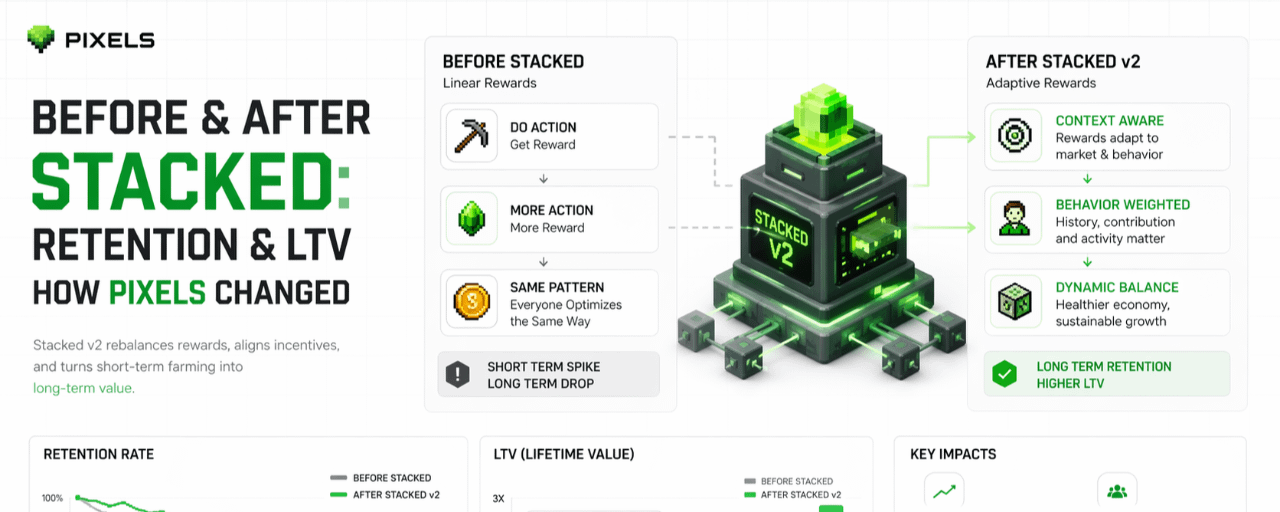
Stacked, specifically Stacked v2, doesn’t seem like a new reward system. It appears to be a layer of coordination, something that sits between player behavior and the amount of rewards issued. Not to pay more, but to pay 'more accurately.'
Previously, rewards in Pixels were quite linear. Do A, get B; do more, get more. This sounds reasonable, but it creates a consequence where all players are drawn to the same optimal behavior, and when everyone does the same thing, the system becomes unbalanced. Resources get over-farmed, value decreases, and players leave.
After implementing Stacked, it seems like the system started to differentiate. Not everyone receives the same rewards even when doing the same thing. It depends on context, the state of the economy, and possibly the players' previous behaviors.
This changes an important aspect: expectations.
Players are no longer certain that 'doing X will always yield Y.' They have to observe, adjust, and inadvertently, they start 'playing' again instead of just optimizing.
Retention in this case doesn't come from keeping players online every day; it comes from keeping them engaged. A small difference, but it seems crucial.
As for LTV? Harder to measure, but if rewards are distributed more reasonably, if there's less inflation, and if players don't just withdraw but also reinvest in the system, then LTV could increase in a quieter way—not spikes but rather a gradual rise.
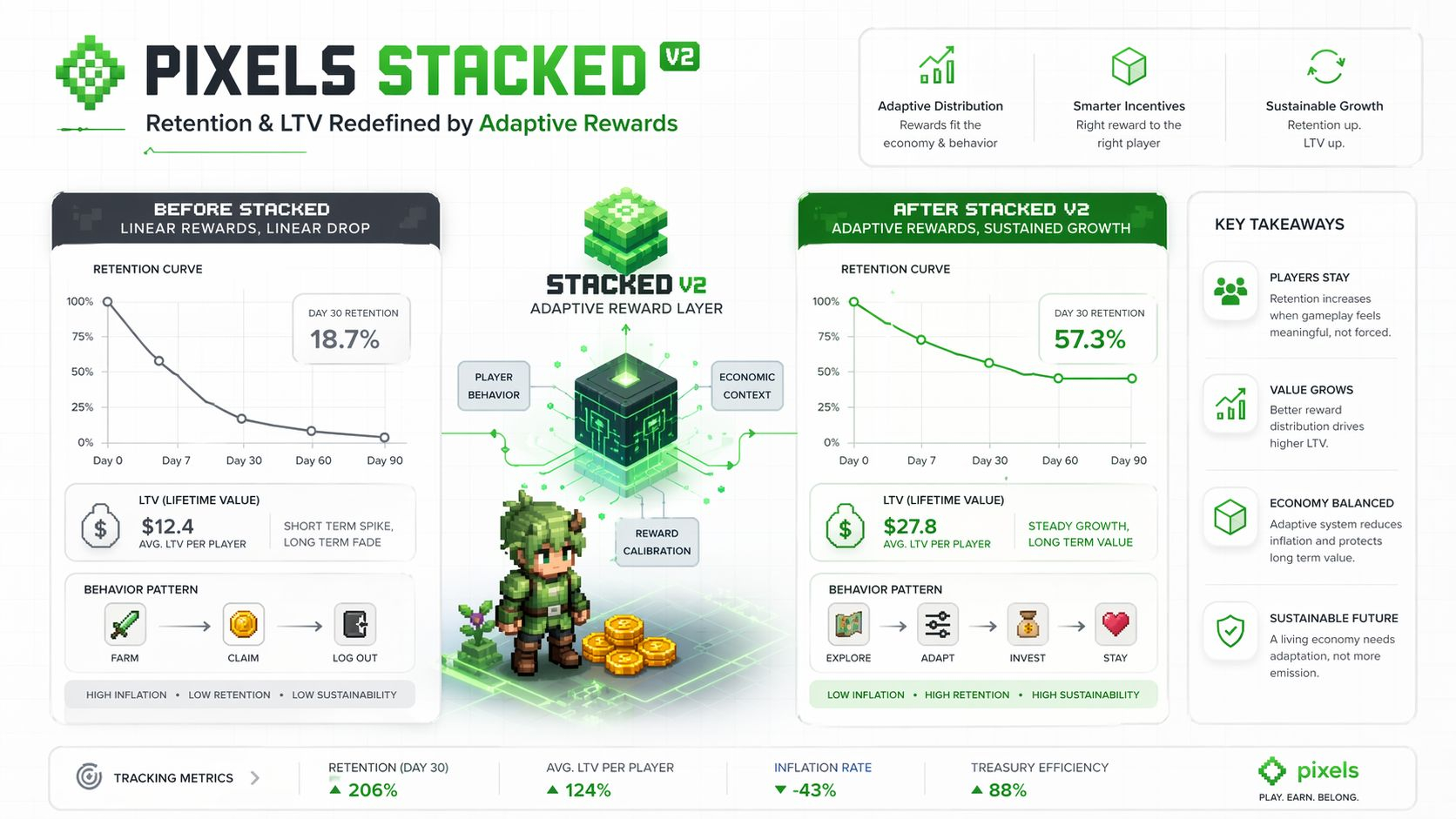
Of course, all of this is still just speculation. The whitepaper doesn’t say much, and the narrative says even less. What matters is: do players actually stay longer? Do they spend more, or is it just a new layer of optimization for the same old behavior?
That's the part I always come back to.
I don't think Stacked is a solution; it seems more like an experiment. A way to introduce an adaptive element into the reward system, which has always been quite rigid.
But experiments need time and real data.
I'm still keeping an eye on things, especially after a few months when the novelty wears off, when players start to understand the system, and when they figure out new farming strategies if any exist. That's when retention becomes real, and LTV, if any, will also be revealed.
For this part, I’m waiting, and I’ll keep monitoring...!